
Publication time reported by BabyLoveGrowth, shown in Mountain time. This is not an independently measured first appearance on this website.

ACA Income Too High for Subsidies? What to Do Above 400% FPL
If your household income is above 400% of the federal poverty level (FPL), you no longer qualify for ACA premium tax credits. You can still buy a Marketplace plan at full price, and you can still compare off-exchange and catastrophic options. The real work is knowing exactly where your line sits, how the Marketplace counts your income, and which plan fits your budget once no credit is attached. As an independent brokerage serving Castle Pines and the rest of Colorado, we help households run that comparison across carriers, at no direct cost to the client.
SimplyinsuranceforyouCompare Coverage Beyond SubsidiesSimply Insurance offers personalized guidance comparing health insurance options for Colorado individuals and families, including plans available at full price.VisitTL;DR
- The subsidy limit is 400% of the federal poverty level. For 2026 coverage that is $62,600 for one person and $128,600 for a family of four.
- The temporary rules that removed this cap ended after 2025, so a dollar over the line can mean no credit at all.
- Income is measured as modified adjusted gross income (MAGI) for your whole tax household, and it is based on what you expect to earn this coverage year.
- Starting with tax year 2026, there is no cap on repaying excess advance credits, so an accurate estimate matters more than before.
- Above the line you can still enroll in full-price coverage, compare plans on and off the exchange, and, with an exemption, consider catastrophic coverage.
Table of Contents
- Where the subsidy line sits
- Why a small raise can matter so much
- How the Marketplace counts your income
- Estimating close to the line
- The repayment rule is stricter now
- If your income is over the limit: your real options
- How we help households above the line
- Our perspective
- FAQ
- Sources
Where the subsidy line sits
The premium tax credit is a sliding-scale credit that helps people with low or moderate income pay for Marketplace coverage. The IRS explains that, for 2026 and later, household income must be at least 100% but no more than 400% of the federal poverty line. You also generally cannot file as Married Filing Separately, be claimed as someone else’s dependent, or have access to affordable employer coverage or a program like Medicaid or Medicare.
CMS publishes the 2026 coverage thresholds for the 48 contiguous states and D.C. in its program integrity rule overview:
Household size 100% FPL 400% FPL (subsidy limit) 1 person $15,650 $62,600 2 people $21,150 $84,600 3 people $26,650 $106,600 4 people $32,150 $128,600For 2027 coverage, KFF reports that the poverty level used is $15,960 for a single adult and $33,000 for a family of four, so the dollar limits move up a little each year. The poverty guidelines are updated annually, so check the figures for the year you are enrolling in.
Why a small raise can matter so much
From 2021 through 2025, temporary federal rules removed the 400% cap and lowered contribution percentages. They were set to sunset on January 1, 2026, and for 2026 the original ACA rules apply. Above the cap, KFF explains, enrollees face the full unsubsidized premium with no limit on what they contribute.
That is the “subsidy cliff.” Under the 2026 rules, the credit is built so that you pay a set percentage of income for the benchmark plan (the second-lowest-cost silver plan in your area). CMS lists the 2026 percentages from IRS guidance: 2.10% of income up to 133% FPL, 6.60% at 200%, 8.44% at 250%, and a flat 9.96% from 300% to 400%. Cross 400% and the credit drops to zero, however large the full premium is.
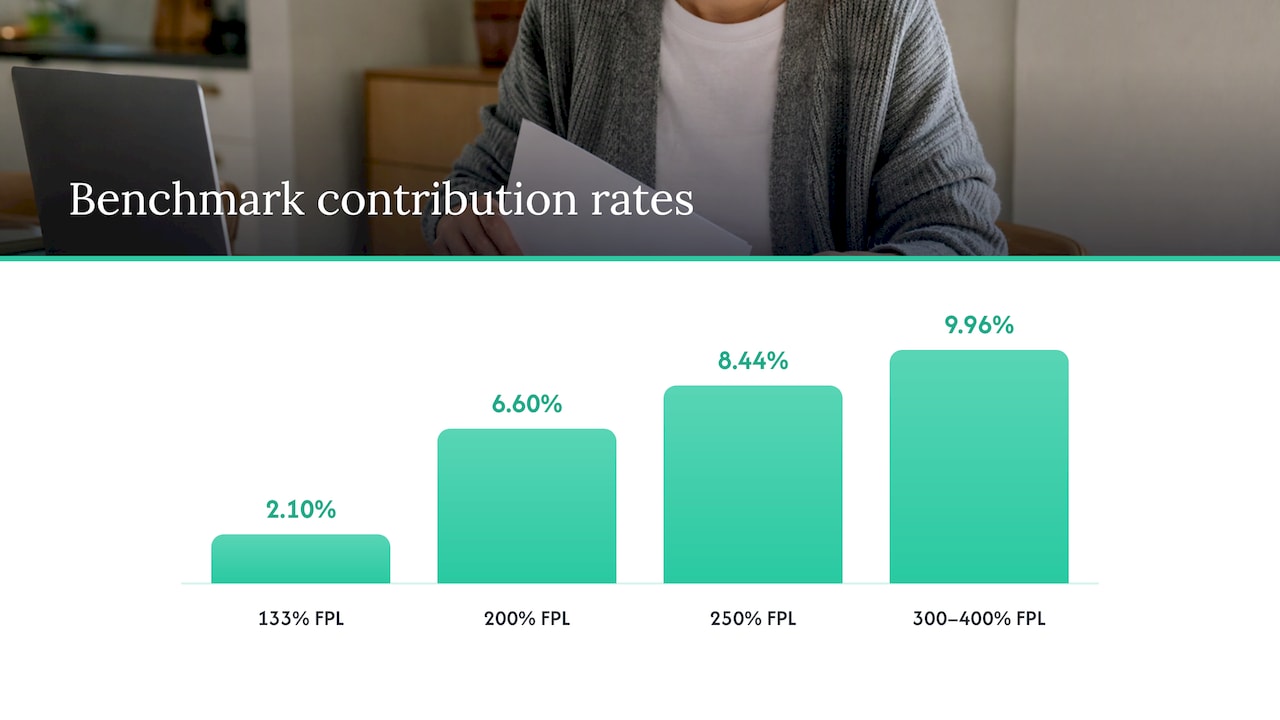
For 2027 coverage, KFF states the required contribution runs from 2.15% of income to 10.22% at 300 to 400% FPL. KFF also reports that between 2025 and 2026 average premium payments rose 58% and average deductibles rose 37%, as enrollees shifted to higher-deductible plans.
A worked example with 2026 figures: a single person at $62,000 is under the $62,600 limit and can still receive a credit that caps their benchmark premium at a percentage of income. A single person at $63,000 is over the limit and pays the plan’s full price. The plan did not change. The income test did.
How the Marketplace counts your income
Many people think they are over the line because of their paycheck, or under it because of a paycheck. The test is neither. It is modified adjusted gross income, and it covers the whole tax household.
- Whose income counts. The IRS defines household income as the MAGI of the taxpayer, a spouse if filing jointly, and dependents who are required to file a return. CMS adds that you report income for your entire tax household, even members who are not applying for coverage.
- What MAGI adds back. Starting from adjusted gross income, MAGI adds excluded foreign income, nontaxable Social Security benefits and tax-exempt interest. It does not include SSI.
- Which year. HealthCare.gov explains that savings are based on your expected income for the coverage year, not last year’s income. Start with last year’s AGI, add the items above, then adjust for expected raises, a new job, or a change in dependents.
The IRS lists events that can push income up sharply: lump-sum Social Security or retirement distributions, realized capital gains, debt forgiveness, marriage, divorce, a birth or adoption, and changes in other coverage. If one of these is likely this year, build it into your estimate before you enroll. For questions about how a particular transaction is taxed, a tax professional is the right person to ask.
Estimating close to the line
If your expected income is near 400% FPL, the estimate is the most consequential number on your application. Here is how to handle it.
- Add up every source. Wages, self-employment income, interest, retirement distributions, rental income and taxable gains for every person in your tax household.
- Add the MAGI items. Include tax-exempt interest and nontaxable Social Security benefits.
- Adjust for the year ahead. A raise in March, a bonus, a spouse starting work, or a sale of investments all belong in the figure.
- Choose how much credit to take monthly. HealthCare.gov notes that if you are worried about repayment, you can use less or none of the credit toward monthly premiums. Any credit you did not take in advance can be claimed when you file.
- Update when things change. Log into your Marketplace account, choose “Report a Life Change,” update your income or household, and review the new eligibility results.
If a birth or other family-building decision is part of your year, household size changes your limit and your credit. Articles on finances and family planning costs can help you think through the spending side of that decision while you update your application.
The repayment rule is stricter now
Advance payments are an estimate. When you file, the IRS compares them with the credit you actually qualify for on Form 8962. HealthCare.gov says that if your income ended up higher than you reported, you pay back the difference.
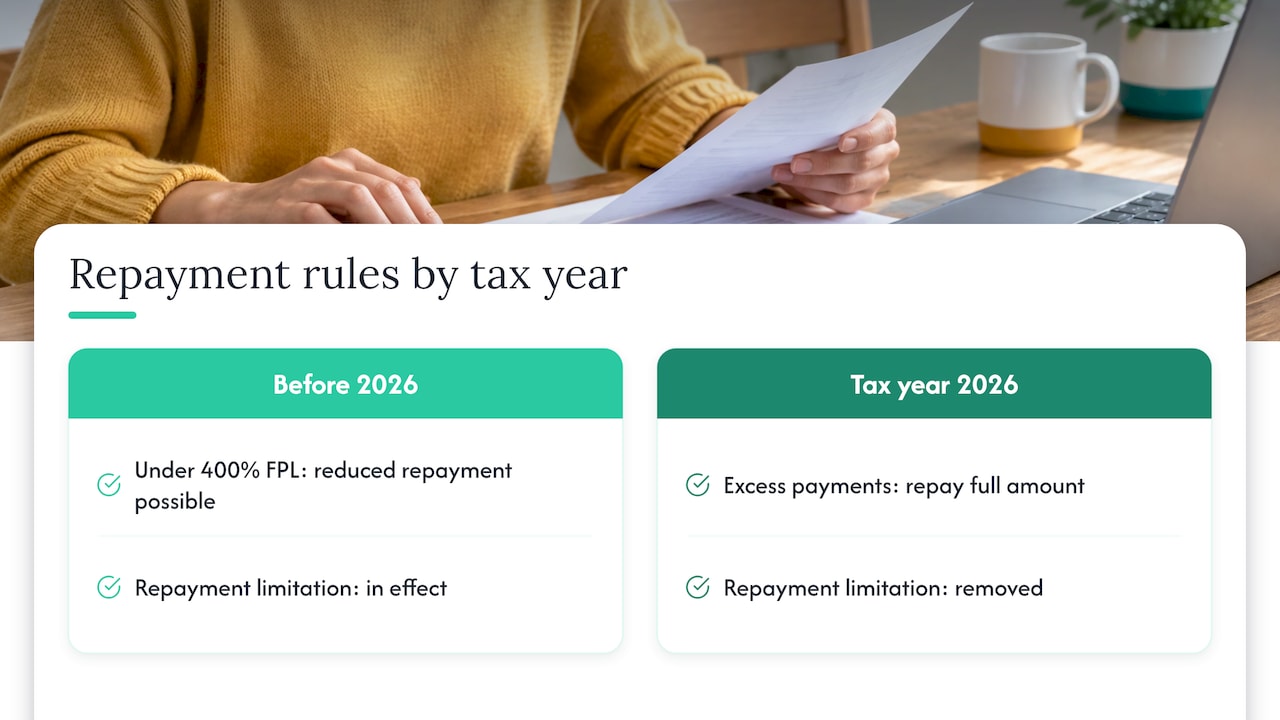
The key change: the IRS states that beginning with tax year 2026, the repayment limitation is removed under the Working Families Tax Cuts Act. Taxpayers must repay the full amount of excess advance payments. Before, households under 400% FPL could qualify for reduced repayment amounts, as CMS’s 2027 enrollment guidance also confirms.
In practice, if you take $6,000 in advance credits and your final income lands above 400% FPL, the credit you are allowed is zero, and the whole $6,000 comes off your refund or is added to what you owe. The IRS says reporting changes promptly is the key way to avoid a balance due, because adjusting advance payments during the year keeps them aligned with the credit you claim. We cover the details in our guide to the 2026 premium tax credit and the end of repayment caps.
If your income is over the limit: your real options
Above 400% FPL, you are not locked out of coverage. You are choosing among full-price options, and that is where comparison pays off.
Enroll in full-price Marketplace coverage
CMS confirms that people above 400% FPL can still enroll in Marketplace coverage at full price. Plans are grouped in metal levels, and the premium you see is the real cost with no credit. Look at the deductible and out-of-pocket maximum together with the premium. Our explainer on the difference between a deductible and an out-of-pocket maximum shows how a low premium can hide a large exposure.
Compare on-exchange and off-exchange plans
When no credit applies, the main reason to buy through the Marketplace is gone, and plans sold directly by carriers become worth comparing. Our guides on on-exchange versus off-exchange plans and on off-exchange coverage for Colorado residents walk through the trade-offs, including what to check about subsidies first. Colorado households can also look at state-specific plans such as the Colorado Option, covered in our 2026 premium breakdown.
Consider catastrophic coverage with an exemption
CMS says that people found ineligible for financial help can get a hardship exemption that unlocks catastrophic plans where available. For consumers 30 or older, CMS’s reconciliation guidance says you must apply for a hardship or affordability exemption and get an exemption certificate number. The affordability exemption applies if the lowest-priced available coverage would cost more than 8.05% of household income for 2026.
Catastrophic plans pair low monthly premiums with very high deductibles, so they protect against a worst-case medical event while you pay for routine care yourself. Our article on catastrophic plans and HSA access explains who may be eligible.
Plan around the enrollment window
Marketplace open enrollment runs once a year, and the cutoff for coverage starting January 1 falls in mid-December. Our open enrollment guide explains the timing and the tax credit risks, and the official schedule is on HealthCare.gov and the Colorado exchange.
Turning 65 changes the picture
The credit is not available to people enrolled in Medicare, so households approaching 65 are really deciding between two systems. If that is you, our Medicare enrollment timeline shows when each step falls, and the Medicare eligibility calculator is a quick place to start.
How we help households above the line
Our individual and family coverage page is built for exactly this comparison: health insurance in Castle Pines and across Colorado. We are licensed, independent brokers working across multiple carriers, so we can lay plans side by side against your health needs and budget. Our support continues after enrollment, with help on claims and annual plan reviews, which matters when your income moves above or below the 400% line from one year to the next. You can see everything we offer on our services page.

If you want a second set of eyes on your expected income before you enroll, reach out through our services page and we will compare your options with you.
Our perspective
The cliff is the part of this rule that surprises people most. Families do not plan their year around a poverty-level threshold, yet a single raise, bonus or stock sale can decide whether a credit exists at all. That is why we treat the income estimate as a planning conversation, not a form field.
We start by walking through the household’s expected income and what could change it. Then we compare plans from several carriers, on and off the exchange, because the best answer above 400% FPL is rarely the one that looks cheapest on a premium list. Premium, deductible, out-of-pocket maximum, doctors and prescriptions all go in the same comparison.
We also stay involved after you enroll. Income moves, families grow, and the rules have changed from one year to the next. A yearly review means your plan is checked against your situation again rather than renewed on autopilot, and we are here for claims questions when they come up.
Zach
FAQ
What happens if I go over 400% FPL after I enroll?
You are no longer eligible for the premium tax credit for that year. When you file, the IRS compares your advance payments with the credit you can claim, and for tax year 2026 onward you repay the full excess. Report income changes to the Marketplace as soon as you know about them.
Does the Marketplace check my income?
Yes. HealthCare.gov says the IRS compares the income on your application with your tax return. Report changes in income and family size right away to avoid owing money back.
Can I still buy Marketplace insurance if my income is too high?
Yes. You can enroll in full-price Marketplace coverage, and you can also compare plans sold directly by carriers. Without a credit, comparing total yearly cost across plans is the best way to choose.
Which income counts toward the limit?
MAGI for your tax household: you, a spouse if filing jointly, and dependents who must file a return. It includes some items not in taxable income, such as nontaxable Social Security benefits and tax-exempt interest. It is based on what you expect for the coverage year.
Sources
- Questions and answers on the Premium Tax Credit, IRS
- 2025 Program Integrity Rule Overview Part II, CMS
- Health Insurance Marketplace Calculator, KFF
- Enhanced Premium Tax Credit and 2026 Exchange Premiums, Congressional Research Service
- Questions About Health Insurance Subsidies, KFF
- Household Size and Types of Income to Include, CMS
- How to estimate your expected income, HealthCare.gov
- Premium Tax Credit, HealthCare.gov
- Repayment caps eliminated for excess advance payments of the premium tax credit, IRS
- Rock Enroll: Ready to Enroll and Renew for 2027 Open Enrollment, CMS
- Taxes, Exemptions, Reconciling APTC, and Failure to File, CMS