

Protect Coverage: File the VCC for U.S. Chronic Special Needs Plans
A Chronic Special Needs Plan (C-SNP) is a Medicare Advantage plan built for people with specific qualifying chronic conditions like diabetes or chronic heart failure. If you or someone you care for has one of these conditions, check plan availability by ZIP code, then ask the treating doctor to submit the Verification of Chronic Condition (VCC) right away.
SimplyinsuranceforyouGet Clear Guidance on C-SNPsSimply Insurance offers personalized, independent guidance comparing Medicare options and supporting you through enrollment, claims, and annual reviews.Explore your Medicare optionsTL;DR:
- A chronic special needs plan requires doctor’s confirmation of your qualifying condition through a Verification of Chronic Condition form to enroll successfully.
- These plans are built around specific conditions like diabetes or heart failure and are usually offered as either HMO or PPO structures within a limited service area.
- Benefits include coordinated care teams, condition-specific formularies, and extras like over-the-counter allowances, but network restrictions and re-verification requirements can pose challenges.
- Enrollment depends on timely VCC submission and remains valid during specific enrollment periods; delays or lapses may lead to disenrollment or coverage loss.
- Comparing plans with a licensed broker can help optimize benefits, out-of-pocket costs, and ensure proper documentation before deadlines.
Table of Contents
- What Makes a Chronic Special Needs Plan Different
- Eligibility Requirements and the VCC Process
- Which Chronic Conditions Qualify for a C-SNP
- What Benefits Come With a C-SNP
- When You Can Enroll and What Happens if Eligibility Changes
- Why Care Coordination Is the Real Value of a C-SNP
- Consumer Protections and Questions to Ask Before You Enroll
- How Simply Insurance Helps You Evaluate and Enroll in a C-SNP
- What C-SNPs Actually Cost
- Matching a C-SNP to Your Actual Health Needs
- Where C-SNP Coverage Falls Short
- How Enrolling in a C-SNP Affects Other Coverage
- Why the Standard Advice on C-SNPs Misses the Point
- Get Help Choosing and Enrolling in a C-SNP
- Sources
- FAQ
What Makes a Chronic Special Needs Plan Different
A C-SNP is a type of coordinated care plan under Medicare Advantage, built around one purpose: managing a specific chronic illness better than a standard plan can. CMS defines SNPs as a category that includes three variants, and a C-SNP is the one restricted to people with qualifying chronic conditions rather than dual Medicaid/Medicare status or institutional care needs.
The restriction is the point. C-SNPs cannot enroll the general public, and every C-SNP must include Part D drug coverage bundled in automatically.
Most C-SNPs are structured as either:
- HMO plans, which require you to use a defined network and typically get a primary care doctor to coordinate referrals.
- PPO plans, which allow more flexibility to see out-of-network providers, usually at a higher cost.
Because enrollment is narrowed to a defined condition or group of conditions, insurers can build benefits, formularies, and provider networks around that specific health need instead of spreading resources across a general population.
Eligibility Requirements and the VCC Process
Qualifying for a C-SNP comes down to three things, all of which CMS requires before enrollment is approved:
- You have Medicare Part A and Part B. Without both, you cannot enroll in any Medicare Advantage plan, C-SNPs included.
- You live in the plan’s service area. C-SNPs are sold county by county, so a plan available in Douglas County might not exist one county over.
- A doctor confirms your qualifying chronic condition. This is done through the Verification of Chronic Condition, and it is not optional paperwork. It is the mechanism that keeps the plan legally distinct from a regular Medicare Advantage product.
The treating provider, not the beneficiary, completes the VCC. Some plans give roughly two months from your coverage start date for that verification to land on file, though the exact window varies by carrier, so confirm the deadline directly with the plan. Miss it, and you risk disenrollment back into original Medicare or a standard plan.
Pro Tip: Ask your doctor’s office to fax or upload the VCC the same day you enroll, and get a confirmation number. Waiting until week six to follow up is how people lose coverage they qualified for.
To check what is actually sold where you live, search plan availability by ZIP code through Medicare.gov or work with a local broker who can pull current options in one call.
Which Chronic Conditions Qualify for a C-SNP
CMS maintains 15 SNP-specific chronic condition categories that plans can be built around, covering illnesses like chronic heart failure, diabetes, chronic lung disorders, end-stage renal disease, and several cardiovascular and neurological conditions. The full list lives on CMS’s C-SNP page, and it is worth checking directly since insurers reference it by category name.
Plans are not free to define conditions however they want. CMS allows three structures:
- Single-condition plans, built around one diagnosis, such as diabetes.
- CMS-approved clinically linked groups, where having any one condition in the group qualifies you. CMS confirms that having at least one condition in a linked group is enough for enrollment, unlike custom groupings.
- MAO-customized groups, where the insurer combines conditions it considers clinically related, but in this case the insurer must verify every condition claimed, not just one.
A plan marketed for “chronic heart and lung conditions,” for instance, might fall into either the second or third category depending on how the insurer structured it. That distinction affects how thorough your VCC needs to be.
What Benefits Come With a C-SNP
Every C-SNP covers everything Original Medicare Part A and Part B cover, plus Part D prescription drugs bundled in by requirement. That baseline is non-negotiable under Medicare’s SNP rules.
What separates a good C-SNP from a mediocre one is what sits on top of that baseline:
- Care coordination teams assigned to manage your specific condition across specialists, not just your primary doctor.
- Condition-focused formularies that often place relevant medications, like insulin or heart failure drugs, on lower-cost tiers.
- Provider networks built around specialists who actually treat your condition, rather than a generic mixed-specialty panel.
- Extra benefits, which vary a lot by carrier and can include over-the-counter allowances, transportation to appointments, or meal delivery after a hospital stay.
These aren’t cosmetic perks. Chronic conditions get worse when care is fragmented across providers who don’t talk to each other, and person-centered, multidisciplinary care planning is linked to better outcomes for people managing multiple chronic conditions precisely because it closes that communication gap.
When You Can Enroll and What Happens if Eligibility Changes
Most people join a C-SNP during the Annual Enrollment Period, which runs each year in the fall, assuming a qualifying plan exists in their service area. Beyond that:
- Initial Enrollment Period works if you’re newly eligible for Medicare and already have a diagnosed qualifying condition.
- Special Enrollment Periods (SEPs) open up if you move outside the plan’s service area or if your chronic condition changes status.
- Loss of eligibility triggers an SEP too. If your condition resolves or a re-verification fails, Medicare gives you a window to switch to another C-SNP, a standard Medicare Advantage plan, or back to Original Medicare, so you avoid a coverage gap.
Coordinate the VCC timing with your enrollment date, not after it. Submitting late is the single most common reason people get bounced out of a plan they otherwise qualified for.
Why Care Coordination Is the Real Value of a C-SNP
The paperwork around eligibility matters, but the actual value of a C-SNP shows up in how well it coordinates your care. Research from AHRQ on person-centered care planning shows that aligning treatment to a patient’s own goals, using multidisciplinary teams, and sharing information digitally across providers reduces fragmentation and improves outcomes for people managing more than one chronic condition at once.
That research translates into a practical checklist. A strong Model of Care should include a shared care plan every provider can see, a team that includes more than just your primary doctor, and clear alignment between what the plan does and what you actually want out of treatment.
Pro Tip: Before enrolling, ask the plan directly: “Who is my care coordinator, and how often will they check in?” A vague answer is a red flag.
Consumer Protections and Questions to Ask Before You Enroll
If you’re already mid-treatment for a chronic condition, continuity matters more than almost any other feature. Medicare requires that prior authorizations for ongoing medically necessary treatments remain valid rather than forcing repeated re-approvals, and beneficiaries retain appeal rights if a plan denies coverage.
Before enrolling, confirm directly with the plan:
- How long does a prior authorization stay valid for your specific ongoing treatment?
- What happens to an approval already in place if you switch from another plan mid-treatment?
- What’s the cost-sharing structure for the medications or procedures tied to your condition specifically?
If a plan representative can’t answer these clearly, treat that as a warning sign, not a formality.
How Simply Insurance Helps You Evaluate and Enroll in a C-SNP
Licensed brokers can help Colorado beneficiaries check which C-SNPs are sold in their ZIP code, compare Models of Care side by side, and coordinate the VCC paperwork with providers to avoid missing deadlines.
Before a broker meeting, bring your Medicare card, a photo ID, recent notes from your treating provider, and a current medication list. That short list lets a licensed broker match you to a plan quickly and flag any VCC requirement before it becomes a disenrollment problem.
What C-SNPs Actually Cost
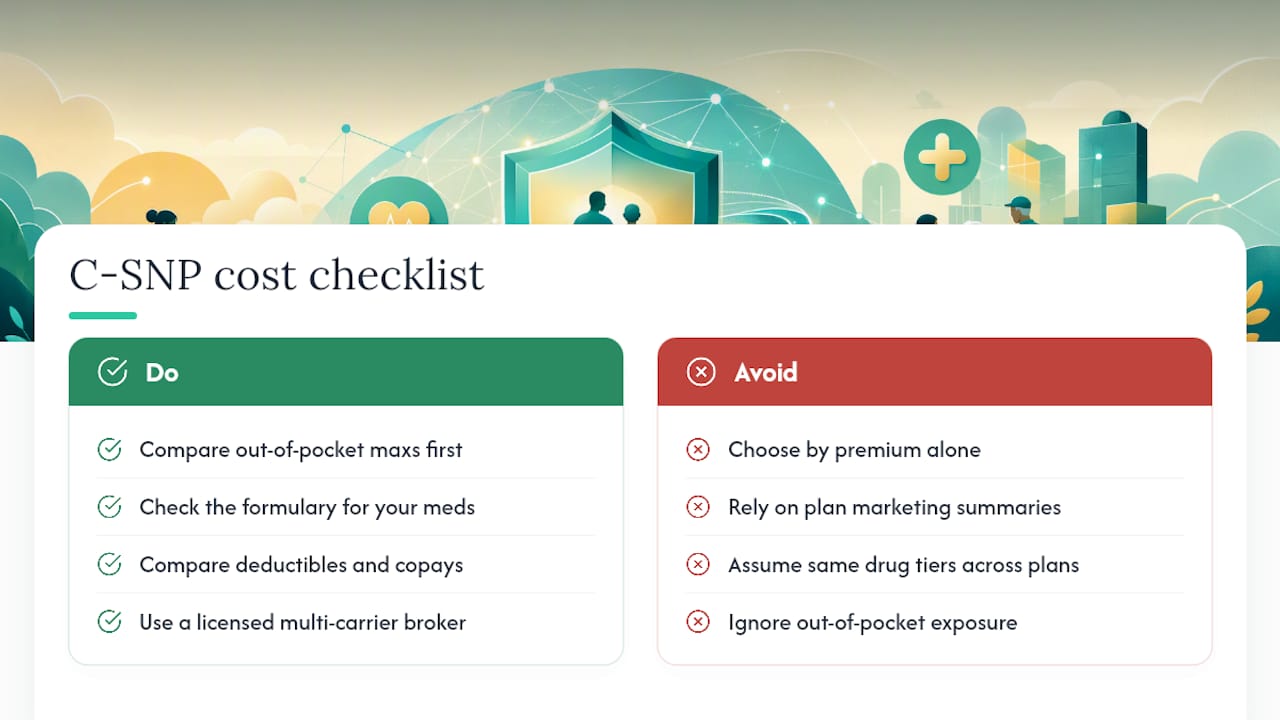
C-SNP premiums vary widely by carrier, county, and how the plan is structured, but a few patterns hold up across most markets. Many C-SNPs carry $0 monthly premiums beyond what you already pay for Part B, since the plan’s revenue comes from Medicare based on your condition and risk profile, not just your premium.
Where costs diverge is in the details: deductibles, specialist copays, and drug tiers. A C-SNP built around diabetes might waive copays for endocrinologist visits and insulin, while charging standard rates for unrelated care. A plan for chronic heart failure might do the opposite, discounting cardiology visits and heart medications while treating everything else at a typical Medicare Advantage rate.
Out-of-pocket maximums matter more here than the premium line. Because C-SNP enrollees tend to need frequent, ongoing care, hitting that maximum earlier in the year can save real money compared to a lower-premium plan with a higher ceiling. Compare the maximum out-of-pocket figure across plans before you compare premiums, not after.
Drug formularies deserve the same scrutiny. Two C-SNPs targeting the same condition can place the exact same medication on different tiers, which changes your copay by a meaningful margin over twelve months. Pull the formulary for your specific medications, not just the plan’s marketing summary, before deciding.
A licensed broker who works across multiple carriers can pull these comparisons side by side faster than searching plan by plan on your own, especially when you’re trying to weigh premium against out-of-pocket exposure for a condition that needs ongoing management.
Matching a C-SNP to Your Actual Health Needs
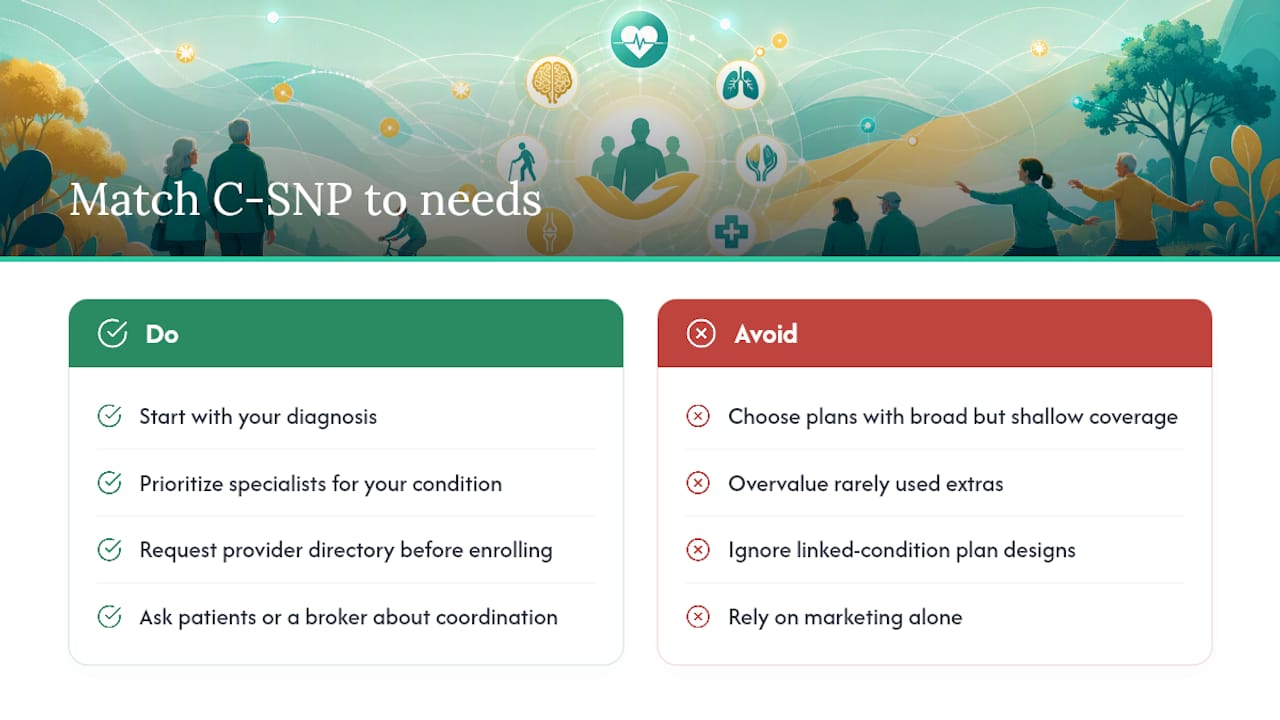
Start with the diagnosis, not the plan. If your qualifying condition is diabetes, prioritize plans with strong endocrinology networks and favorable insulin tiers over ones with broader but shallower coverage. If it’s chronic heart failure, weigh cardiology access and hospital readmission support more heavily than dental extras.
Look past the condition category to the specific network. A plan built around “chronic lung disease” is only useful to you if the pulmonologists in that network are ones you can actually get an appointment with inside a reasonable drive. Ask for the provider directory before enrolling, not after your first appointment request gets stuck in a scheduling backlog.
Weigh the extra benefits against what you’ll realistically use. Over-the-counter allowances and meal delivery after hospitalization sound appealing on a brochure, but if you’re managing a stable chronic condition with infrequent hospital stays, a plan with a stronger drug formulary and lower specialist copays will likely serve you better long term.
Check whether the plan uses a single-condition design or a clinically linked group. If you have more than one qualifying condition, a plan built around a linked group might cover both under one enrollment rather than forcing you to choose which condition to enroll under.
Finally, talk to people already using the network if you can, and ask a broker directly which plans in your county have strong reputations for care coordination versus which ones just meet the minimum Model of Care requirements. That distinction rarely shows up in a plan’s marketing material.
Where C-SNP Coverage Falls Short
C-SNPs solve a specific problem well and leave other gaps untouched. The most common limitation is condition specificity itself: a plan built around diabetes generally will not give you enhanced benefits for an unrelated condition you develop later, even though your baseline Part A and Part B coverage stays intact.
Network restrictions bite harder in C-SNPs than in some standard Medicare Advantage plans, particularly with HMO structures. If your preferred specialist isn’t in the plan’s network, switching plans mid-year isn’t simple. You are generally locked in outside of qualifying enrollment windows or Special Enrollment Periods.
Re-verification is another blind spot people underestimate. Some C-SNPs require periodic reconfirmation that you still have the qualifying condition. If that reconfirmation lapses or your provider doesn’t respond promptly, you can lose C-SNP-specific benefits even without any change in your actual health status.
Extra benefits like OTC allowances or transportation aren’t guaranteed across the board. They vary by carrier and by year, and a plan can reduce or drop them at the next annual renewal. Don’t treat any advertised extra as a permanent feature of the plan.
Finally, a C-SNP built for one condition typically won’t out-perform a general Medicare Advantage plan on cost or network breadth for care unrelated to that condition. If you have a qualifying condition but also need broad specialist access for something else entirely, weigh that trade-off honestly before enrolling.
How Enrolling in a C-SNP Affects Other Coverage
Enrolling in a C-SNP replaces Original Medicare as your primary coverage source, the same way any Medicare Advantage plan does. Your Part A and Part B benefits don’t disappear, but claims route through the C-SNP rather than directly through Medicare.
If you currently carry a Medicare Supplement (Medigap) policy, enrolling in a C-SNP typically means dropping that Medigap coverage, since Medigap is designed to work alongside Original Medicare, not Medicare Advantage. Some people keep the Medigap policy paid up during a trial period in case they want to switch back, but that adds a second premium worth weighing against the benefit.
Employer or retiree health coverage interacts differently depending on the plan. Some employer plans coordinate fine with a C-SNP; others require you to drop one or the other. Check with your HR or benefits administrator before enrolling, since the rules aren’t uniform across employers.
If you already have a stand-alone Part D prescription drug plan, that gets replaced automatically, since every C-SNP bundles Part D in. You cannot keep a separate stand-alone drug plan and a C-SNP active at the same time.
Why the Standard Advice on C-SNPs Misses the Point
Most explainers treat C-SNPs as a paperwork puzzle: check the boxes, submit the VCC, done. That framing undersells what actually determines whether the plan helps you. The eligibility rules matter, but they’re the easy part. The harder, more consequential question is whether the plan’s Model of Care actually functions the way CMS intends it to, with a real coordination team, not a name on a brochure.
Too many people enroll based on the $0 premium or the OTC allowance, and skip the questions that matter for someone managing a serious chronic illness: who calls you when a specialist appointment falls through, and how fast does the plan respond when a prior authorization needs renewing. The AHRQ research on person-centered care backs this up, coordination quality moves outcomes more than benefit lists do.
If you take one thing from this guide, prioritize the VCC deadline and the Model of Care interview over comparing extra perks. Get the verification submitted early, then interrogate the coordination team before you sign anything.
— Zach
Get Help Choosing and Enrolling in a C-SNP
Some brokerages offer no-cost Medicare consultations for Colorado residents considering whether a C-SNP is suitable. Licensed brokers can check which C-SNPs are sold in your ZIP code, compare Model of Care structures, and help coordinate the Verification of Chronic Condition with your provider.

Book a consultation, bring your Medicare card and a current medication list, and ask specifically for VCC coordination if you already have a qualifying diagnosis. Start with the Medicare guide to see what’s available in your area, or reach out directly if you’re ready to compare specific plans before the next enrollment window closes.
Sources
- Special Needs Plans (SNP) | Medicare
- Special Needs Plans | CMS
- Person-centered care planning for people living with or at risk for multiple chronic conditions (AHRQ analysis)
This article is general information, not a substitute for advice from a qualified doctor. Consult a qualified healthcare professional about your own circumstances before acting on anything here.
FAQ
What are the three types of Special Needs Plans?
Medicare offers Chronic Condition SNPs (C-SNPs), Dual Eligible SNPs (D-SNPs) for people with both Medicare and Medicaid, and Institutional SNPs (I-SNPs) for people needing long-term institutional care.
Who is eligible for a Medicare C-SNP?
You need Medicare Part A and Part B, must live in the plan’s service area, and need a qualifying chronic condition confirmed through a Verification of Chronic Condition completed by your doctor.
What chronic conditions qualify for a C-SNP?
CMS maintains 15 SNP-specific chronic condition categories, including diabetes, chronic heart failure, and chronic lung disorders, and plans can be built around a single condition or a clinically linked group of conditions.
How long does VCC verification take?
Timing varies by carrier, and some plans allow roughly two months from your coverage start date, but you should confirm the exact deadline with the plan and have your doctor submit it as soon as you enroll to avoid disenrollment.
Can a local broker help me compare C-SNP plans?
Yes. Simplyinsuranceforyou checks plan availability by ZIP code, compares Model of Care structures across carriers, and coordinates VCC paperwork with your provider so you don’t miss a submission deadline.