
Publication time reported by BabyLoveGrowth, shown in Mountain time. This is not an independently measured first appearance on this website.

Colorado Medigap Birthday Rule: Does It Exist in 2026?
Colorado does not have a Medigap birthday rule. The National Association of Insurance Commissioners (NAIC), the group of state insurance regulators, lists Colorado’s effective birthday rule as “NO” in its state chart current as of May 11, 2026. So you cannot count on a yearly window to move to a cheaper Medigap plan without answering health questions. What protects you in Colorado is getting the first choice right, knowing the rights you do have, and reviewing your coverage every year before a switch becomes difficult. As independent brokers serving Castle Pines, Denver and the rest of Colorado, we walk through all three below.
SimplyinsuranceforyouReview Your Colorado Medigap OptionsSimply Insurance offers personalized guidance to help you compare Medicare coverage and understand your options in Colorado.VisitTL;DR
- Colorado has no Medigap birthday rule, according to the NAIC’s state chart dated May 11, 2026.
- Your strongest Medigap right is the six-month open enrollment period that starts when you enroll in Medicare Part B. During it, insurers cannot turn you down or charge more for your health.
- After that window, Colorado insurers can generally use medical underwriting, meaning they can look at your health history before they decide whether to insure you.
- Never cancel your current Medigap policy until the new one has accepted you in writing.
- Colorado does require insurers to sell Medigap to people under 65 who have Medicare because of a disability, which federal law alone does not.
Table of Contents
- What a Medigap birthday rule is
- Where Colorado stands
- What Colorado gives you instead
- After the window closes: what “no birthday rule” means in practice
- Waiting periods to know about
- How to switch Medigap plans in Colorado without a gap
- Costs to weigh before you switch
- Perspective: why we start the Medigap decision early
- Get your Medigap timeline mapped out
- FAQ
- Sources
What a Medigap birthday rule is
Medigap, also called Medicare Supplement, is private insurance that pays some of what Original Medicare leaves behind: deductibles, coinsurance and copays. The plans are labeled with letters, such as Plan G and Plan N, and a given letter offers the same standard benefits whichever company sells it.
A birthday rule is a state-level protection. In states that have one, people who already hold a Medigap policy can switch once a year, in a short window around their birthday, to a plan with equal or lesser benefits. The insurer cannot reject them for their health. KFF’s October 13, 2026 overview of Medigap guaranteed issue rules describes it this way and adds the key limit: the rule does not let people without Medigap buy a new policy. It only helps people who already have one.
That is why searching for “the Colorado birthday rule” can mislead. Some websites describe the rule as if it applied everywhere. It does not.
Where Colorado stands
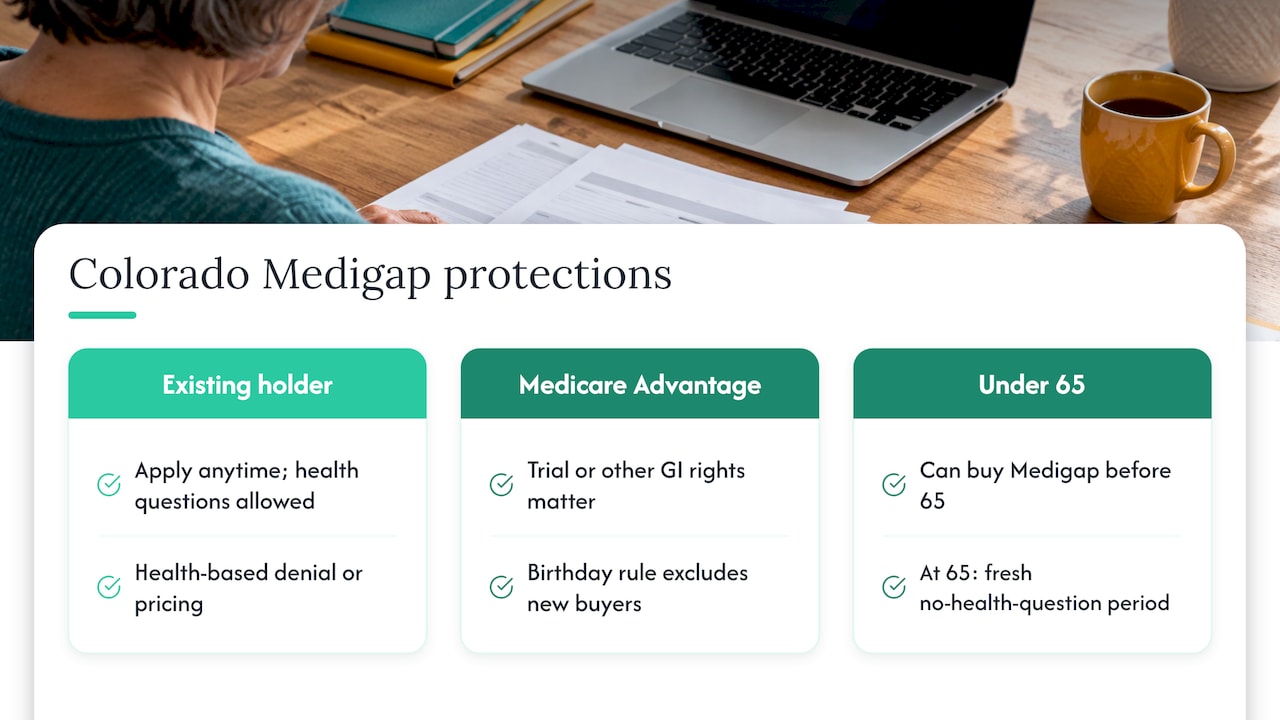
The NAIC chart is the cleanest answer. It lists Colorado as having no effective birthday rule. The same chart confirms that Colorado does require Medigap coverage for beneficiaries under 65.
KFF names sixteen states with birthday rules: California, Delaware, Idaho, Illinois, Indiana, Kentucky, Louisiana, Maryland, Nevada, New Mexico, Oklahoma, Oregon, Utah, Virginia, West Virginia and Wyoming. Their switching windows run from 30 to 63 days around the policyholder’s birthday, and some states let you switch only within the same company or only to the same plan letter. Colorado is not on the list.
Two practical points follow:
- If you read a guide that says you have a set number of days after your birthday to change Medigap carriers in Colorado, it is describing another state’s rule.
- If you move to Colorado from a birthday-rule state, such as Utah or Idaho, the rule you used before does not come with you. Colorado’s rules apply once you live here.
The Colorado Division of Insurance publishes the state’s own Medigap guide each year. Its 2026-2027 edition says you have guaranteed-issue rights during the first six months after you enroll in Part B, and that insurers may use underwriting afterward.
What Colorado gives you instead
The Medigap open enrollment period
This is the main protection. The state guide explains that during the first six months after you enroll in Part B, insurers cannot deny you coverage regardless of your health. The clock starts on the first day of the month your Part B begins, not on your birthday and not when you first became eligible. If you delay Part B because you have employer coverage, the six months starts when Part B actually begins.
Because the date matters so much, we wrote a page on how to confirm your Part B start date before you plan anything else. Your Medicare card and your Medicare account show it.
Other guaranteed-issue rights
Some life events also give you a right to buy Medigap without health questions, for example when certain kinds of coverage end. These are called guaranteed issue rights. Medicare.gov advises applying for the new policy no more than 63 days after your prior coverage ends and keeping any termination letters, notices or claim denials as proof of your right. Our explainer on guaranteed issue rights covers the situations in plain language.
If you joined a Medicare Advantage plan when you first became eligible and later want to go back to Original Medicare with a Medigap plan, you may have a trial right. We explain how it works in our guide to the Medicare trial right in Colorado.
Medigap if you are under 65
Colorado requires insurers to sell Medigap policies to residents under 65 who have Medicare because of a disability. Federal law alone does not require this, and it is one of the places where Colorado is stronger than the national baseline. When you turn 65, a new open enrollment period begins, so it is worth marking that birthday on the calendar.
If a particular prescription is part of your decision, for instance a newer drug like a weight loss medication, it helps to read about insurance coverage of weight loss medications, because drug coverage in Medicare comes through a Part D plan and not through Medigap.
After the window closes: what “no birthday rule” means in practice
The Colorado Division of Insurance says that in most cases there is no guarantee you can buy a new Medigap policy after your initial enrollment period, because companies decide whether to insure you based on your health. Medicare.gov says the same on the federal side: there is generally no federal right to switch Medigap policies outside the six-month period or a guaranteed issue right, and it points readers to their state insurance department for any additional state rights.
Here is what that looks like for three people.
Maria, 66, in Denver. She bought a Medigap plan at 65 and is healthy. A rival carrier now advertises a lower premium for the same plan letter. In Colorado she can apply for it at any time, but the company can ask health questions and may accept, decline or price her according to the answers. Because she is healthy today, switching may be approved. Her situation could change. If she waits several years and develops a chronic condition, the same application could be declined.
Tom, 70, in Castle Pines. He joined a Medicare Advantage plan at 65, and he wants to move to Original Medicare with a Medigap plan. A birthday rule would not have helped him even in a birthday-rule state, since those rules cover only existing Medigap holders. What matters for Tom is whether he still has a trial right or another guaranteed issue right.
Linda, 64, on Medicare through disability. Colorado lets her buy Medigap before 65. When she turns 65, a fresh enrollment period gives her another chance to compare plans without health questions.
The lesson is the same each time. In Colorado, your best price comparison happens when the law guarantees acceptance. After that, it depends on your health at the moment you apply.
Waiting periods to know about
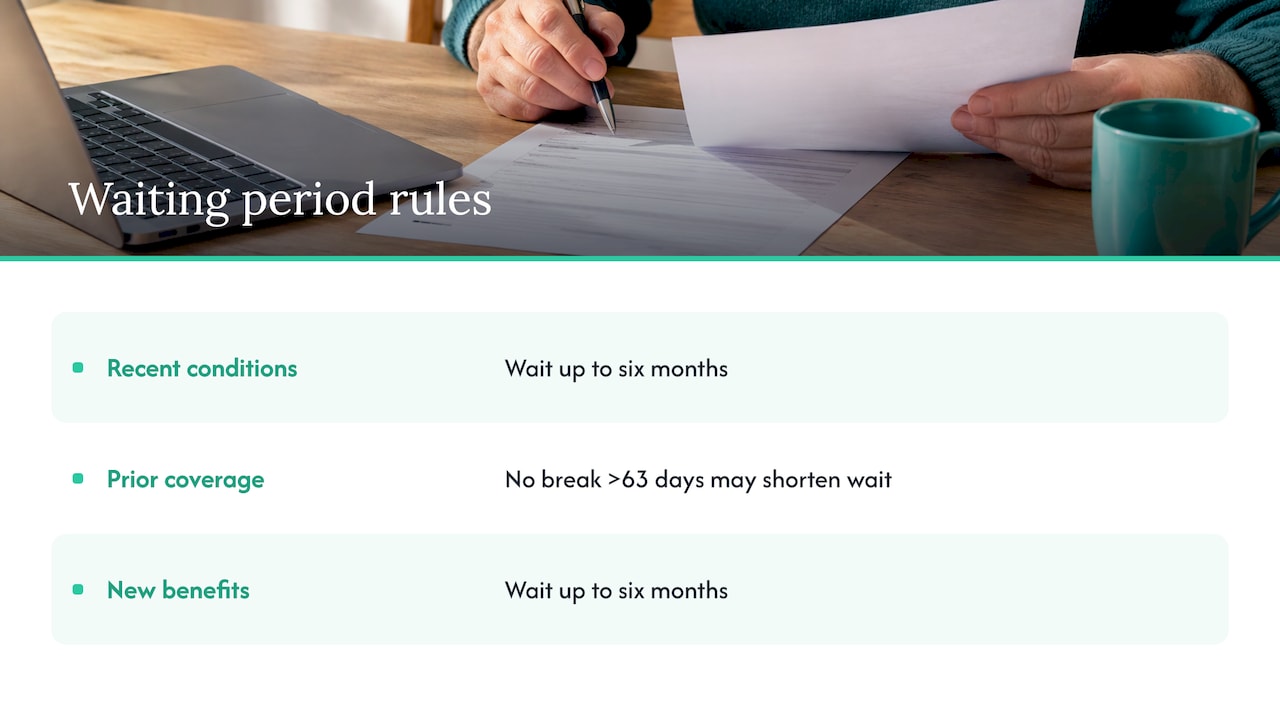
Even during open enrollment, a new policy can come with a limit. The state guide says insurers may make you wait up to six months for coverage of conditions treated or diagnosed within six months of the coverage start date. Creditable coverage, meaning health coverage you held before, can shorten that wait if you had no break of more than 63 days.
The guide adds that if the new policy has a benefit your old one lacked, the company can make you wait up to six months before covering that specific benefit. For example, moving from a plan with a smaller set of benefits to a more comprehensive one can trigger a wait on the extra benefit.
This is another reason to compare plans before you enroll. It takes some care to see which benefits are new to you and which are not.
How to switch Medigap plans in Colorado without a gap
If you are inside a guaranteed window, or you are healthy enough to be accepted through underwriting, the steps below keep you covered. The order matters, and each step is where people tend to stumble.
- Confirm which right you are using. Check whether you are within six months of your Part B start, or whether a guaranteed issue event applies. Write down the dates. Mistakes here are the most expensive, because if the right does not apply, health questions do.
- Compare the same plan letter across carriers. Plan G from one company covers the same benefits as Plan G from another, so the difference is mostly price, how the company raises premiums over time, and service. As independent brokers, we quote across multiple carriers and put the options side by side, including Plan G and Plan N.
- Collect your proof. Keep termination letters, notices of coverage ending and claim denials. Medicare.gov advises holding on to them when you use a guaranteed right.
- Apply before you cancel. The Colorado Division of Insurance advises that you not cancel your current Medigap policy until the new company has accepted you. Cancelling first can leave you with nothing if the application is declined.
- Use the 30-day free look. After you receive the new policy, you have 30 days to decide whether to keep it, and you must pay both premiums for that month. Cancel the old policy only when you are sure.
- If you are leaving Medicare Advantage, apply first. The guide says to apply and be accepted before dropping the plan, then disenroll in writing or by calling Medicare. Our guide to avoiding gaps when changing Medicare Advantage covers the timing.
- Check the effective date. Make sure the new policy starts on the day the old one ends.
Costs to weigh before you switch
A lower premium is not the only measure. When we compare Medigap plans we look at how each company has historically raised premiums with age, whether the plan has a waiting period for you, and how the company handles claims. Our overview of Medicare costs in Colorado lays out what you pay for Part B, Part D and supplemental coverage, and the Medicare cost calculator lets you work out your own numbers.
If you are deciding between Medigap and Medicare Advantage, see Medicare Advantage vs. Medigap for a side-by-side view.
Perspective: why we start the Medigap decision early
In Colorado, the best moment to choose a Medigap plan is the moment the law guarantees you can have any plan. We have built our practice around that fact.
Many people reach us after hearing about a birthday rule from a friend in another state. We explain what Colorado actually offers, then we build a plan around the dates that matter: your Part B start, the six months that follow, and any trial right you may hold. We are independent and licensed, so we compare plans across multiple carriers and match them to your health needs and budget, not to one company’s product list.
The decision does not end at enrollment. We help with claims and with an annual review each year, so that you have someone looking at your coverage when your needs change, and when the Annual Enrollment Period comes around in the fall. For us, a good Medigap choice is one you still feel good about five years later.
Zach
Get your Medigap timeline mapped out
If you are turning 65, helping a parent with Medicare, or wondering whether your current Medigap plan is still the right one, we can map your dates and compare Plan G and Plan N quotes across carriers. Our brokerage is paid by the carriers when you enroll, so there is no direct cost to you. Our Medigap plans page for Castle Pines describes the options, and our services page lists everything from Medicare Advantage consultations to appeals and grievances.

We serve Castle Pines, Denver and the rest of Colorado, so you can start with Medicare Planning.
FAQ
Does Colorado have a Medigap birthday rule?
No. The NAIC’s state chart, current as of May 11, 2026, lists Colorado as having no effective birthday rule. Colorado does give you guaranteed-issue rights during the six months after you enroll in Part B, and it requires Medigap to be offered to people under 65 with Medicare because of a disability.
Can I switch Medigap plans in Colorado whenever I want?
You can apply at any time, but outside a guaranteed window the insurer can review your health before deciding. That is why the first six months after Part B starts is the best time to compare. If you have a qualifying guaranteed issue right, you can also switch without health questions, and you should apply within 63 days of your prior coverage ending.
What should I do before cancelling my old Medigap policy?
Wait until the new company has accepted you. The Colorado Division of Insurance guide notes that you get a 30-day free-look period on the new policy, and that you must pay both premiums during that month. Cancel the old policy only after you have decided to keep the new one.
Which states have a Medigap birthday rule?
KFF lists sixteen: California, Delaware, Idaho, Illinois, Indiana, Kentucky, Louisiana, Maryland, Nevada, New Mexico, Oklahoma, Oregon, Utah, Virginia, West Virginia and Wyoming. Colorado is not one of them. Windows run from 30 to 63 days around the policyholder’s birthday.
Sources
- NAIC: State Medigap Rules, Birthday Rule and Coverage for under 65 (May 11, 2026)
- KFF: Medigap Guaranteed Issue Requirements, An Overview of Federal and State Rules (October 13, 2026)
- Colorado Division of Insurance: Medicare Supplement Insurance Policies, 2025-2026 guide
- Colorado Division of Insurance: Medicare Supplement Insurance Policies, 2026-2027 guide
- Medicare.gov: Can I change my Medigap policy?
- Weight Loss Meds and Insurance: What Plans Cover in 2026