
Publication time reported by BabyLoveGrowth, shown in Mountain time. This is not an independently measured first appearance on this website.

Dental HMO vs PPO: 4 Questions to Pick the Right U.S. Plan
Choose a dental HMO if your priority is the lowest monthly cost and you’re fine using an in-network primary dentist for everything. Choose a dental PPO if you need freedom to see specialists or out-of-network dentists without a referral. The exception: if you’re facing major work like a crown or implant soon, run the numbers on both plus a dental savings plan before signing anything, since waiting periods can wipe out any premium savings.
TL;DR:
- PPO plans generally have higher premiums, deductibles, and annual maximums, but offer broader network access and direct specialist visits without referrals.
- HMO plans feature lower premiums and no deductibles with fixed copays but limit care to in-network providers and require referrals for specialists.
- Waiting periods on major procedures like crowns or implants typically last six to twelve months, making immediate coverage for such work unlikely without prior plan continuity.
- Dental savings plans, not insurance, have no waiting periods or annual caps, providing immediate discounts for major procedures at participating providers.
- Consulting with a broker can clarify network status, waive waiting periods, and help match plan choices to specific dental needs and timelines at no extra cost.
Table of Contents
- Dental HMO vs PPO: What Each One Actually Means
- Comparing the Trade-Offs That Actually Matter
- The Waiting Period Trap Almost Nobody Reads About
- How to Actually Choose Between Them
- Where a Local Broker Fits Into This Decision
- Get Help Comparing Plans Before You Enroll
- Sources
Dental HMO vs PPO: What Each One Actually Means
A dental HMO (DHMO) locks you into a network. You pick a primary dentist, that dentist coordinates your care, and specialist visits typically require a referral from within the same network. There’s usually no deductible. Instead you pay a fixed copay per procedure, set in advance on a schedule your insurer hands you at enrollment. The ADA’s overview of dental plan types is a good reference if you want the underlying terminology spelled out.
A dental PPO (DPPO) trades that structure for range. Networks run larger, and you can go out-of-network and still get partial reimbursement, just at a lower rate than you’d get in-network. PPOs generally carry a deductible plus coinsurance (you pay a percentage, not a flat fee), and most cap what the plan will pay out in a given year.
Coverage tiers look similar on paper across both plan types:
- Preventive care (cleanings, exams, X-rays): usually covered at or near 100% under both HMO and PPO.
- Basic services (fillings, extractions): partial coverage, copay under HMO, coinsurance under PPO.
- Major services (crowns, root canals, bridges): the biggest cost gap between the two, and where waiting periods bite hardest.
Cigna’s comparison of DHMO and DPPO plans breaks down how that copay-versus-coinsurance split plays out procedure by procedure.
Comparing the Trade-Offs That Actually Matter
Premiums tell only part of the story. DHMO premiums typically run lower each month because insurers manage cost by restricting who you can see. DPPO premiums run higher because you’re paying for the option to go outside the network, even if you never use it.
Here’s where the real financial differences show up:
- Deductibles and coinsurance: PPOs often require you to hit a deductible before coverage kicks in on basic and major work, then split the remaining cost with you through coinsurance. HMOs skip the deductible entirely and use flat copays instead.
- Annual maximums: Many PPOs cap what they’ll pay per year. DHMOs frequently have no annual maximum at all, since the fixed-copay model limits the insurer’s exposure differently.
- Network size: PPO networks are generally broader, and UnitedHealthcare’s plan comparison notes that out-of-network reimbursement under a PPO gives you a fallback option an HMO simply doesn’t offer.
- Referrals: HMOs route everything through your primary dentist. PPOs let you see a specialist directly.
Two quick scenarios show how this plays out. A single adult who just needs two cleanings and an occasional filling each year will almost always spend less under a DHMO, thanks to low premiums and no deductible drag. But someone who needs a crown, then a root canal on a different tooth six months later, often comes out ahead on a PPO, even with the higher premium, because the flexibility to see an endodontist directly (no referral loop) saves both time and money.
The clearest practical test for your own situation: if you already have a dentist you like, check whether that dentist is in-network before you decide anything else. If not, and you’re not willing to switch, a PPO may be the only realistic option regardless of cost.
The Waiting Period Trap Almost Nobody Reads About
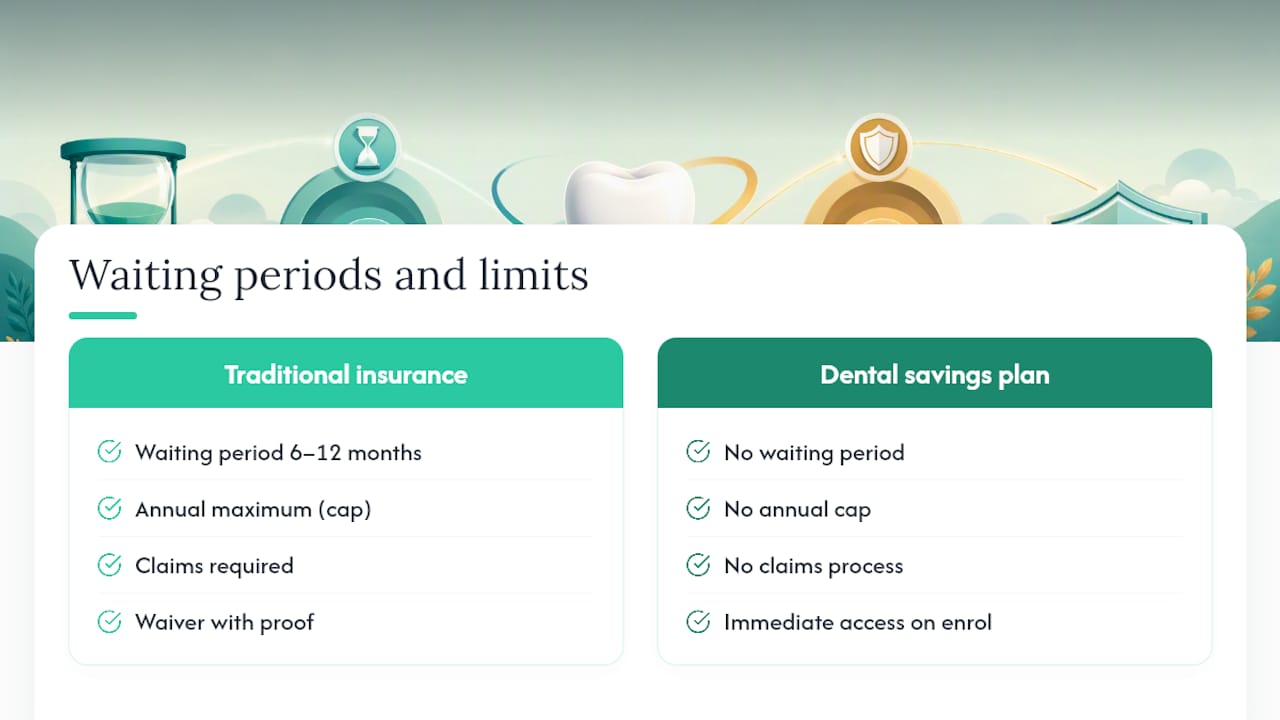
Here’s the detail that trips up more people than premiums ever do: most insurance plans (HMO and PPO alike) impose waiting periods on major services, commonly running 6 to 12 months before coverage on crowns, bridges, or implants kicks in, according to Investopedia’s breakdown of HMO and PPO dental plans. If you switch from a prior plan with continuous coverage, some insurers will waive that waiting period, but you have to ask, and you have to prove it.
Annual maximums compound the problem. A typical annual maximum, which sounds fine until you need a single crown that costs more than that on its own, a gap DentalPlans documents in detail when comparing insurance against savings plans.
This is exactly where a dental savings plan (sometimes called a dental discount plan) earns a second look. It isn’t insurance. There’s no waiting period, no annual cap, and no claims process, just a membership fee in exchange for discounted rates at participating dentists the moment you enroll. For someone paying full price with no employer subsidy and a crown needed now, a savings plan can beat traditional insurance in that first year simply by skipping the wait.
Before you sign anything, pull up the plan’s Summary of Benefits and check three things: the waiting period language, the annual maximum, and whether your specific procedure falls under “basic” or “major.”
How to Actually Choose Between Them
Run through this before you compare a single plan:
- List your usual dentist and confirm network status. If switching providers is a dealbreaker, that alone may decide HMO versus PPO for you.
- Estimate what you’ll actually need in the next 12 months. Routine cleanings only, or do you already know a crown or root canal is coming?
- Count who’s on the plan. Family coverage changes the math, since kids’ orthodontic needs often favor PPO flexibility.
- Set a real budget split. Compare what you’d pay monthly in premiums against what you’d pay out-of-pocket for one major procedure under each plan.
When you’re talking to an insurer or broker, ask these exact questions: What’s the current in-network dentist list, and can I get it in writing? What’s the waiting period on major services, and does prior coverage waive it? What’s the annual maximum, and does it reset on the calendar year or the plan year? What happens if I need emergency care out-of-network?
Red flags worth chasing down in any Summary of Benefits and Coverage: vague language around “usual and customary” reimbursement rates on out-of-network claims, a copay schedule that excludes common procedures you’ll actually need, and any waiting period that isn’t stated in plain months.
Pro Tip: Save a screenshot or PDF of the insurer’s provider directory the day you enroll. Networks change, and having proof of what was listed when you signed up matters if a dentist drops out mid-year.
Where a Local Broker Fits Into This Decision
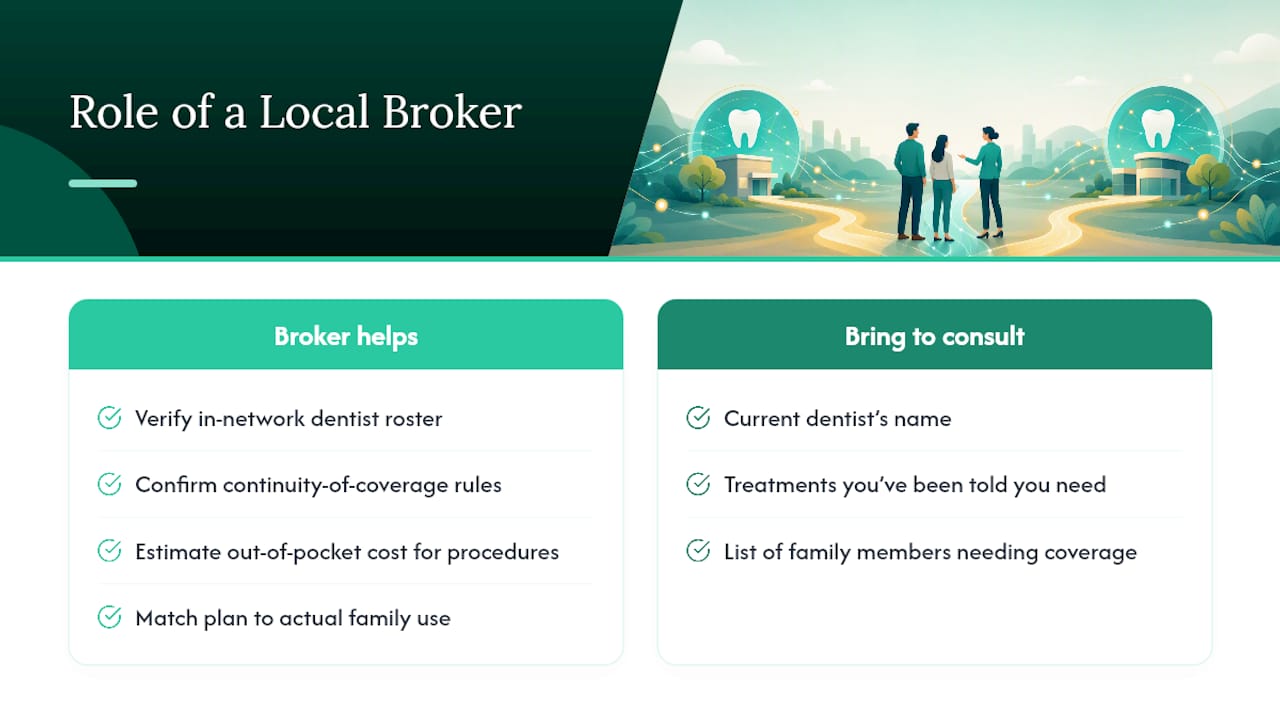
Comparing plan documents on your own works fine for routine cases. It gets harder once you’re weighing a family’s mixed needs, or you already know major work is coming and want to know exactly how a waiting period will hit your wallet. That’s the gap a broker can close: verifying an in-network dentist roster before you enroll, confirming whether continuity-of-coverage rules waive a waiting period based on your prior plan, and running real numbers on out-of-pocket cost for the specific procedures you’re facing.
If you’re heading into a consultation, bring your current dentist’s name, any treatment you’ve already been told you’ll need, and a list of who else needs coverage. Simply Insurance works with Colorado residents on exactly this kind of comparison, alongside the Medicare and health insurance guidance the brokerage is built around, and the goal is the same either way: match the plan to what you’ll actually use, not just what looks cheapest on a rate sheet.
— Zach
Get Help Comparing Plans Before You Enroll
Licensed brokers can check your actual dentist’s network status and flag waiting periods before you sign up, at no cost to you since carriers pay the commission.

If you’re stuck deciding between a lower-cost HMO and a more flexible PPO, or wondering whether a savings plan makes more sense for work you need done soon, request a free dental insurance consultation and get a straight answer based on your specific dentist, family, and timeline. Assistance is also available for broader coverage questions if you’re comparing health insurance options alongside dental. Schedule a call and walk away with a plan recommendation instead of a stack of PDFs to decode on your own.
Sources
The ADA’s dental plan overview covers plan terminology in plain terms. Cigna and UnitedHealthcare explain their own HMO and PPO structures directly. DentalPlans offers the clearest side-by-side on insurance versus savings plans for readers weighing both.
- Types of Dental Plans | ADA
- Dental PPO vs. Dental HMO insurance | UnitedHealthcare
- Compare dental insurance and dental savings plans | DentalPlans