
Publication time reported by BabyLoveGrowth, shown in Mountain time. This is not an independently measured first appearance on this website.

Choose Family Health Insurance for U.S. Families by Total Cost
Most families choose between four paths: employer-sponsored coverage, ACA Marketplace plans (often with subsidies), Medicaid or CHIP, and a handful of niche fallback options. Check your employer plan’s dependent pricing first. If that’s too expensive or unavailable, run a ZIP-based Marketplace price estimate; if your income is low, check Medicaid or CHIP eligibility in your state. Federal rules and tools drive real dollar differences, so use the official ones, not guesswork.
SimplyinsuranceforyouCompare Family Coverage With Local GuidanceSimply Insurance helps Colorado individuals and families compare health insurance options with personalized advice and ongoing support.Explore your coverage optionsTL;DR:
- Employer-sponsored plans often offer the lowest premiums but may charge full price for dependents, making Marketplace plans more cost-effective in some cases.
- Qualification for Medicaid or CHIP depends heavily on whether your state expanded Medicaid under the ACA, affecting coverage and income thresholds.
- Silver plans provide the best value for families receiving subsidies because they are the only tier eligible for cost-sharing reductions.
- Comparing actual expected medical costs, provider networks, and plan details before buying is essential to avoid higher out-of-pocket expenses.
- Using official tools and running subsidy estimates based on accurate income data helps determine the most affordable and suitable coverage options.
Table of Contents
- What are the main family health insurance options?
- How do Marketplace subsidies and cost-sharing reductions work?
- Employer coverage vs. Medicaid vs. CHIP: which one applies?
- What do metal tiers actually cost a family?
- How do you actually compare two plans?
- When can you enroll, and where do you get exact prices?
- When does it make sense to work with a licensed broker?
- A quick word on priorities
- Get Local Help Comparing Family Health Plans
- Sources
What are the main family health insurance options?
Four categories cover almost every family’s situation, and each one trades cost against flexibility differently.
- Employer-sponsored coverage works best for families where at least one parent has a job offering group insurance. It usually carries the lowest monthly cost because the employer splits the premium, but plan choice is limited to whatever HR offers.
- ACA Marketplace plans fit families without employer coverage, self-employed households, and anyone whose income qualifies for premium tax credits. You pick from Bronze, Silver, Gold, or Platinum tiers based on how you want to balance premium versus out-of-pocket costs.
- Medicaid and CHIP serve low-income families and children, often at little or no cost, though eligibility depends heavily on your state.
- Short-term, catastrophic, and supplemental plans (like critical illness or accident coverage) fill temporary gaps or add protection on top of a major medical plan, but they are not full substitutes for one.
The real trade-off across all four is premium versus exposure: a cheap plan that leaves you owing thousands after one ER visit isn’t actually cheap.
How do Marketplace subsidies and cost-sharing reductions work?
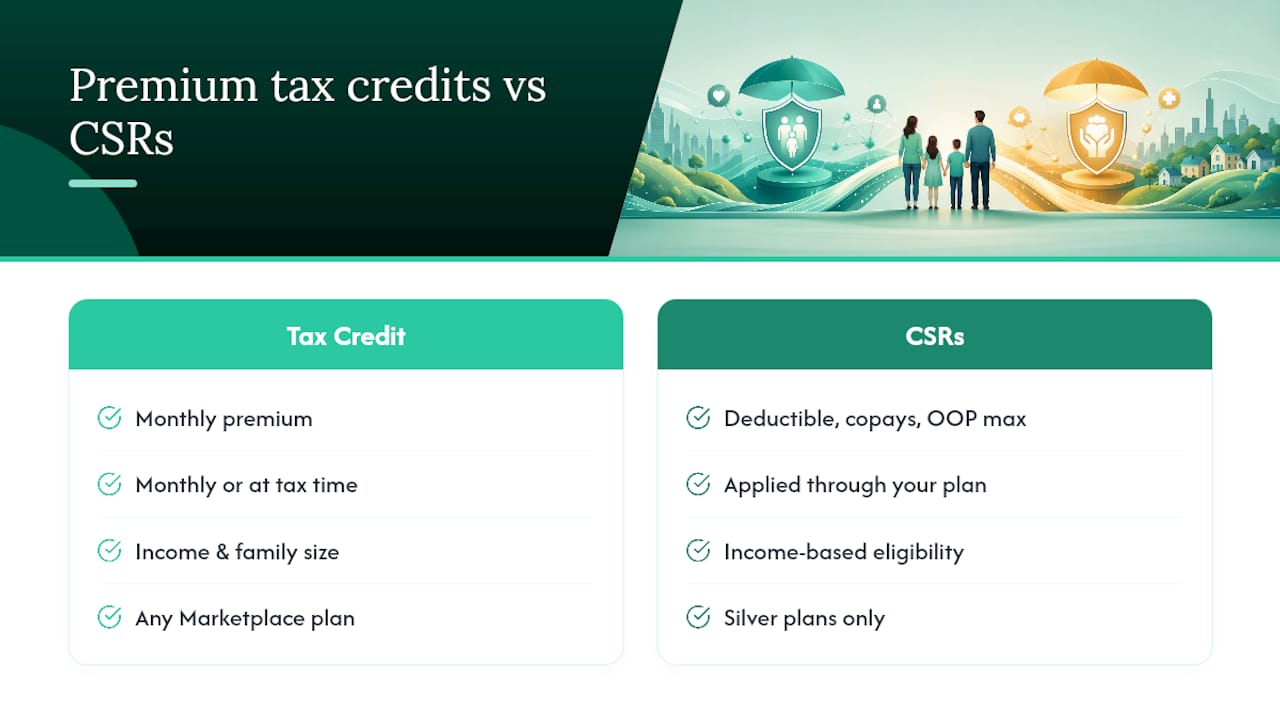
Premium tax credits reduce your monthly Marketplace premium on a sliding scale tied to household income and family size. You can take the credit monthly to lower what you pay upfront, or claim it at tax time. The catch: if you underestimate your income when enrolling, you may owe back a portion of the credit during subsidy reconciliation, so use realistic income figures, not optimistic ones.
Cost-sharing reductions are a separate benefit that lowers your deductible, copays, and out-of-pocket maximum, but they only attach to Silver plans. A family that qualifies for CSRs and picks Bronze instead is leaving real money on the table.
Whether you qualify for Medicaid instead of Marketplace subsidies often comes down to a single fact: did your state expand Medicaid? States that expanded coverage under the ACA extend Medicaid eligibility to more low-income adults; states that didn’t leave a coverage gap where families earn too much for Medicaid but still qualify for substantial Marketplace subsidies.
To see your actual numbers, run your ZIP code through HealthCare.gov’s “See plans & prices” tool and cross-check the estimate with the KFF subsidy calculator. The two together give you a subsidy estimate and a realistic monthly premium before you commit to anything.
Employer coverage vs. Medicaid vs. CHIP: which one applies?
Employer coverage usually wins on price when it’s available, because the company typically pays a meaningful share of the premium, especially for employee-only coverage. Dependent coverage is the wrinkle: many employers charge full price to add a spouse or kids, which can flip the math toward a Marketplace plan.
- Ask HR for the exact monthly cost of adding your spouse and each child, not just the employee-only rate.
- Compare that number against a Marketplace estimate for the same family before deciding.
- If you’re leaving a job, COBRA lets you keep your old employer plan temporarily, though usually at the full unsubsidized premium.
- Medicaid and CHIP eligibility vary by state and are typically based on income relative to the federal poverty level; many states cover kids at higher income thresholds than parents.
- Short-term plans can bridge a coverage gap between jobs but generally don’t cover pre-existing conditions or preventive care the way ACA-compliant plans do.
Once you have real numbers from HR, the Marketplace comparison takes minutes.
What do metal tiers actually cost a family?
Bronze, Silver, Gold, and Platinum plans differ in actuarial value, which is the percentage of average costs the plan covers versus what you pay out-of-pocket; for more background on plan tiers and product features, see this insurance insights blog. Bronze plans cover roughly the smallest share and carry the lowest premiums but the highest deductibles; Platinum flips that entirely. Industry cost analyses consistently show Silver as the tier where subsidized families get the best overall value, largely because that’s the only tier eligible for cost-sharing reductions.
Four numbers determine your real annual cost, not just the premium:
- Deductible: what you pay before insurance starts covering most costs.
- Copay: a flat fee per visit or prescription.
- Coinsurance: your percentage share of costs after the deductible.
- Maximum out-of-pocket (MOOP): the hard ceiling on what you’ll pay in a year, after which the plan covers 100%.
HMOs generally cost less and require a primary care referral to see specialists; PPOs cost more but let you see out-of-network providers without a referral; EPOs sit in between, skipping the referral requirement but keeping you in-network. POS plans blend HMO referral rules with some out-of-network flexibility.
Pro Tip: If your family is generally healthy and can cover a higher deductible from savings, an HSA-eligible Bronze or Silver plan lets you set aside pretax money for medical costs. It’s one of the few moves that lowers your taxable income while building a dedicated health fund.
How do you actually compare two plans?
Run the math before you compare brochures.
- List your expected visits, prescriptions, and any known procedures for the next 12 months.
- Check whether your current doctors and specialists are in-network for each plan.
- Add the annual premium to your expected out-of-pocket costs, capped at each plan’s MOOP.
- Verify each plan’s drug formulary covers your prescriptions at a reasonable tier.
- Confirm referral rules if anyone in the family sees specialists regularly.
A family paying $450 a month for a Bronze plan with a $7,000 deductible could pay more out of pocket after two urgent care visits and a routine surgery than a family paying $580 a month for a Silver plan with a $2,000 deductible and CSR-reduced copays.
Watch for narrow networks and heavy prior-authorization requirements buried in the plan documents. If a child has a chronic condition, the lower premium plan is rarely the cheaper one once you add up specialist visits and prescriptions over a full year.
When can you enroll, and where do you get exact prices?
Open Enrollment for Marketplace plans typically runs from November through mid-January, but qualifying life events, a birth, marriage, job loss, or move, trigger a Special Enrollment Period outside that window. Report your expected annual income accurately when you apply; overestimating or underestimating it affects your subsidy and can trigger repayment at tax time.
- Use Healthcare for ZIP-specific prices and enrollment.
- Run the KFF subsidy calculator to estimate your premium tax credit before you shop.
- Check your state’s own Marketplace site if you live in a state-run exchange rather than the federal one.
- Save screenshots of your plan quotes and subsidy estimates. You’ll want them when you file taxes.
When does it make sense to work with a licensed broker?
Complex situations, stacking subsidies with a chronic condition, comparing plans after a move between states, or juggling multiple dependents with different provider needs, are where a second set of eyes pays off. Simplyinsuranceforyou provides personalized guidance for families in Castle Pines and across Colorado, with support that continues after enrollment through claims help and annual plan reviews, plus specialty coverage like critical illness plans alongside major medical.
Before a consultation, gather:
- Your household’s expected annual income
- Current plan details, if you have coverage now
- A list of preferred doctors and prescriptions
A quick word on priorities
The right family health insurance options usually come down to running the actual numbers, employer offer, Marketplace subsidy, or Medicaid eligibility, rather than guessing from premium alone. Set a calendar reminder to recheck your plan every year, and don’t wait for Open Enrollment if you have a baby, move, or lose a job; those trigger a Special Enrollment window immediately.
— Zach
Get Local Help Comparing Family Health Plans
Licensed brokers give Colorado families something the online plan finders can’t: a professional who reviews your actual doctors, prescriptions, and budget before you enroll, and who stays available after enrollment for claims questions and annual reviews. That ongoing relationship matters more than most families realize until they hit a billing dispute or a plan change mid-year.

If you’re in Castle Pines or anywhere in Colorado, start with a look at individual and family health insurance options tailored to your situation, or browse the full range of insurance services and coverage options Simplyinsuranceforyou offers. There’s no cost to work with a broker since carriers pay the commission, so reach out and get a real comparison before you commit to a plan.
This article is general information, not a substitute for advice from a qualified financial advisor. Consult a qualified financial professional about your own circumstances before acting on anything here.
Sources
- Healthcare
- KFF subsidy calculator and guidance
- MoneyGeek — Best health insurance analyses
- Forbes Advisor — best affordable health insurance