
Publication time reported by BabyLoveGrowth, shown in Mountain time. This is not an independently measured first appearance on this website.
$2,100 Cap: When Medicare Beneficiaries Should Use GoodRx
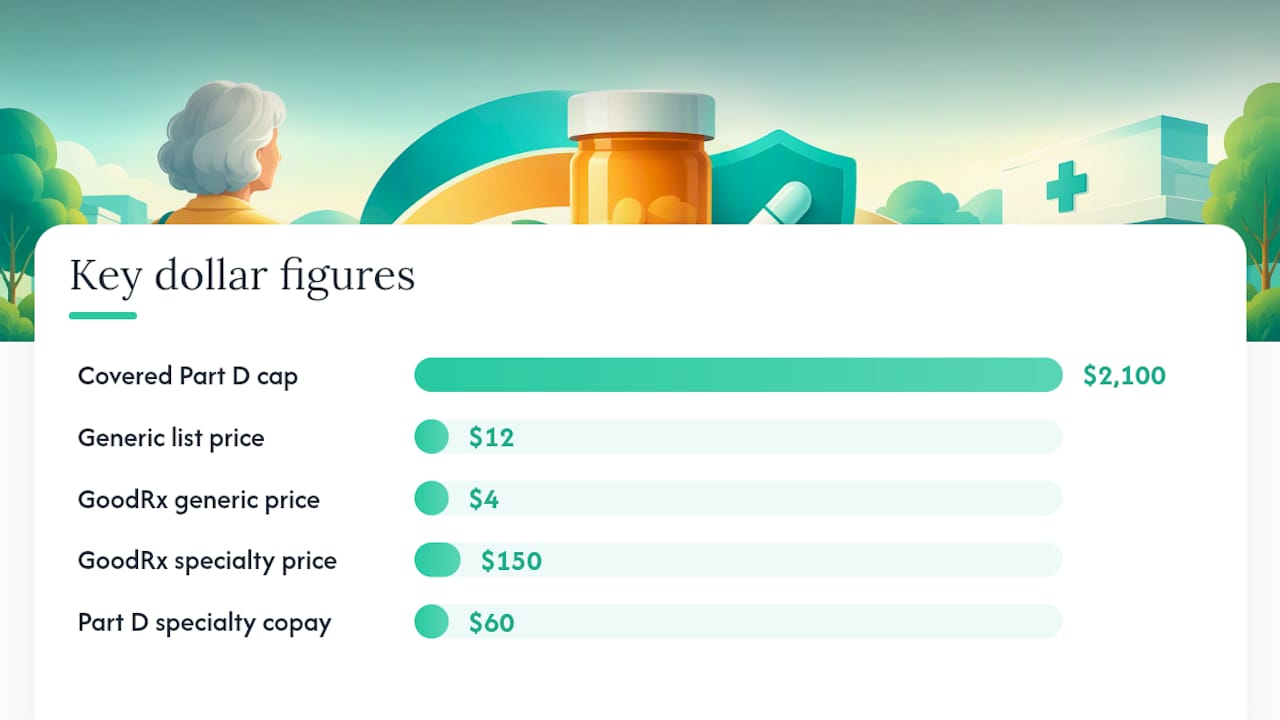
Yes, you can use GoodRx instead of Medicare for a single prescription, but you cannot run both at the same pharmacy counter for the same fill. GoodRx is a cash discount, not insurance, so a pharmacist processes either your Part D claim or your GoodRx coupon, never both. That choice matters more starting in 2026: money you pay through GoodRx never counts toward your Part D deductible or the new $2,100 covered-Part-D out-of-pocket threshold.
SimplyinsuranceforyouGet Clearer Medicare GuidanceSimply Insurance offers personalized guidance from licensed brokers, with support for plan comparisons, enrollment, claims, and annual reviews.Visit Simply InsuranceTL;DR:
- Using GoodRx for a single prescription does not count toward your Medicare Part D deductible or the $2,100 out-of-pocket threshold starting in 2026.
- Prices for the same drug can vary widely depending on pharmacy, strength, and timing, making comparison crucial before choosing between GoodRx and Medicare coverage.
- If you’re nearing the $2,100 cap, paying through Part D can help you reach free coverage for subsequent fills, unlike GoodRx payments which do not contribute to this limit.
- For maintenance medications, protecting your progress toward the cap is usually more beneficial than small upfront savings via GoodRx, especially for expensive or brand-name drugs.
- Combining coupons and Medicare benefits at the same pharmacy is allowed, but only one payment method is processed per fill, affecting your cost and coverage progress.
Table of Contents
- How the Rule Works: Why GoodRx and Medicare Can’t Be Combined
- GoodRx vs. Part D: A Practical Decision Framework
- How to Use GoodRx at the Pharmacy: Step-by-Step
- Other Ways to Lower Prescription Costs Besides Coupons
- Does GoodRx Affect Your Medicare Advantage Network or Coverage?
- Does Using GoodRx Hurt Medication Adherence or Continuity of Care?
- What the Rules Actually Say About Coupons and Medicare
- Real-World Cost Comparisons: GoodRx vs. Part D by Medication Type
- A Broker’s Take on Coupons, Copays, and the 2026 Cap
- Get a Free Medicare Prescription Plan Check
- Sources
- FAQ
How the Rule Works: Why GoodRx and Medicare Can’t Be Combined
Every pharmacy transaction runs through one payer. If the pharmacist submits your Part D claim, that fill counts toward your deductible, your plan’s coverage phases, and your annual out-of-pocket total. If you hand over a GoodRx coupon instead, the pharmacy processes it as a cash sale outside your Medicare insurance entirely. Medicare’s own guidance confirms beneficiaries can use a coupon for an individual prescription, but GoodRx isn’t Medicare insurance and can’t be layered on top of a Part D or Medicare Advantage drug claim in the same transaction.
That distinction has real consequences for your yearly math. Part D now moves through a deductible phase, then cost-sharing, until you hit the 2026 covered-Part-D out-of-pocket cap of $2,100. After that, covered drugs cost you nothing for the rest of the year. Every dollar you pay through Part D pushes you closer to that finish line. Every dollar you pay through GoodRx does not, because it never touches your plan’s records at all.
GoodRx prices themselves come from negotiated rates with pharmacy benefit managers, not from Medicare. That’s why the same pill can cost wildly different amounts depending on the pharmacy, the exact strength, and the day you fill it. A coupon that saved you money in January isn’t guaranteed to be the cheapest option in July, which is one reason comparing prices at each fill matters more than assuming last time’s answer still holds.
GoodRx vs. Part D: A Practical Decision Framework
The right choice depends on the drug, not a blanket rule. Here’s the order of operations that actually protects your wallet over a full year.
- Get the exact price from both sides. Ask the pharmacist for your Part D copay and pull up the GoodRx price for the identical strength, quantity, and pharmacy location. A mismatch in dosage or fill size makes any comparison meaningless.
- Check whether the drug is recurring or one-off. A maintenance medication you’ll refill monthly behaves very differently in the math than a ten-day antibiotic you’ll never touch again.
- Look at where you sit relative to the $2,100 threshold. If you’re close to hitting the covered-Part-D cap, paying through Part D now can trigger free covered drugs for the rest of the year, which is a meaningful financial protection. Paying cash through GoodRx resets nothing in your favor.
- Weigh brand-name drugs separately. Many carry manufacturer discounts or negotiated rates inside Part D that a GoodRx cash price can’t touch.
Statistic Callout: Under the 2026 Part D redesign, once you spend $2,100 out of pocket on covered drugs, your plan picks up 100% of the cost for the remainder of the calendar year. GoodRx payments never count toward that number, no matter how much you spend.
Consider two quick scenarios. A beneficiary filling a $12 generic blood pressure pill that GoodRx prices at $4 saves $8 immediately, with almost no downside since they’re nowhere near the $2,100 cap that year. Now flip it: someone on an expensive specialty drug who pays $150 through GoodRx instead of a $60 Part D copay saves nothing. They pay more upfront and lose $60 of progress toward a cap that would have made every fill for the rest of the year free once reached.
How to Use GoodRx at the Pharmacy: Step-by-Step
Walking in prepared saves you an awkward conversation at the counter and, often, real money.
Before you go:
- Search GoodRx for your exact medication, matching the strength, formulation, and quantity your doctor prescribed.
- Confirm the coupon applies at your specific pharmacy, since prices vary by location.
- Pull up the coupon on your phone or print it, so you’re not fumbling at checkout.
At the counter:
- Show your Medicare card and your GoodRx coupon together.
- Tell the pharmacist directly which option you want to use for that fill.
- Ask if they can check both prices before you decide. Most pharmacists can compare Part D and GoodRx pricing on request, but they’ll process whichever one you select.
If the coupon doesn’t work or the pharmacy hesitates, try a different participating pharmacy or ask the pharmacist to manually run it as a cash GoodRx transaction rather than through insurance.
Pro Tip: Re-check the GoodRx price every time you refill. GoodRx pricing shifts with pharmacy benefit manager arrangements, so a discount that beat your copay last month might not this month.
Other Ways to Lower Prescription Costs Besides Coupons
GoodRx isn’t your only lever, and for some beneficiaries it isn’t even the best one.
- Extra Help (Low-Income Subsidy) can dramatically cut Part D premiums, deductibles, and copays for those who qualify, and unlike GoodRx, those reduced payments still count toward your Part D accumulation.
- State Pharmaceutical Assistance Programs and manufacturer patient assistance programs sometimes beat both GoodRx and Part D copays for specific brand-name drugs. Eligibility rules vary, so check directly with the program.
- The Medicare Prescription Payment Plan spreads your covered Part D costs across monthly installments rather than one large bill. It’s a cash-flow tool, not a discount, so it doesn’t lower what you owe, just when you owe it.
- If your current Part D plan’s formulary keeps pushing you toward coupons, that’s a signal to review your plan during Open Enrollment. A Part D plan comparison with a broker or SHIP counselor can reveal a formulary that actually covers your medications at a lower copay.
Does GoodRx Affect Your Medicare Advantage Network or Coverage?
Using GoodRx for a fill doesn’t change your Medicare Advantage plan’s network rules or cancel your coverage. Your plan stays intact whether you pay cash through GoodRx for one prescription or use your Part D benefit for the next. The two systems simply don’t interact.
What it does affect is the money side of your plan’s accounting. Medicare Advantage plans with drug coverage track your spending toward the same 2026 $2,100 covered-Part-D threshold that stand-alone Part D plans do. A GoodRx cash purchase sits outside that tracking entirely, so it neither helps nor hurts your network status, but it also doesn’t move you any closer to the point where your plan covers drugs at no cost.
There’s a subtler wrinkle worth knowing. Some Medicare Advantage plans negotiate preferred pharmacy pricing that beats both their own standard copay and GoodRx’s cash rate for certain generics. That’s another reason a blanket “always use GoodRx for generics” rule can backfire. The only way to know is to ask the pharmacist to check the plan’s preferred network price against the coupon before you decide which one to hand over.
None of this requires notifying your plan or your pharmacy network in advance. You can mix and match: Part D for one drug, GoodRx for another, plan-preferred pricing for a third, all within the same benefit year, as long as you tell the pharmacist which method to use for each individual fill.
Does Using GoodRx Hurt Medication Adherence or Continuity of Care?
Used thoughtfully, GoodRx can actually improve adherence by making a drug affordable enough that you don’t skip doses or split pills to stretch a bottle. The risk shows up when beneficiaries treat coupon shopping as a substitute for consistent coverage rather than a tool for specific fills.
Switching between a coupon and your Part D benefit from month to month, or bouncing between pharmacies chasing the lowest price, can create gaps in your medication record. Your Part D plan and your regular pharmacy build a history of what you’re taking, which helps catch dangerous drug interactions and duplicate therapies. A cash purchase through GoodRx at a pharmacy you don’t normally use may not show up in that record at all, which matters if you see multiple doctors or take several medications.
The safest approach is to stick with one primary pharmacy whenever possible, even when you’re paying with GoodRx instead of Part D there. That keeps your pharmacist’s records complete regardless of which payment method you choose for a given fill. If cost is pushing you to fill a maintenance drug at three different pharmacies over the course of a year, that’s a sign to have a broader conversation with your doctor or a Medicare Part D specialist about a more sustainable long-term solution, rather than treating coupon-hopping as your permanent strategy.
What the Rules Actually Say About Coupons and Medicare
There’s no law preventing a Medicare beneficiary from using a manufacturer or pharmacy discount card. GoodRx itself states plainly that you can use its coupons even if you have Medicare, and Medicare’s own cost guidance doesn’t prohibit it either. What the rules do govern is how the transaction gets processed: one payer per fill, never both stacked together.
The policy angle that deserves more attention is the 2026 Part D redesign itself. Before this redesign, the incentive to protect your Part D spending was weaker because the catastrophic threshold sat much higher. Now that covered-Part-D out-of-pocket costs cap at $2,100 annually, bypassing your plan for cash coupons carries a bigger opportunity cost than it used to, especially for anyone on expensive or recurring medications.
Independent researchers have flagged a related concern. Analysis from the Commonwealth Fund found that some beneficiaries use discount websites even while enrolled in Part D, and warned that doing so may not actually lower their total annual costs, since those cash purchases don’t advance any Part D protection. That’s not a legal problem. It’s a math problem, and it’s one more reason to run the numbers before defaulting to a coupon out of habit.
Real-World Cost Comparisons: GoodRx vs. Part D by Medication Type
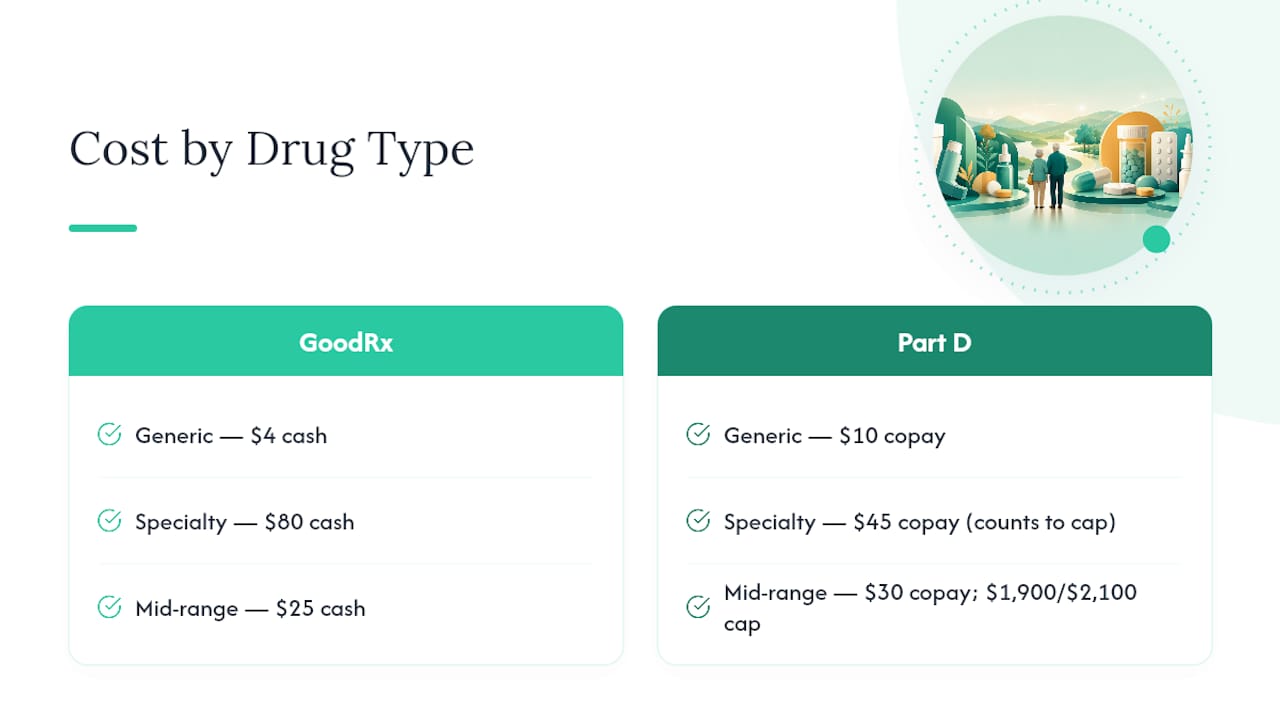
Numbers make this concrete. A common generic like a statin or a blood pressure medication might carry a $10 Part D copay at a preferred pharmacy, while GoodRx lists it for $4 at the same location. For someone who fills that one drug and stays well under the $2,100 threshold for the year, GoodRx is the clear winner: $6 saved with no meaningful downside.
Now take a specialty or brand-name drug with a $45 Part D copay after the deductible phase. GoodRx might price the same drug at $80 in cash, because Part D negotiated rates and manufacturer rebates that a discount card can’t access. Here, Part D wins outright on price, and it also moves $45 toward the $2,100 cap that could make every subsequent fill free for the rest of the year.
The trickiest case is the mid-range drug where GoodRx and the Part D copay land close together, say $25 versus $30. On price alone, GoodRx looks better by $5. But if you’re already at $1,900 toward your $2,100 threshold, paying the $30 through Part D gets you within striking distance of unlocking free covered drugs for months, an advantage the $5 GoodRx savings can’t match. The lesson holds across nearly every case: check the sticker price, but check your position relative to the cap before you decide.
A Broker’s Take on Coupons, Copays, and the 2026 Cap
The clients who save the most aren’t the ones chasing the lowest price on every fill. They’re the ones who separate recurring, expensive medications from occasional, cheap ones, and treat those two categories differently. For a maintenance drug you’ll take for years, protecting your progress toward the $2,100 threshold usually beats a small coupon win. For a short-term generic, GoodRx often wins outright with no tradeoff.
That’s why an annual formulary and benefits check matters more under the 2026 redesign than it did before. A plan that looked fine last year might not fit this year’s drug list.
— Zach
Get a Free Medicare Prescription Plan Check
Comparing a GoodRx price against your Part D copay tells you what’s cheaper today. It doesn’t tell you whether your current plan’s formulary is costing you money every month, or whether switching Part D plans during Open Enrollment could eliminate the coupon math altogether. Some independent brokers run that comparison for you, plan by plan, drug by drug, using licensed independent brokers who work across multiple carriers rather than pushing one company’s product.

Our Medicare Advantage Consultation and Plan G & Plan N Quotes service reviews your current formulary against your actual prescriptions, models how close you are to the 2026 $2,100 threshold, and flags whether a coupon strategy or a plan switch saves you more over the full year. We also handle Annual Enrollment changes and claims support if a plan isn’t covering what you expected. If you’re on Castle Pines or Colorado and want a straight answer on whether GoodRx or your Part D plan makes sense for your specific medications, start a free Medicare Planning review with a licensed broker today.
This article is general information, not a substitute for advice from a qualified financial advisor. Consult a qualified financial professional about your own circumstances before acting on anything here.
Sources
- How much does Medicare drug coverage cost? | Medicare
- Yes, You Can Use GoodRx If You Have Medicare
- Draft CY 2026 Part D Redesign Program Instructions (fact sheet) | CMS
- Are online discount websites helping Medicare beneficiaries? | Commonwealth Fund
FAQ
Can You Use GoodRx Even If You Have Medicare?
Yes. Having Medicare doesn’t disqualify you from using a GoodRx coupon for a specific prescription fill. The pharmacy simply processes either your Part D claim or the GoodRx cash price, never both at once, per Medicare’s guidance.
What’s the Catch With Using GoodRx?
The catch is that GoodRx payments don’t count toward your Part D deductible or the 2026 $2,100 covered-Part-D out-of-pocket threshold. You might save money on one fill but lose progress toward a cap that could make later fills free.
Can I Use GoodRx if I’m Over 65?
Age and Medicare enrollment don’t restrict GoodRx eligibility. Anyone, including Medicare beneficiaries, can use a GoodRx coupon at a participating pharmacy as long as they choose it instead of, not alongside, their Part D or Medicare Advantage claim.
Is GoodRx Cheaper Than Medicare Part D?
It depends entirely on the specific drug, dose, and pharmacy. Cheap generics often price lower through GoodRx, while brand-name or specialty drugs frequently cost less through Part D once manufacturer rebates and negotiated rates apply, so comparing both at the counter is the only reliable way to know.
Should I Talk to a Broker Before Choosing Between GoodRx and Part D?
If you’re managing several prescriptions or one expensive recurring medication, a Part D plan comparison with a licensed broker can show whether switching plans during Open Enrollment beats relying on coupons altogether. Simplyinsuranceforyou offers this review at no direct cost to you.