

Does Medicare Cover Hospice? Costs and Rules for 2026
Yes. Medicare Part A covers hospice for eligible beneficiaries, and most hospice services come at little to no cost once you elect the benefit. Coverage centers on comfort, not cures, so treatments aimed at fixing the terminal illness stop while symptom management, nursing, and family support take over.
- Requires a doctor’s certification that life expectancy is six months or less
- Small copays may apply for prescriptions and respite care
- Coverage continues past six months if the hospice team recertifies your eligibility
Key Takeaways
Medicare Part A pays for hospice care once a physician certifies a terminal prognosis and the patient signs the election statement, with coverage renewable indefinitely through recertification.
Point Details Coverage is nearly complete Medicare pays a daily rate to the hospice, covering nursing, equipment, drugs, and counseling with almost no direct billing. Six months is a guideline Benefit periods renew through recertification, including a required face-to-face visit starting with the third period. Costs are capped and small Expect up to $5 per symptom-control prescription and 5% coinsurance for respite care, with no hospice deductible. Room and board is the exception Facility room and board isn’t covered unless the hospice specifically arranges inpatient or respite care. Local broker support matters Simplyinsuranceforyou helps Colorado families track recertification timing, MA coordination, and appeals at no cost to the client.Table of Contents
- What Hospice Coverage Under Medicare Actually Means
- Who Qualifies for Hospice Coverage Medicare Pays For
- What Medicare Hospice Coverage Includes and Excludes
- The Four Levels of Hospice Care Medicare Pays For
- What You’ll Actually Pay Out of Pocket
- How Long Hospice Coverage Lasts and How Recertification Works
- Finding a Medicare-Approved Hospice Provider
- What the Plan of Care Covers and What Happens Next
- Why Families Often Misjudge the Hospice Timeline
- Get Help Navigating Hospice and Medicare Coverage in Colorado
- Where to Verify Hospice Coverage Rules Directly
- Sources
What Hospice Coverage Under Medicare Actually Means
Hospice under Medicare is a shift in goal, not a reduction in care. The interdisciplinary team, physicians, nurses, social workers, chaplains, and grief counselors, builds a plan around pain relief, breathing comfort, and emotional support for the patient and family.
- Physicians and nurses manage symptoms and adjust medications as needs change
- Social workers and counselors handle emotional, spiritual, and family logistics
- Care usually happens wherever the patient lives, whether that’s home, a nursing facility, or assisted living
A common myth is that electing hospice care means giving up all medical treatment. Care unrelated to the terminal diagnosis, such as treatments for other conditions or routine checkups, can still fall under regular Medicare coverage.
Pro Tip: Ask the hospice team in writing exactly which conditions they consider “related” to the terminal illness. That single conversation prevents most billing disputes down the road.
Who Qualifies for Hospice Coverage Medicare Pays For
Eligibility comes down to three things: Part A enrollment, a terminal diagnosis, and your signature on an election statement.
- Confirm Part A coverage. You need active Medicare Part A, the hospital insurance portion, to access the hospice benefit.
- Get certified. Both your regular attending physician and the hospice medical director must certify a prognosis of six months or less if the illness runs its expected course.
- Sign the election statement. This document formally selects hospice care and waives standard Medicare payment for curative treatment of the terminal illness.
- Let the hospice file the paperwork. Once you sign, the hospice submits a Notice of Election to Medicare, and coverage typically starts that same day.
Talk to your primary doctor first if symptoms are worsening and curative treatment isn’t helping. They can refer you for a hospice evaluation, which usually happens within a day or two of the request.
What Medicare Hospice Coverage Includes and Excludes
Medicare pays the hospice provider a daily rate rather than billing separately for each visit, which is why hospices must document everything under one plan of care instead of itemizing charges.
Covered under the hospice benefit:
- Physician and nursing services
- Medical equipment and supplies (wheelchairs, hospital beds, oxygen)
- Prescription drugs for pain and symptom control
- Home health aide and homemaker services
- Physical, occupational, and speech therapy for comfort purposes
- Dietary counseling
- Social work and grief counseling for the family
- Short-term inpatient care and respite care
Not covered:
- Curative treatment for the terminal illness once you’ve elected hospice
- Routine room and board in a nursing home or assisted living facility
- Care from providers not arranged through the hospice team
- Emergency room visits unrelated to the hospice plan of care
Room and board is where most families get caught off guard. If your loved one lives in a nursing facility, Medicare’s hospice benefit doesn’t cover the facility’s daily room charge unless it’s a short-term inpatient or respite stay arranged by the hospice itself.
The Four Levels of Hospice Care Medicare Pays For
CMS recognizes four distinct levels of hospice care, and knowing which one applies helps you understand both the setting and the intensity of support you’ll receive.
- Routine home care. This is the default level for most patients, delivered at home, in a nursing facility, or in assisted living. Nurses and aides visit on a scheduled basis rather than around the clock.
- Continuous home care. Reserved for crisis periods, this brings near-continuous nursing into the home to manage acute symptoms and avoid an unnecessary hospital trip.
- General inpatient care. When symptoms can’t be controlled at home, the hospice arranges admission to a hospital or inpatient facility for short-term, intensive symptom management.
- Respite care. This level of care provides short-term inpatient stays to give family caregivers a break, with maximum durations set by Medicare regulations.
Pro Tip: If a caregiver hasn’t had a break in weeks, ask the hospice directly about respite care. Many families never realize it’s built into the benefit and assume they have to arrange (and pay for) it themselves.
What You’ll Actually Pay Out of Pocket
There’s no deductible for the hospice benefit itself, and Medicare pays your hospice provider a daily rate directly. Your personal costs are limited to two specific items.
- Up to $5 per prescription for drugs used to manage pain or symptoms
- A 5% coinsurance charge for inpatient respite care, based on the Medicare-approved amount
Both of these figures come straight from Medicare’s official hospice publication, and the respite coinsurance is capped against the annual inpatient hospital deductible so it can’t spiral. Room and board costs in a facility aren’t part of this arrangement unless the hospice specifically arranged an inpatient or respite stay. If you need medication for a condition unrelated to the terminal illness, your Part D plan usually still covers it the normal way.
How Long Hospice Coverage Lasts and How Recertification Works
Hospice coverage isn’t a one-time six-month window. Medicare structures it in renewable benefit periods, so many patients receive care well beyond that initial estimate.
- First two periods run 90 days each. Your doctor and the hospice medical director must both recertify that the terminal prognosis still holds.
- After that, periods shift to 60 days, indefinitely. There’s no cap on the total number of 60-day periods as long as recertification continues.
- Starting with the third benefit period, a face-to-face visit is required. A hospice physician or nurse practitioner must personally see the patient and document the visit before recertification is approved, a rule laid out in the CMS Benefit Policy Manual.
Missing that face-to-face documentation window can interrupt payments, so hospices generally schedule these visits well ahead of the deadline.
Finding a Medicare-Approved Hospice Provider
Not every hospice agency is created equal, and confirming Medicare certification before you sign anything saves headaches later.
- Search Medicare.gov’s Care Compare tool or call 1-800-MEDICARE to confirm a provider’s certification status
- Ask whether the hospice directly arranges inpatient and respite admissions or refers you elsewhere
- Request a written list of services, along with any addendum describing items or conditions they won’t cover
Pro Tip: Ask point-blank how the hospice bills for room and board if your loved one is in a facility. Some agencies handle this smoothly with the nursing home; others leave families to sort it out mid-crisis.
What the Plan of Care Covers and What Happens Next
Once you elect hospice, the interdisciplinary team drafts a written plan of care with input from your attending physician and family. This document drives every service you receive.
- Symptom and pain management protocols tailored to the diagnosis
- Medical equipment delivery and setup
- Caregiver training so family members can safely assist at home
- Bereavement counseling for the family, often continuing for a year after death
If something isn’t covered, you can request a written addendum explaining why. If you disagree with a coverage decision, you have the right to appeal, and your local State Health Insurance Assistance Program (SHIP) counselor can walk you through that process at no cost.
Why Families Often Misjudge the Hospice Timeline
Most people treat the six-month prognosis as a hard deadline, and that misunderstanding causes real damage. Families rush decisions, avoid hospice too long, or panic when month five arrives because they think coverage simply ends. It doesn’t. The recertification process exists precisely because prognosis estimates aren’t exact science, and plenty of patients live well past that initial window while remaining fully covered.
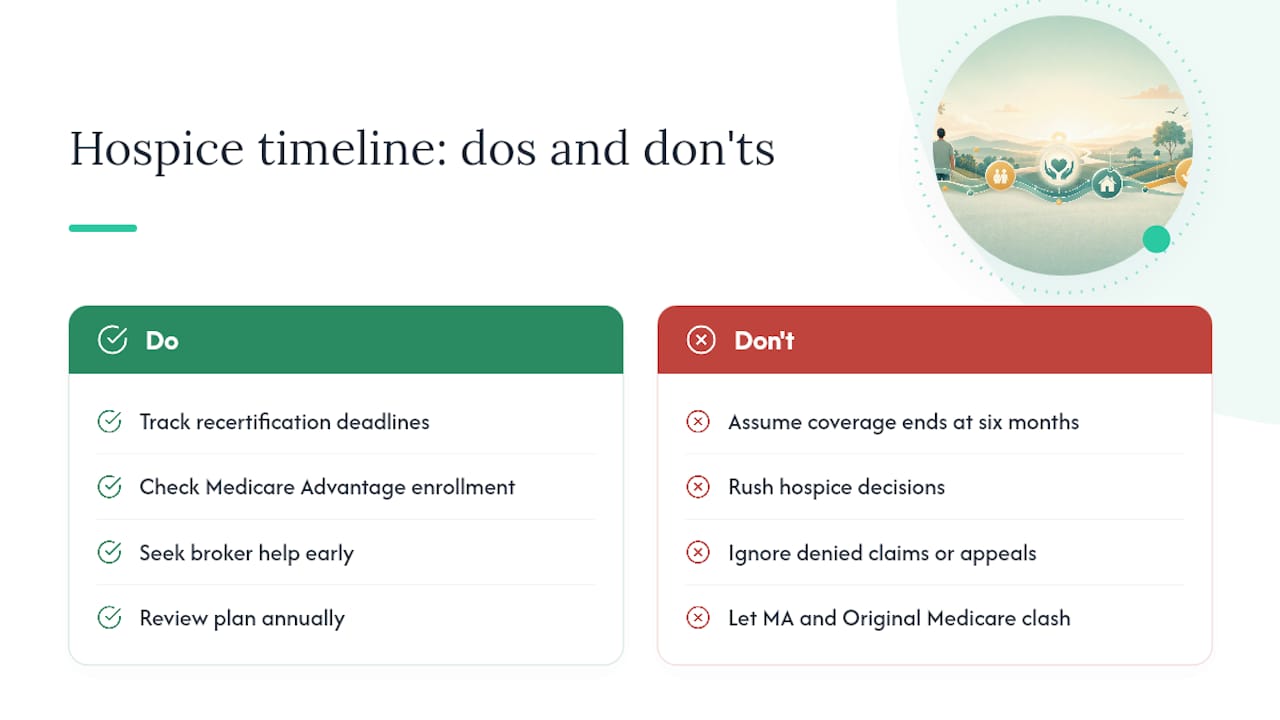
What gets underappreciated is how much coordination hospice recertification actually requires, especially once a Medicare Advantage plan is in the picture. MA enrollees keep their plan for everything unrelated to the terminal illness, but hospice itself gets billed through Original Medicare. That split trips people up constantly, and it’s exactly the kind of detail a broker catches before it becomes a billing fight. Helping families track recertification timing, sort out appeals, and keep Medicare Advantage and Original Medicare from stepping on each other is where hands-on guidance earns its keep, whether that’s checking enrollment status, walking through a denied claim, or sitting down annually to review whether a plan still fits.
Serving clients across Colorado by phone or in person, that kind of steady, local support is what turns a confusing six-month prognosis into a manageable, well-documented benefit.
— Zach
Get Help Navigating Hospice and Medicare Coverage in Colorado
Reading through benefit periods, coinsurance rules, and recertification paperwork while caring for a loved one is a lot to carry alone. Simplyinsuranceforyou gives Colorado families something a call center can’t: a licensed local broker who actually reviews your specific Medicare Advantage or Original Medicare setup and tells you what changes once hospice starts.

A free consultation covers the details that matter most: how hospice election interacts with your current plan, when recertification documentation is due, and what to do if a claim gets denied. Start with the Medicare Guide for a full breakdown of how Part A, B, C, and D work together, or reach out through Medicare Help serving all of Colorado to schedule time with a broker who already knows the local hospice landscape. Book your consultation today and get answers before the next recertification deadline sneaks up on you.
Where to Verify Hospice Coverage Rules Directly
- Medicare covers eligibility, election statements, and provider search
- CMS hospice payment guidance explains the four levels of care and per-diem billing
- The Medicare hospice getting-started booklet breaks down costs and copays in plain language
- Call 1-800-MEDICARE or your state’s SHIP office for personalized help with appeals or provider disputes
This article is general information, not a substitute for advice from a qualified doctor. Consult a qualified healthcare professional about your own circumstances before acting on anything here.