
Publication time reported by BabyLoveGrowth, shown in Mountain time. This is not an independently measured first appearance on this website.

Turning 65? 5 Questions Before Choosing Independent or Captive Agent
A captive agent represents one insurer and works best when you want a brand-backed, integrated experience with a single company you already trust. An independent agent represents multiple carriers and works best when you want price comparison and someone who can move your policy at renewal if your needs change. For Medicare and health coverage especially, most people benefit from starting with an independent agent, since your health and budget rarely stay fixed for a decade.
TL;DR:
- Independent agents typically offer a wider range of carriers, making them better suited for complex health plans and changing needs over time.
- Captive agents focus on their company’s products, providing faster quotes and deep knowledge of a single carrier’s policies, but they can’t offer better options elsewhere.
- Choosing an agent involves verifying their carrier list, asking about compensation, and comparing quotes from multiple sources to ensure a good fit and transparency.
- Most personal insurance policies are paid through carrier commissions, with little or no direct fee to the consumer, but broker fees may apply for complex commercial arrangements.
- An independent brokerage offers ongoing support, annual reviews, and policy adjustments, which are especially valuable during Medicare and health coverage transitions.
Table of Contents
- Independent vs Captive Agent: How Each One Actually Works
- Weighing the Pros and Cons of Each Agent Type
- How to Choose the Right Agent for Your Situation
- What an Independent Brokerage Actually Delivers Day to Day
- Get Independent Medicare Guidance With No Direct Fee
- Sources
Independent vs Captive Agent: How Each One Actually Works
The core difference comes down to who the agent answers to. A captive insurance agent is under contract with one carrier group, full stop. Everything they sell, quote, and service runs through that one company’s systems, pricing, and underwriting rules. An independent agent holds appointments with multiple carriers and can shop your situation across all of them at once.
That structural difference shows up fast once you start comparing quotes. A captive agent can usually bind coverage in minutes because they’re working inside one carrier’s integrated platform. There’s no back-and-forth between systems. An independent agent takes a bit longer up front because they’re pulling quotes from several carriers, but that extra step is exactly what lets them find a better rate or a plan design that actually fits your situation instead of the one option on the shelf.
Coverage breadth splits the two models too. Captive agents tend to go deep on their carrier’s specific products because that’s all they sell. They know the fine print of that one company’s policies cold. Independent agents go wide instead of deep. That breadth matters most on lines where personal fit varies a lot, like Medicare Advantage or supplement plans, where the “best” carrier depends entirely on your doctors, prescriptions, and zip code.
It also helps to know the difference between an agent and a broker. Agents represent the insurance company and have authority to bind coverage on the carrier’s behalf. Brokers represent you, the client, and in some states carry a fiduciary duty to act in your interest. In practice, this distinction matters most for complex commercial accounts. For routine health, Medicare, or auto coverage, most people use the terms interchangeably, and the practical experience often comes down more to independent versus captive than agent versus broker.
The customer journey looks different too. With a captive setup, you typically go straight to that company’s website or call center, and an agent picks up from there inside one ecosystem. With an independent agent, you’re more likely to research online first, then bring your questions to a human who compares several carriers side by side. That hybrid pattern, research online then talk to a person at the decision point, is becoming the norm rather than the exception, and it favors independent agents who can act on what you found.
Market share reflects that shift already. Independent channels place roughly 62% of property and casualty premiums and about 88% of commercial lines, with captive and direct channels holding most of the remaining personal-lines business. In plain terms, independents dominate the complicated stuff, while captives still hold a strong footing in simple, single-product personal insurance.
- Captive agents: one carrier, deep product knowledge, fast binding
- Independent agents: multiple carriers, broader comparison, slower initial quote but more flexibility later
- Agents bind coverage on behalf of the insurer; brokers work on behalf of the client
- Independent channels handle the bulk of commercial and complex personal-lines business
Weighing the Pros and Cons of Each Agent Type
Neither model is universally better. What matters is which set of tradeoffs fits your situation, particularly if you’re comparing health plans or approaching Medicare eligibility.
- Independent agent, upside. You get real choice across carriers, someone who can re-market your policy at renewal if your premium jumps or your health needs shift, and a person in your corner during claims disputes rather than a claims rep who works for the carrier. For anyone turning 65 or navigating changing health needs, that renewal flexibility is often the deciding factor, since your ideal Medicare Advantage carrier this year may not be the best fit in three years.
- Independent agent, downside. Not every independent agent carries the same carrier roster, so “independent” doesn’t automatically mean access to every company you might want. Some also take longer to get you a first quote since they’re pulling from multiple systems instead of one.
- Captive agent, upside. You get a consistent brand experience, tools built specifically around that carrier’s products, and often loyalty discounts for bundling multiple policies with the same company. Their product training tends to run deep because they only need to master one company’s offerings.
- Captive agent, downside. If your best fit happens to be with a different carrier, a captive agent structurally can’t offer it. That’s not a knock on their skill. It’s just the limit of the model.
- Compensation, both models. Standard retail transactions rarely come with a direct fee to you either way. Both independent and captive agents are typically paid through commissions from the carrier, not a bill sent to your inbox. Brokers sometimes charge fees on complex commercial deals, but that’s the exception, not the rule for personal health or Medicare coverage.
How to Choose the Right Agent for Your Situation
Picking an agent isn’t about trusting a logo. It’s about asking a few pointed questions and paying attention to how directly they answer.
Start with carrier access. Ask exactly which companies they can quote for the coverage you need, and ask to see their actual carrier list and appointments rather than taking “we’re independent” at face value. Anyone can claim independence. A real carrier list proves it.
From there, run through a short list before you commit:
- Confirm their state license and how long they’ve held appointments with each carrier they mention.
- Ask how they’re compensated, and expect a straight answer, not a dodge.
- Ask what happens if you need help filing a claim, not just buying the policy.
- Ask how often they proactively review your coverage, versus waiting for you to call.
- Get quotes from at least two sources for the same coverage so you’re comparing apples to apples.
Watch for red flags along the way. An agent who can’t produce a clear carrier list, gets vague when you ask about compensation, or takes days to return a simple question is telling you something about the service you’ll get after you sign. Before your first conversation, pull your current policy documents together so an agent can compare your actual coverage instead of guessing.
Pro Tip: Book your annual review before open enrollment starts, not during it. Agents get slammed in the fall, and a rushed five-minute call is a poor substitute for someone actually looking at whether your plan still fits.
What an Independent Brokerage Actually Delivers Day to Day
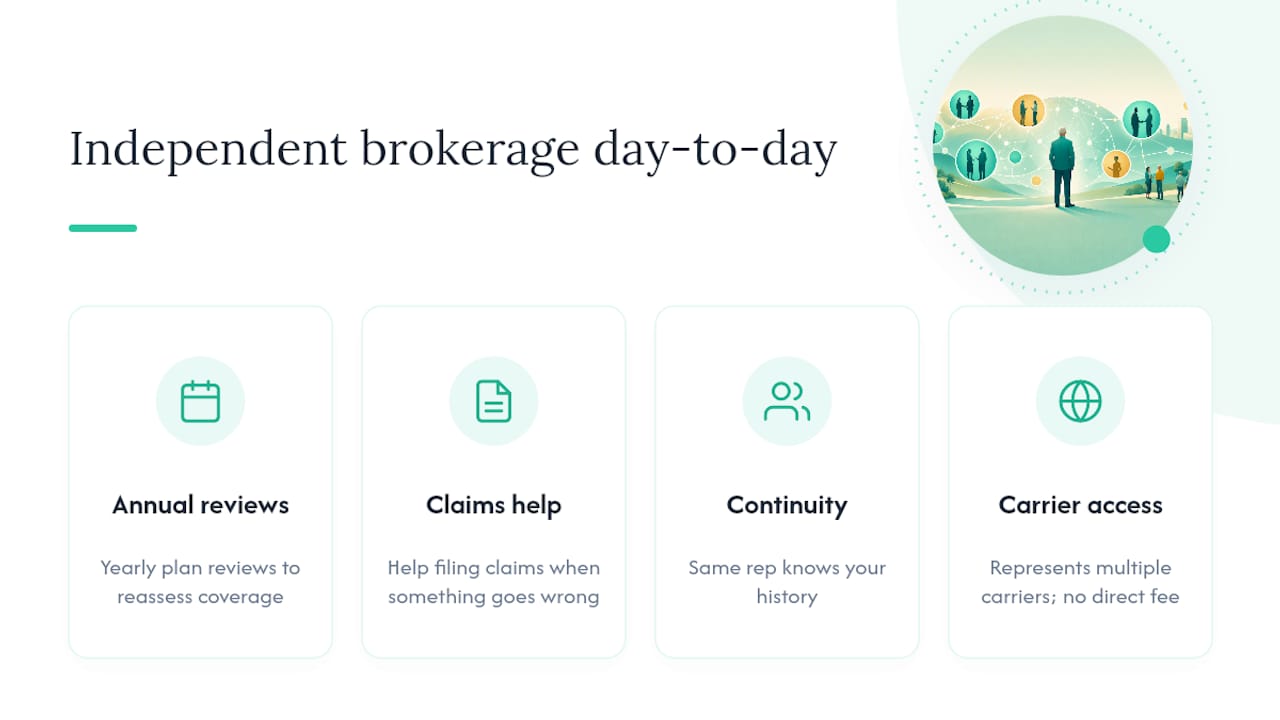
Simplyinsuranceforyou operates as an independent brokerage, which means representing multiple carriers rather than one, with no direct fee to you for standard Medicare or health plan enrollment. The value shows up less at signup and more a year later, when your prescriptions change or a carrier drops a doctor from its network.
Ongoing support looks like annual plan reviews, help filing claims when something goes wrong, and a person who already knows your history when you call instead of a new rep each time. Continuity like this tends to matter most during Medicare and health transitions, where the right plan one year isn’t guaranteed to be right the next. Ask any brokerage for its carrier list, references, and a walkthrough of what an annual review actually covers before you commit.
— Zach
Get Independent Medicare Guidance With No Direct Fee
If you’re turning 65, sorting through a Medicare Advantage renewal, or just tired of a captive agent who can only offer you one company’s answer, an independent brokerage solves the exact problem this article laid out: real carrier comparison instead of a single option.

Simplyinsuranceforyou works with multiple carriers across Colorado and doesn’t charge a direct fee for standard Medicare enrollment. A first meeting typically covers a side-by-side comparison of plans available in your area, help walking through the enrollment paperwork, and a plan for checking back in before your coverage needs shift again. If you want to see how that comparison looks for your specific situation, visit the Medicare guide to get started, or check the full carrier list first if you’d rather see the options before you talk to anyone.
This article is general information, not a substitute for advice from a qualified financial advisor. Consult a qualified financial professional about your own circumstances before acting on anything here.