
Publication time reported by BabyLoveGrowth, shown in Mountain time. This is not an independently measured first appearance on this website.

12 Months to 65: Medicare Enrollment Checklist and Broker Timing
Sign up for Medicare during your Initial Enrollment Period, or confirm you’re already covered through automatic enrollment. Before you do anything else, gather your Social Security number, proof of age, current insurance details, and a list of your medications and providers. Then contact Social Security or check Medicare to confirm your status and compare plans.
SimplyinsuranceforyouGet Clear on Your Medicare OptionsSimply Insurance provides personalized guidance from licensed brokers, with ongoing support through enrollment, claims, and annual reviews.Visit Simply InsuranceTL;DR:
- Enrollment during the initial window begins three months before your 65th birthday, but missing it can lead to penalties and delays in coverage start dates.
- Automatic enrollment occurs for those already receiving Social Security benefits, but applying online or in person requires having your personal documents ready.
- Comparing Original Medicare, Medicare Advantage, Medigap, and Part D plans is critical, with timing and plan details like formulary and provider networks influencing cost and coverage.
- Post-enrollment, it’s essential to confirm your cards, coordinate coverage with providers, and keep records to avoid overlapping insurance costs or missed benefits.
- Working with licensed brokers can help navigate complex situations, prevent costly mistakes, and tailor plan options to your specific medications, providers, and circumstances.
Table of Contents
- Your Medicare Enrollment Checklist Timeline, Month by Month
- What Are Medicare’s Enrollment Periods, and Which One Applies to You?
- How Do You Actually Sign Up for Medicare?
- Original Medicare, Medicare Advantage, Part D, or Medigap: How Do You Choose?
- What Should You Do Right After Your Coverage Starts?
- When Does It Actually Make Sense to Use a Broker?
- Get Hands-On Help Finishing Your Medicare Checklist
- Why Working With a Broker Beats Guessing Alone
- Sources
- FAQ
Your Medicare Enrollment Checklist Timeline, Month by Month
Most of the stress around Medicare comes from doing everything at once, three weeks before a deadline. Spread the work out and it stops feeling like a scramble.
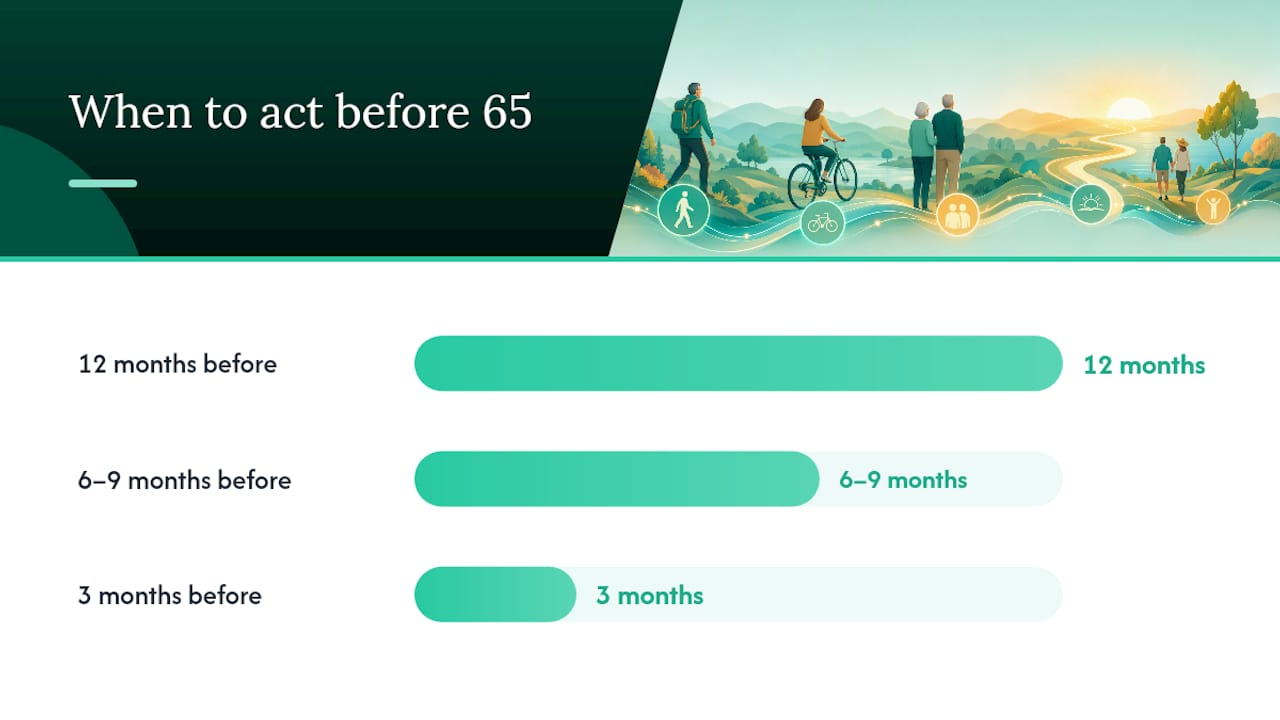
12 months before your 65th birthday:
- Learn the basic structure: Part A (hospital), Part B (medical), Part C (Medicare Advantage), and Part D (drug coverage).
- Write down every medication you take, the dosage, and which pharmacy fills it.
- List your current doctors and specialists, including anyone you’d hate to lose access to.
- If you’re still working, ask your HR department whether your group health plan counts as creditable coverage. This single question determines whether you can delay Part B without a penalty.
6 to 9 months before:
- Estimate what Original Medicare versus Medicare Advantage might cost you based on your actual prescriptions and providers.
- Note when your personal Medigap open enrollment window will open, since it’s tied to your Part B start date, not your birthday.
3 months before:
- Check whether you’re already receiving Social Security or Railroad Retirement benefits. If so, you’ll likely be auto-enrolled and don’t need to apply.
- If you’re not automatically enrolled, plan to apply online or by phone once your Initial Enrollment Period opens.
During your IEP: Complete your Part A and Part B enrollment, then decide on Part D, Medigap, or a Medicare Advantage plan.
Right after enrolling: Save every confirmation number, watch the mail for your card, and give your new plan information to each provider’s office.
Pro Tip: Set a phone reminder for the first day of your Initial Enrollment Period, not just your birthday. The clock actually starts three months earlier, and missing that head start is the most common reason people scramble later.
What Are Medicare’s Enrollment Periods, and Which One Applies to You?
Your Initial Enrollment Period (IEP) is a window that starts three months before the month you turn 65, includes your birthday month, and runs three months after that, according to CMS’s official enrollment guidance. Sign up in the early months of the Initial Enrollment Period and coverage typically starts the month you turn 65. Wait until after your birthday month, and your start date gets pushed back.
Special Enrollment Periods (SEPs) let you enroll outside the IEP without penalty, but only under specific conditions:
- You or your spouse are actively working and covered by a qualifying group health plan.
- You’ve moved out of your plan’s service area.
- You’ve lost Medicaid or other qualifying coverage.
COBRA and retiree health plans do not qualify you for a Special Enrollment Period, a distinction that trips up more people than almost anything else in the enrollment process. Miss both your IEP and any SEP, and you’re stuck waiting for the General Enrollment Period (January 1 to March 31), with coverage typically starting July 1.
Skip enrollment entirely without a qualifying SEP and you risk a permanent late-enrollment penalty added to your Part B premium for as long as you carry the coverage. For a deeper breakdown of how these windows interact, see Medicare’s enrollment periods explained.
How Do You Actually Sign Up for Medicare?
If you’re already collecting Social Security or Railroad Retirement benefits, Medicare typically enrolls you automatically. Watch your mailbox for a welcome package roughly three months before you turn 65. No package by then? Don’t wait around.
- Apply online at ssa.gov, which is usually the fastest route.
- Call Social Security directly at 1-800-772-1213.
- Visit a local Social Security office in person.
- Railroad employees should contact the Railroad Retirement Board instead of Social Security.
Before you start any of these, have this on hand:
- Your Social Security number
- Proof of age (birth certificate or passport)
- Proof of citizenship or lawful presence, if it wasn’t already verified for Social Security
- Details on any current employer or retiree insurance
- Your medication list with dosages and pharmacy information
Pro Tip: Photograph or scan every document before you submit it, and write down your confirmation number the moment you finish applying. If anything gets lost in processing, you’ll have proof you completed the medicare application process on time.
Original Medicare, Medicare Advantage, Part D, or Medigap: How Do You Choose?
This is where your document list actually pays off. Original Medicare gives you access to almost any doctor or hospital that accepts Medicare nationwide. Medicare Advantage plans often restrict you to a network, but can bundle in extra benefits that Original Medicare doesn’t cover, like dental or vision. Medigap exists specifically to fill the out-of-pocket gaps Original Medicare leaves open.
Run your medication list and provider list against each plan option using Medicare’s Plan Finder tool. Small formulary differences between two similar-looking plans can mean hundreds of dollars a year in prescription costs.
What to check Why it matters Drug formulary match Confirms your prescriptions are covered at a reasonable tier Provider network inclusion Confirms your current doctors accept the plan Premiums vs. out-of-pocket limits Balances monthly cost against worst-case exposure Star ratings and prior authorization rules Signals plan quality and how much red tape you’ll faceTiming matters more than most people realize here. Your Medigap open enrollment period begins the month you turn 65 and have Part B active, and it lasts several months. During that window, insurers generally can’t deny you coverage for preexisting conditions. Miss it, and you may face medical underwriting later. If you want to revisit your choice down the road, the Annual Enrollment Period (October 15 to December 7) and the Medicare Advantage Open Enrollment Period (January 1 to March 31) both let you make changes, though effective dates differ between the two.
What Should You Do Right After Your Coverage Starts?
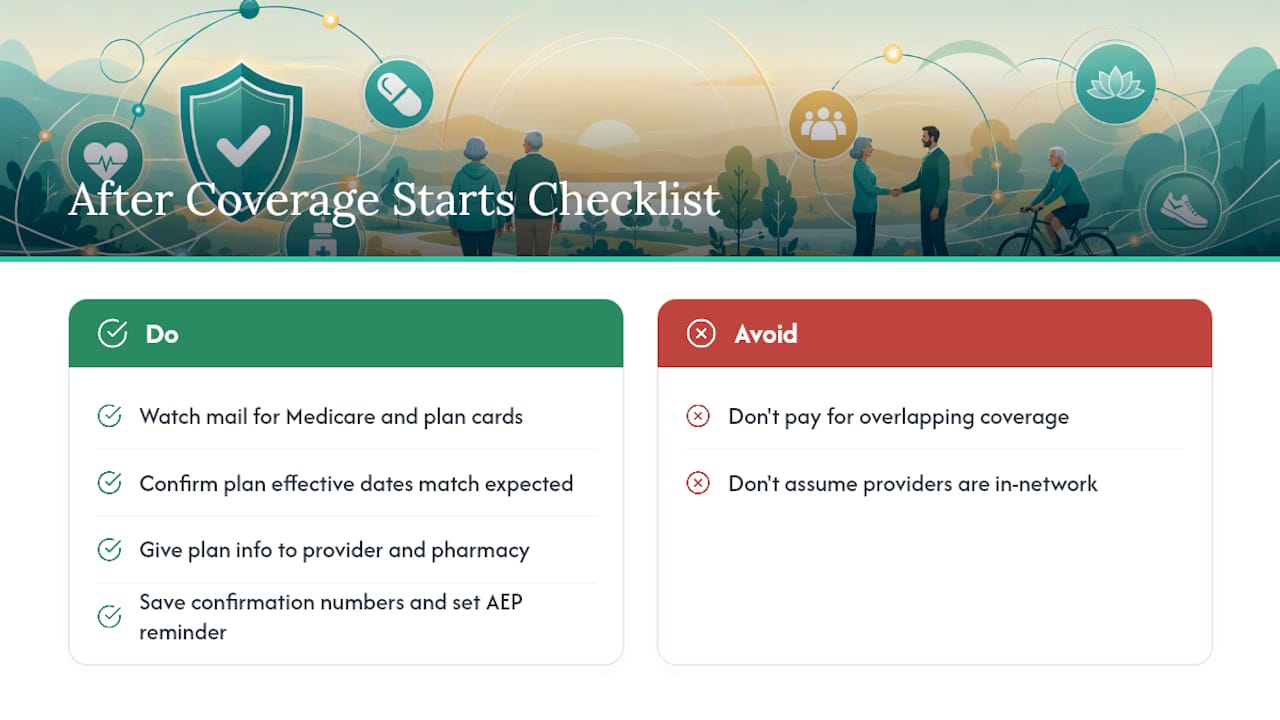
Watch the mail for your Medicare card and any new plan ID card, and confirm the effective dates match what you expected. Give your provider’s office and your pharmacy your new plan information right away, and double check they’re actually in-network before your first appointment. If you had Marketplace or employer coverage running alongside your new Medicare plan, cancel or coordinate it so you’re not paying for overlapping coverage. Save every confirmation number from the enrollment process, and set a calendar reminder for next year’s Annual Enrollment Period.
When Does It Actually Make Sense to Use a Broker?
A Plan Finder search works fine for straightforward cases. But once your situation involves several moving parts at once, working past 65 while your spouse doesn’t have coverage, five prescriptions from three different pharmacies, specialists in two states, the math gets complicated fast, and a wrong plan choice locked in for a year can cost real money. Some insurance brokers work with Colorado residents on exactly these situations: enrollment help, Medigap and Part D comparisons, annual plan reviews, and claims support once you’re already enrolled.
Get Hands-On Help Finishing Your Medicare Checklist
There are licensed, independent brokers who compare plans across multiple carriers for Colorado residents, often at no cost, and offer ongoing support including annual reviews and claims help long after enrollment day.

Bring the same checklist items you gathered here, your medication list, provider names, and current insurance details, to a consultation, and a licensed broker will walk through your options for Medicare Advantage, Medigap, and Part D side by side. That includes help with Plan G and Plan N quotes, Social Security timing questions through RSSA planning, and support if you ever need to file an appeal or grievance down the line. If you’re turning 65 soon, start with the Medicare Planning page to schedule a consultation before your Initial Enrollment Period closes.
Why Working With a Broker Beats Guessing Alone
Timing mistakes are the ones people regret most. A rushed decision made during a seven-month window that felt “far away” until it wasn’t. What actually helps isn’t more information. It’s someone who’s compared thousands of formularies against thousands of provider networks asking the two or three questions you didn’t know to ask, like whether your specific insulin is covered at the tier you assumed, or whether your cardiologist actually takes the plan you’re eyeing. Experienced brokers often see this pattern: people who did their homework but still missed a detail that mattered because Plan Finder can’t ask follow-up questions the way a person can. The checklist gets you 80 percent of the way there. A conversation with someone who does this daily tends to close the other 20, and that’s usually where the actual savings live.
— Zach
This article is general information, not a substitute for advice from a qualified doctor. Consult a qualified healthcare professional about your own circumstances before acting on anything here.
Sources
- Sign up for Medicare (Social Security Administration)
- Medicare
- Checklist: Medicare Initial Enrollment (Triage Cancer)
FAQ
When Should I Start My Medicare Enrollment Checklist?
Start gathering documents and comparing plan types about 12 months before you turn 65, even though your actual Initial Enrollment Period doesn’t open until three months before your birthday month. Starting early gives you time to check employer coverage rules and estimate costs without rushing.
What Documents Do I Need to Apply for Medicare?
You’ll need your Social Security number, proof of age like a birth certificate or passport, proof of citizenship or lawful presence, and details on any current insurance. Bringing a medication list with dosages and pharmacy information also speeds up plan comparisons.
What Happens if I Miss My Initial Enrollment Period?
Without a qualifying Special Enrollment Period, you’ll have to wait for the General Enrollment Period between January 1 and March 31, with coverage usually starting July 1. You may also face a permanent late-enrollment penalty added to your Part B premium.
Can I Delay Medicare if I’m Still Working at 65?
Yes, if you have qualifying group health coverage through an employer, you can often delay Part B without penalty and enroll later through a Special Enrollment Period. COBRA and retiree coverage do not count as qualifying employer coverage for this purpose.
Does Simplyinsuranceforyou Charge for Medicare Enrollment Help?
Simplyinsuranceforyou’s Medicare planning consultations don’t carry a published price on their site, and current pricing details are available directly through their services page. As an independent brokerage, they’re typically compensated by carriers when you enroll, not by charging you directly.