
Publication time reported by BabyLoveGrowth, shown in Mountain time. This is not an independently measured first appearance on this website.

$500–$2,500 Allowances: Medicare Hearing Aid Coverage for U.S. Seniors (2026)
Original Medicare will not pay a dime toward hearing aids or the exams to fit them. That is the short answer, and it hasn’t changed for 2026. Your next moves: check whether your visit qualifies as a diagnostic exam under Part B, review a Medicare Advantage plan’s hearing benefit if you have one, and look into the VA or an HSA if Original Medicare leaves you exposed.
SimplyinsuranceforyouCompare Medicare Hearing BenefitsSimply Insurance provides personalized, independent guidance on Medicare and health coverage options, with support during enrollment and future claims.Explore your coverage optionsTL;DR:
- Medicare does not pay for hearing aids or fitting exams except when the exam is ordered to diagnose a medical condition, with potential 20% coverage.
- Most Medicare Advantage plans offer some hearing benefit, with allowances ranging from about $500 to over $2,500 per ear or pair, depending on the plan.
- Cochlear implants and bone-anchored hearing aids are considered surgically implanted devices, with costs depending on the surgical setting and coverage rules.
- Without coverage, the out-of-pocket cost for hearing aids can reach thousands of dollars, and Medigap policies do not cover these because Original Medicare does not pay for them.
- Checking coverage and billing practices beforehand, and exploring VA benefits or HSA/FSA funds, can help beneficiaries avoid surprise bills and find better financial options.
Table of Contents
- What Does Medicare Cover for Hearing Loss?
- How Do Medicare Advantage Plans Cover Hearing Aids?
- Are Cochlear Implants Covered Differently Than Hearing Aids?
- What Will Hearing Aids Actually Cost You Without Coverage?
- How Do You Check Your Own Coverage and Avoid Surprise Bills?
- Will New Legislation Change Medicare Hearing Aid Coverage?
- A Local Broker’s Take on Hearing Benefits
- Get Help Comparing Plans With Real Hearing Benefits
- Sources
What Does Medicare Cover for Hearing Loss?
The exclusion isn’t a policy quirk. It’s written into federal law. Section 1862(a)(7) of the Social Security Act explicitly bars Medicare from paying for hearing aids or the exams used to fit them, and Medicare.gov lists both as “not covered,” full stop.
But that’s not the whole story. Part B does pay for diagnostic hearing and balance exams when a doctor orders one to investigate a specific medical problem, like sudden hearing loss, dizziness, or a suspected inner ear disorder. In that scenario, you’ll typically pay 20% of the Medicare-approved amount after your Part B deductible.
Here’s where people get tripped up: the same test can be billed two completely different ways.
- Covered scenario: Your doctor orders a hearing exam to diagnose a medical condition.
- Non-covered scenario: You visit an audiologist specifically to select or fit a hearing aid.
The UCSF EARS Program notes that coverage often comes down to the documented purpose of the visit, not the test itself. Some clinics bundle a diagnostic exam with device fitting into one bill, which can quietly erase your Part B coverage. Ask for separate line items before you agree to anything.
There’s no partial benefit, no annual allowance, and no exception for severity of hearing loss.
How Do Medicare Advantage Plans Cover Hearing Aids?
Medicare Advantage is where most beneficiaries actually get help paying for hearing aids. Most Advantage plans in 2026 include some kind of hearing benefit, though the details swing wildly from plan to plan.
Typical structures include:
- A fixed dollar allowance per ear or per pair, refreshed annually or every two years
- A flat copay for specific hearing aid tiers (basic, mid-range, premium)
- A requirement to use an in-network audiologist or a specific hearing aid supplier
Allowances commonly run from roughly $500 to $2,500 or more per ear or per pair, depending on the carrier and network. That’s a wide range, and the number on a brochure isn’t always the number you’ll actually get, since network restrictions and approved brand lists can limit your real-world choices even when the allowance looks generous.
Your Evidence of Coverage document spells out the exact terms. Look for a section labeled “hearing services” or “hearing aids,” and pay attention to whether it says “in-network only,” what the annual or biennial limit is, and whether a hearing exam is required before the allowance kicks in.
Pro Tip: Call your plan’s member services line and ask them to read you the exact hearing aid benefit language from your Evidence of Coverage. Brochures simplify. The actual policy document doesn’t.
Are Cochlear Implants Covered Differently Than Hearing Aids?
Cochlear implants and bone-anchored hearing aids (BAHA) get treated as surgically implanted prosthetic devices, not as hearing aids. That classification matters enormously, because Medicare covers implanted prosthetics under Part A or Part B depending on where the surgery happens, as long as you meet clinical criteria for severe to profound hearing loss that hearing aids can’t adequately address.
Expect standard cost-sharing to apply:
- Part A deductible and coinsurance if the procedure happens in a hospital inpatient setting
- Part B deductible plus 20% coinsurance if it’s done outpatient
Medicare also applies “reasonable useful life” rules to implant processors, commonly cited around five years, which affects when you’re eligible for a covered replacement versus paying out of pocket for an early upgrade.
What Will Hearing Aids Actually Cost You Without Coverage?
If your plan doesn’t offer a hearing benefit, expect real out-of-pocket numbers, not small ones. Hearing aids purchased outside any coverage typically run into the thousands per pair once you add exams, fittings, and follow-up adjustments.
A Medigap policy won’t rescue you here. Medigap only pays cost-sharing on services Original Medicare already covers. Since Original Medicare pays nothing toward hearing aids, Medigap has nothing to supplement. It’s a common and understandable point of confusion, but it’s a dead end.
Three paths actually help:
- HSA/FSA/HRA funds: IRS Publication 502 confirms hearing aids, batteries, and hearing exams qualify as eligible medical expenses.
- VA benefits: Enrolled veterans often receive hearing aids and related care at no cost through VA audiology services.
- State Medicaid: Dual-eligible beneficiaries should check their state’s Medicaid hearing benefit, since rules vary significantly by state.
How Do You Check Your Own Coverage and Avoid Surprise Bills?
Don’t wait for a bill to find out what’s covered. Work through this before you book an appointment.
- Pull up your plan’s Evidence of Coverage (Advantage members) and search for “hearing” to see the exact allowance and network rules.
- Call the clinic before your visit and ask whether the appointment will be billed as a diagnostic exam or a hearing aid fitting service.
- Request a physician order for the exam if you have a medical symptom like dizziness, sudden hearing changes, or ear pain, since that increases the odds Part B pays its share.
- Ask for itemized, separate billing for diagnostic and device-related services rather than one bundled charge.
- If a claim gets denied that you believe should have been covered, file an appeal with your plan and keep copies of the physician order and itemized bill.
Pro Tip: Save every itemized receipt and physician order in one folder the moment you schedule a hearing related visit. If you need to appeal a denial later, that paperwork is what wins the case.
If you get stuck decoding a denial letter or an Evidence of Coverage, a broker who handles Medicare appeals and grievances can walk through the specific plan language with you.
Will New Legislation Change Medicare Hearing Aid Coverage?
There’s real movement in Congress, though nothing has become law yet. H.R. 500, the Medicare Hearing Aid Coverage Act, would remove the statutory exclusion entirely and require Medicare to cover hearing aids and related exams for eligible beneficiaries.
You can read the full bill text and track its status directly on Congress.gov.
- The bill targets the exact exclusion under Section 1862(a)(7) that currently blocks coverage.
- Even if it passes, CMS would still need to write implementation rules, which takes time.
- Passage wouldn’t retroactively cover past purchases, and Medicare Advantage benefit details would likely still vary by plan during any transition.
Given that timeline, lean on Medicare Advantage, VA benefits, or HSA/FSA funds now rather than waiting on Congress.
A Local Broker’s Take on Hearing Benefits
Most people don’t find out their plan’s hearing benefit is thin until they’re standing in an audiologist’s office with a bill in hand. That’s the moment we try to prevent. When we run a benefits review for a client in Castle Pines or anywhere else in Colorado, hearing coverage is one of the first things we check, because it’s one of the most commonly misunderstood parts of a plan. If your current plan’s hearing allowance doesn’t match your actual needs, that’s worth catching during an annual review, not after a purchase.
— Zach
Get Help Comparing Plans With Real Hearing Benefits
An independent brokerage serving Castle Pines and communities across Colorado can compare hearing benefits, allowances, and network rules across multiple carriers instead of pushing one company’s product.

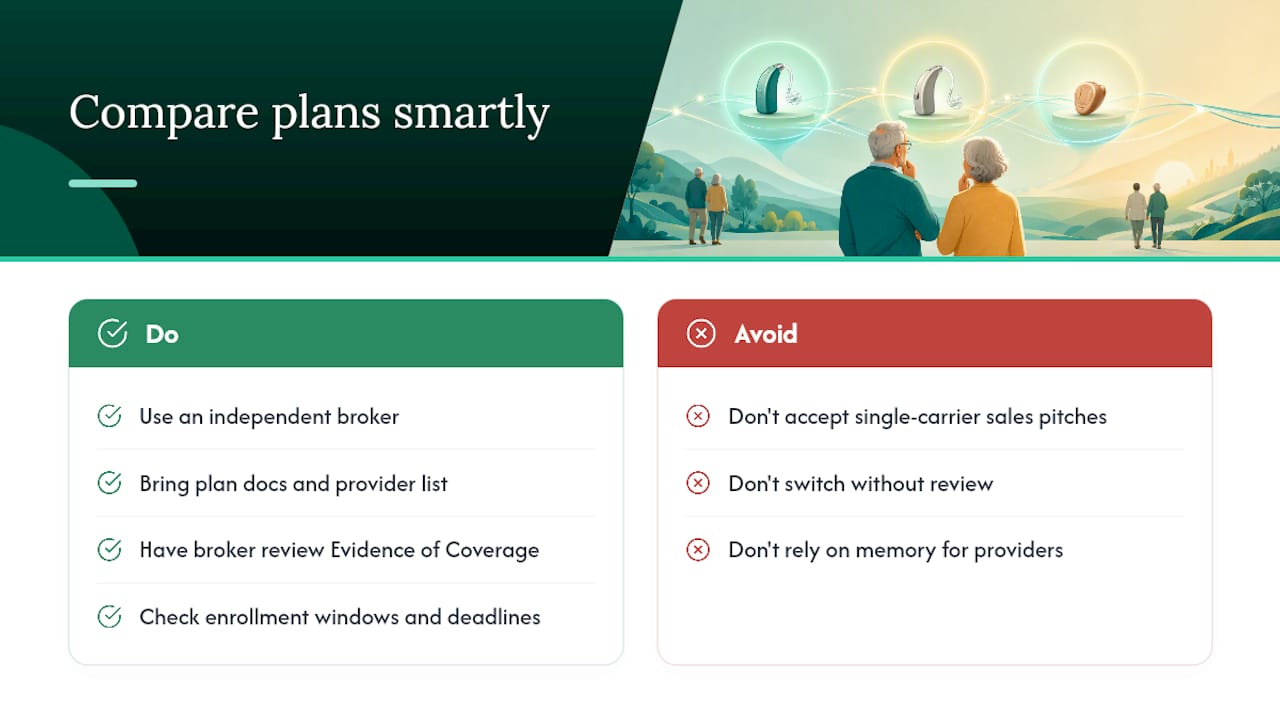
If you’re turning 65, switching plans during an enrollment window, or just found out your current Advantage plan’s hearing allowance won’t cover what you need, a licensed broker can help by reviewing your Evidence of Coverage in detail, flagging any hearing benefit limitations, and comparing it against other carriers available in your area. For a broader look at Medicare enrollment windows and deadlines, this enrollment timeline guide is a useful reference before you make a switch.
Bring your current plan documents and a list of the providers you want to keep, and we’ll build the comparison from there. Visit our Medicare guide to schedule a consultation and get a straight answer about what your options actually cover.
This article is general information, not a substitute for advice from a qualified doctor. Consult a qualified healthcare professional about your own circumstances before acting on anything here.
Sources
- Medicare
- Medicare hearing coverage — UCSF EARS Program
- Congress
- Does Medicare Cover Hearing Aids? 2026 Guide — National Hearing Institute