

Medicare IRMAA 2026: Income Brackets, Surcharges, and Appeals
If your 2024 income was above $109,000 (single) or $218,000 (married filing jointly), you’ll pay more than the standard Medicare premium in 2026. The standard Part B premium is $202.90 a month, but IRMAA adds a surcharge on top of that, ranging from $81.20 to $487.00 a month for Part B and $14.50 to $91.00 a month for Part D according to Medicare official figures. Medicare and the Social Security Administration calculate your 2026 tier using your 2024 tax return, the standard two-year lookback.
Here’s what that means in practice:
- Under the threshold: You pay only the standard $202.90 Part B premium, plus your Part D plan’s regular cost.
- Above the threshold: You owe a Part B surcharge and, if you have Part D, a Part D surcharge, both scaled to five income tiers.
- Recently lost income? Form SSA-44 lets you ask Social Security to use more recent numbers instead of 2024’s.
Quick math: the gap between the lowest and highest Part B IRMAA tier is over $400 a month, or roughly $4,872 a year, just for one spouse. That’s the range this article walks through, tier by tier.
Key Takeaways
IRMAA in 2026 adds a surcharge to Part B and Part D premiums, with amounts varying according to income as determined from your 2024 tax return, following official Medicare guidelines.
Point Details Check your 2024 MAGI Compare it against the $109,000 (single) or $218,000 (joint) threshold to see if IRMAA applies. Review your SSA notice closely IRMAA determinations arrive separately from standard enrollment paperwork and are easy to overlook. File SSA-44 if eligible A qualifying life-changing event, like retirement or divorce, can reset your bracket using more current income. Watch for MAGI surprises Municipal bond interest, Roth conversions, and one-time capital gains all count toward your IRMAA tier. Talk to Simplyinsuranceforyou Their brokers model MAGI scenarios, assist with SSA-44 filings, and compare plans at no direct cost to you.Where to Verify Official 2026 IRMAA Numbers
- CMS 2026 fact sheet: official Part B premium, deductible, and IRMAA tier figures.
- SSA Form SSA-44: download the appeal form and instructions directly.
- Your Medicare account: check your own billing statements and payment history.
This article is general information, not a substitute for advice from a qualified financial advisor. Consult a qualified financial professional about your own circumstances before acting on anything here.
Table of Contents
- What Are the 2026 IRMAA Brackets for Part B and Part D?
- What Counts as MAGI for IRMAA Purposes?
- How Does IRMAA Billing Actually Work?
- How Do You Appeal an IRMAA Determination With Form SSA-44?
- What Planning Strategies Help Manage IRMAA Exposure?
- What Mistakes Do People Make With IRMAA, and How Does a Broker Help?
- How Simply Insurance Helps You Manage IRMAA Costs in Colorado
- Sources
What Are the 2026 IRMAA Brackets for Part B and Part D?
Five income tiers determine how much extra you’ll pay above the standard Part B premium, and the jump between tiers isn’t gradual. It’s a cliff. Cross a threshold by even a dollar and you owe the entire higher surcharge for that tier, not a prorated amount.
For single filers, based on 2024 MAGI:
- No IRMAA if income is at or below the lowest threshold.
- IRMAA surcharges increase progressively with income tiers, with specific surcharge ranges according to official 2026 Medicare data.
Exact surcharge amounts per tier are available on official Medicare resources.
For married couples filing jointly, each threshold roughly doubles, but the surcharge amounts per person stay the same as the single-filer tier they fall into. If both spouses are on Medicare and your household MAGI lands in the top bracket, you’re both paying the top surcharge, which can mean nearly $1,380 a month in combined IRMAA on top of standard premiums.
Married filing separately gets far less room to breathe. If you lived with your spouse at any point during the year and file separately, the brackets jump almost immediately: MAGI above $109,000 puts you in the second highest tier, and above $137,000 lands you in the top tier. There’s no gradual climb like there is for joint filers. According to Medicare’s official IRMAA page, these figures apply per person, so a couple filing separately can face two maxed-out surcharges even at moderate combined income. CMS confirmed these figures in its November 2025 fact sheet, along with the standard premium and deductible updates for the year.
One number worth remembering: roughly 8% of Medicare beneficiaries pay some level of IRMAA, according to CMS. The first four brackets get adjusted for inflation each year, but the top bracket is fixed, which means more people drift into that highest surcharge over time even without a raise.
What Counts as MAGI for IRMAA Purposes?
Your IRMAA tier isn’t based on adjusted gross income alone. It’s MAGI, which for IRMAA purposes means your AGI from Form 1040, line 11, plus tax-exempt interest from line 2a. That second piece surprises a lot of people, because municipal bond interest is federally tax-free, but Medicare still counts it when deciding your premium tier.
Several other income sources routinely push people into a higher bracket without much warning:
- Municipal bond interest — technically tax-exempt, but added right back in for MAGI.
- IRA and 401(k) withdrawals — required minimum distributions after age 73 count in full.
- Roth conversions — the entire converted amount counts as taxable income in the year you convert.
- Capital gains — selling a rental property or a concentrated stock position can spike MAGI for one year only.
- Pension income and taxable Social Security — both flow into AGI and, therefore, into MAGI.
The two-year lookback means a single unusual year can echo into your premiums two years later. Say you sold a second home in 2024 and realized a $150,000 capital gain. That gain gets added to your MAGI for 2024, which is exactly the number SSA uses to set your 2026 IRMAA tier, even if your income in 2025 and 2026 looks completely normal.
Pro Tip: Before you finalize any large one-time transaction, like a Roth conversion or a property sale, run the numbers forward two years. A gain that saves you money today can cost you thousands in Medicare surcharges the year after next.

How Does IRMAA Billing Actually Work?
Part B IRMAA typically gets folded into your existing Part B premium and deducted automatically from your Social Security check, the same way your standard premium already is. You won’t see two separate line items. It shows up as one combined deduction.
Part D IRMAA works differently. Medicare bills that surcharge separately from your plan premium, even though your actual Part D coverage is sold by a private insurer, according to Medicare’s Part D IRMAA page. That means you could be paying your drug plan carrier directly for your monthly premium while paying Medicare separately for the IRMAA portion.
If you’re not yet collecting Social Security, Medicare bills you directly for both amounts. Your options include:
- Setting up Medicare Easy Pay for automatic bank withdrawals.
- Paying online through your Medicare account.
- Paying through your bank’s online bill pay service.
Falling behind on Part D IRMAA specifically carries real risk. Medicare can drop you from Part D coverage for nonpayment, even if you’re current on your actual plan premium. Read every SSA notice carefully. IRMAA determinations arrive separately from your regular Medicare enrollment paperwork, and it’s easy to assume a letter is routine when it isn’t.
How Do You Appeal an IRMAA Determination With Form SSA-44?
Form SSA-44 exists for one purpose: telling SSA that your 2024 tax return doesn’t reflect your current financial reality. It’s the tool to use after a genuine life-changing event, not simply because you think your premium is too high.
Qualifying events include retirement or reduced work hours, marriage, divorce, death of a spouse, loss of pension income, or an employer settlement payment. You generally have 60 days from the date on your IRMAA notice to request a reconsideration, though SSA-44 itself can be filed whenever a qualifying event occurs.
Here’s the process:
- Identify your qualifying event from the list SSA provides on the form itself.
- Estimate your current-year MAGI, or provide the actual figure from a more recent tax year if one’s available.
- Attach documentation: a signed statement, a pension letter, a settlement notice, or a tax return, depending on the event.
- Submit the form to your local Social Security office or by mail; SSA verifies your estimate against IRS records before approving a change.
- Wait for a written determination, which typically arrives within a few weeks, though processing time varies by office.
Pro Tip: Keep a copy of everything you submit, including the date. If SSA loses paperwork or takes longer than expected, having your own record makes a follow-up call far less painful. If you can’t get through online or by mail, calling SSA directly or visiting a field office in person often resolves things faster than waiting on a written response.
What Planning Strategies Help Manage IRMAA Exposure?
Most successful IRMAA planning happens before the tax year closes, not after you’ve already received a surcharge notice. A few tactics show up again and again in broker and tax-planning conversations:
- Spread large distributions across years. Splitting a big IRA withdrawal or Roth conversion over two tax years can keep you out of a higher bracket in either one.
- Time capital gains deliberately. If you’re near a threshold, consider whether realizing a gain in December versus January changes your tier.
- Use tax-loss harvesting to offset realized gains in the same year, reducing net MAGI impact.
- Track tax-exempt interest carefully. Municipal bond income still counts for IRMAA even though it’s federally tax-free.
- Coordinate Roth conversions with your tax advisor across a multi-year window rather than converting everything in one shot.
None of these moves are free. Delaying a gain or spreading a conversion can shift your overall tax liability in ways that outweigh the premium savings, depending on your bracket and estate goals.
Timing one-off taxable events across calendar years is often the single most practical lever for avoiding a multi-thousand-dollar annual IRMAA increase, but it only works with real coordination between your tax advisor and whoever is tracking your Medicare enrollment.
Pro Tip: Bring your broker into the conversation before December 31, not after. Once the tax year closes, your MAGI is locked in, and the only remaining option is an SSA-44 appeal if you qualify. A broker who understands both your Medicare Part D situation and your income picture can model scenarios before you commit to a distribution or conversion.
What Mistakes Do People Make With IRMAA, and How Does a Broker Help?
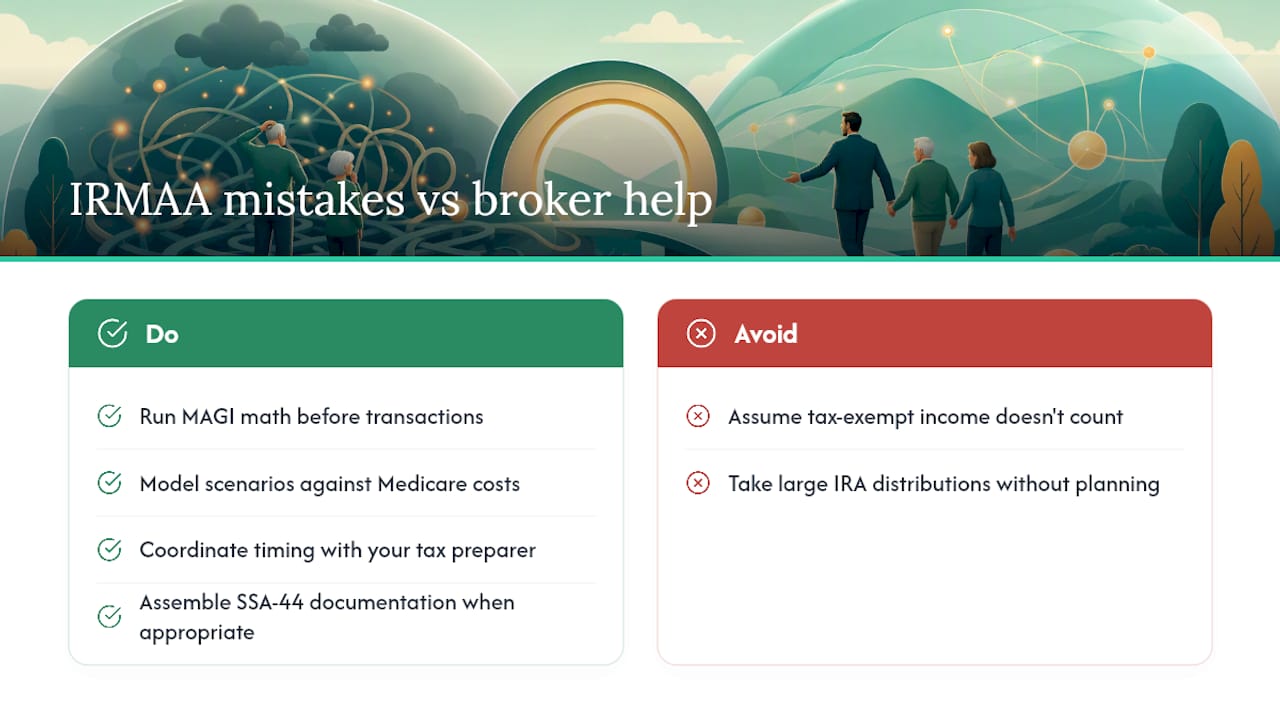
The most common surprise I see involves people who assume tax-exempt income doesn’t count for anything, then get hit with a Part B surcharge because their municipal bond interest pushed their MAGI over a threshold they never watched. A close second: someone takes a single large IRA distribution to pay for a home renovation, forgets that number becomes their MAGI two years later, and opens an IRMAA notice with no idea why their premium jumped $400 a month.
A broker who’s paying attention runs the MAGI math before the transaction happens, not after the notice arrives. That means modeling scenarios against the current Medicare cost structure, coordinating with your tax preparer on timing, helping assemble documentation if an SSA-44 filing makes sense, and keeping an eye on enrollment deadlines so a premium problem doesn’t turn into a coverage gap.
— Zach
How Simply Insurance Helps You Manage IRMAA Costs in Colorado
Working out your own MAGI exposure, filing SSA-44 correctly, and comparing plan options that offset a higher premium takes more than a quick internet search. Simplyinsuranceforyou reviews your specific income situation, walks through how a life-changing event might qualify you for a new IRMAA determination, and helps you compare Medicare Advantage, Medicare Supplement, and Part D options so your total costs make sense given your bracket.

This isn’t a service with a bill attached. Simplyinsuranceforyou is compensated by the insurance carriers when you enroll through their guidance, so there’s no direct charge to you for the plan comparison, the SSA-44 assistance, or the annual review that follows. The team serves clients across Colorado, from Castle Pines to Denver, Centennial, and Colorado Springs, with the same hands-on approach whether you’re newly eligible for Medicare or trying to untangle an unexpected IRMAA notice. If you want a straight answer about where you stand for 2026, visit the Simply Insurance Medicare guide and set up a conversation before your next enrollment window closes.
Sources
- 2026 Medicare Parts A & B Premiums and Deductibles - CMS
- SSA-44: Medicare Income-Related Monthly Adjustment Amount - Life-Changing Event - SSA