
Publication time reported by BabyLoveGrowth, shown in Mountain time. This is not an independently measured first appearance on this website.

Avoid Multiple $1,736 Medicare Part A Deductibles in Colorado
The Medicare Part A inpatient hospital deductible for 2026 is $1,736 per benefit period, up $60 from 2025. Once you meet it, hospital coinsurance kicks in at $434 a day for days 61 through 90, $868 a day if you tap into lifetime reserve days, and skilled nursing facility coinsurance runs $217 a day for days 21 through 100. None of these numbers are annual. They reset every time you start a new benefit period.
SimplyinsuranceforyouReview Your Medicare CoverageGet personalized, independent guidance comparing Medicare and health insurance options for your needs, goals, and future coverage decisions.Explore your coverage optionsTL;DR:
- Beneficiaries should monitor their hospital stays to avoid paying multiple deductibles if readmitted within 60 days, as that keeps them in the same benefit period.
- The coinsurance for days 61 through 90 increased to $434 per day in 2026, and lifetime reserve days now cost $868 per day, with costs rising as deductible amounts increase.
- Most beneficiaries automatically qualify for premium-free Part A if they or their spouse worked at least 40 quarters, but those with fewer quarters face higher monthly premiums with no impact on deductibles.
- Repeated hospitalizations more than 60 days apart will trigger multiple $1,736 deductibles annually, making supplemental coverage essential for managing high costs in chronic health situations.
- Consulting a licensed broker before hospitalization helps assess individual exposure to costs and identify options like Medigap or Medicare Advantage plans, which can include annual out-of-pocket limits.
Table of Contents
- Medicare Part A deductible 2026: how benefit periods trigger it
- What the 2026 coinsurance schedule looks like day by day
- Who actually pays a Part A premium in 2026
- How CMS sets the deductible and coinsurance amounts each year
- Ways to limit your Part A exposure before you need it
- How the 2026 deductible compares to recent years
- What a real hospital stay costs under these numbers
- What this means for your total Medicare Part A costs
- What we see working for Colorado beneficiaries
- Get a personalized Part A cost review before you need it
- Sources
Medicare Part A deductible 2026: how benefit periods trigger it
The deductible isn’t tied to a calendar year, which trips up more people than you’d expect. It’s tied to something Medicare calls a benefit period, and understanding that distinction is the whole ballgame.
A benefit period starts the day you’re admitted as an inpatient and ends once you’ve been out of a hospital or skilled nursing facility for 60 consecutive days. Stay out longer than 60 days, then get readmitted, and you’re on the hook for a brand new $1,736 deductible even if it’s the same illness, the same hospital, and the same calendar year. Medicare.gov walks through this benefit-period mechanic in detail, and it’s worth reading closely before you assume your costs are capped.
Services measured by benefit period include:
- Inpatient hospital care
- Inpatient rehabilitation facility stays
- Skilled nursing facility (SNF) care
- Some home health services that follow a hospital or SNF stay
- Hospice care in certain circumstances
Here’s a real-world scenario: someone is hospitalized in March, discharged after eight days, then hospitalized again in April for an unrelated issue. Because fewer than 60 days passed between discharge and readmission, that’s still the same benefit period, so no second deductible applies. Flip it around: discharged in March, readmitted in July, more than 60 days later, and a fresh $1,736 deductible applies.
What the 2026 coinsurance schedule looks like day by day
Days 1 through 60 of a hospital stay cost you nothing beyond the deductible you already paid. Day 61 is where coinsurance starts, and the jump is steep.
By the numbers: Days 61–90 cost $434 per day in coinsurance. Lifetime reserve days cost $868 per day. Beyond day 150, you cover the full cost of hospital care yourself. Skilled nursing coinsurance is $0 for days 1–20 and $217 per day for days 21–100.
Here’s the full breakdown for 2026:
- Days 1–60 (hospital): $0 coinsurance after the $1,736 deductible
- Days 61–90 (hospital): $434 per day
- Lifetime reserve days (60 total, used once): $868 per day
- Beyond day 150: you pay all costs
- SNF days 1–20: $0
- SNF days 21–100: $217 per day
Lifetime reserve days are a one-time bank of extra hospital days available across a beneficiary’s lifetime, up to a statutory limit of 60 days total. If you’re managing a chronic condition that involves repeated long hospitalizations, tracking how many reserve days you’ve already spent matters more than almost any other number on this page.
Who actually pays a Part A premium in 2026
Most people never think about a Part A premium because they never pay one. If you or a spouse worked and paid Medicare taxes for at least 40 quarters, roughly 10 years, you get premium-free Part A automatically. That covers the overwhelming majority of beneficiaries.
If you fall short of that work history, you’ll owe a monthly buy-in premium on top of the deductible and coinsurance figures above. For 2026, the Medicare costs fact sheet lists these buy-in tiers:
- Individuals with 30 to 39 quarters of covered work pay a monthly premium based on the 2026 established rates.
- Individuals with fewer than 30 quarters pay a higher monthly premium set for 2026.
- Late enrollment may lead to additional surcharges on these premiums.
One thing worth being clear about: paying a monthly premium doesn’t change or reduce your inpatient deductible. The $1,736 applies the same way whether you get Part A for free or pay full price for it.
How CMS sets the deductible and coinsurance amounts each year
The deductible isn’t picked arbitrarily. Federal law ties the coinsurance tiers to it using fixed fractions: days 61–90 coinsurance equals one-quarter of the deductible, lifetime reserve day coinsurance equals one-half, and SNF coinsurance for days 21–100 equals one-eighth. Change the deductible, and the other numbers move with it automatically, which is why they’ve all ticked up together for 2026.
CMS and the Federal Register notice for CY 2026 are required to publish these figures between September 1 and September 15 of the preceding year, with the new amounts taking effect January 1. That timeline gives you a reliable window each fall to check for updates before open enrollment closes. The year-over-year increases tend to be modest because they track a payment-weighted average of hospital cost trends rather than swinging with inflation headlines.
Ways to limit your Part A exposure before you need it
A $1,736 deductible hitting more than once in a year is the scenario that pushes people toward supplemental coverage. Original Medicare has no annual out-of-pocket cap, so repeated hospitalizations separated by more than 60 days can generate multiple full deductibles in the same calendar year.
Two paths address that risk differently:
- Medigap policies commonly cover the Part A deductible and coinsurance outright, though you’ll pay a separate monthly premium and enrollment timing matters. Missing your Medigap open enrollment window can mean medical underwriting later, which some applicants don’t pass.
- Medicare Advantage plans restructure your cost-sharing entirely and include an annual out-of-pocket maximum, something Original Medicare lacks. The tradeoff is network restrictions, so check whether your hospital and specialists are in-network before switching.
- Talk to a licensed broker before you’re staring down a hospital bill. Bring your Medicare card, a list of any hospital or SNF stays from the past year, and your current plan details so the conversation starts with real numbers instead of guesswork.
Pro Tip: Keep a running log of every hospital admission date and discharge date. If you’re ever unsure whether a new stay falls inside your existing benefit period or starts a fresh one, that log settles it in seconds instead of a phone call to Medicare.
Medigap guidance for Colorado residents breaks down how these policies handle Part A cost-sharing specifically.
How the 2026 deductible compares to recent years
The $1,736 figure represents a $60 increase over the 2025 deductible of $1,676, continuing a pattern of steady, incremental growth rather than dramatic jumps. The deductible has climbed roughly $40 to $60 most years this decade, generally tracking hospital cost trends nationwide rather than spiking with general inflation numbers you’d see on the news.
That consistency actually helps with planning. A beneficiary budgeting for a possible hospitalization can reasonably expect next year’s deductible to land somewhere close to this year’s, plus a modest bump, rather than facing wild unpredictability. It also means the coinsurance figures move in lockstep, since they’re calculated as fractions of the deductible itself. When the deductible rises $60, the days 61–90 coinsurance rises by a quarter of that, and the lifetime reserve day rate rises by half of that.
The bigger point for beneficiaries isn’t the year-over-year delta. It’s that these numbers only ever move in one direction. There’s no scenario in recent history where the deductible dropped from one year to the next. If you’re the kind of person who budgets a health savings cushion or plans retirement income around fixed costs, treat this as a line item that reliably increases every January and build a small buffer into your annual planning rather than being caught off guard.
What a real hospital stay costs under these numbers
Numbers on a page are one thing. Watching them apply to an actual stay makes the stakes clearer.
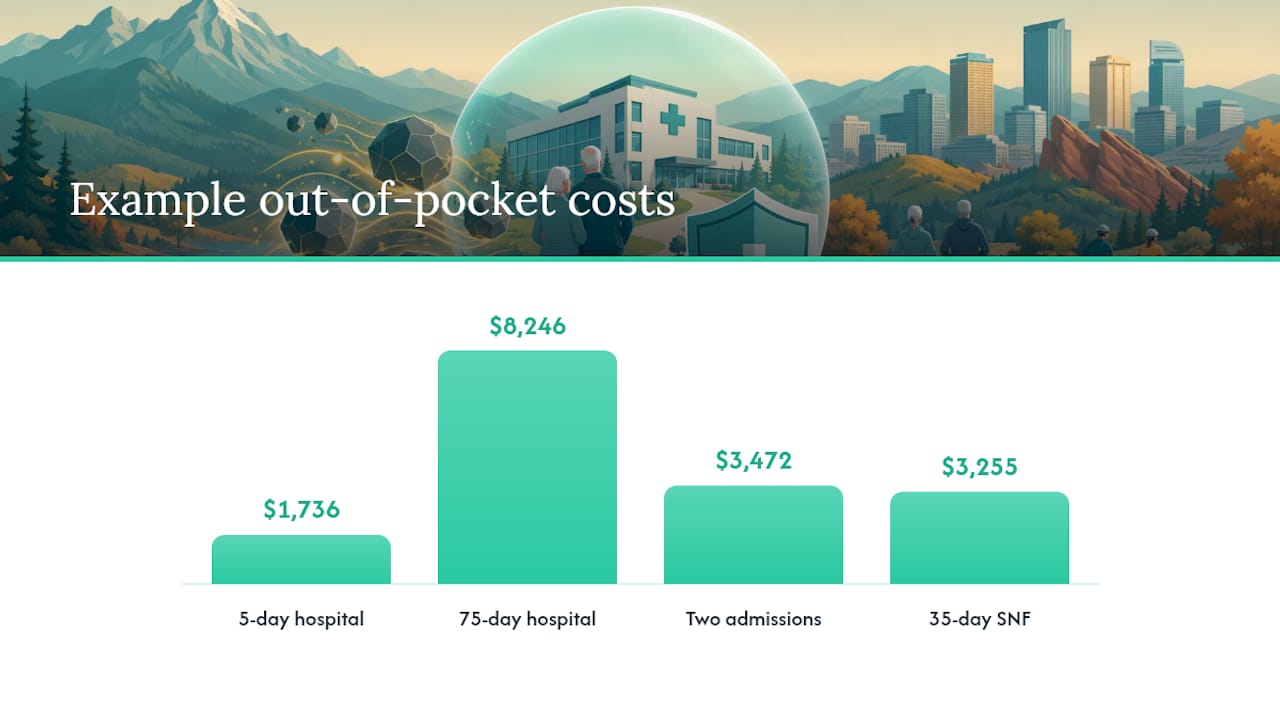
Scenario one: a five-day hospitalization. You’re admitted, treated, and discharged after five days. You owe the full $1,736 deductible and nothing more in coinsurance, since you never crossed day 61. That’s your total Part A hospital bill for the stay, assuming premium-free Part A.
Scenario two: a 75-day hospitalization. You owe the $1,736 deductible for days 1 through 60. Then you owe coinsurance for 15 additional days (days 61 through 75) at $434 per day, adding $6,510. Total Part A cost: $8,246, not counting any Part B charges for physician services during that stay.
Scenario three: a rehospitalization 70 days after discharge. You’re admitted in January for 10 days, discharged, then readmitted in late March, more than 60 days later, for another 6 days. Because more than 60 days passed between stays, this counts as a new benefit period. You owe the $1,736 deductible twice in the same year, once for each admission, totaling $3,472 in deductibles alone.
Scenario four: a skilled nursing stay following hospitalization. After a qualifying hospital stay, you spend 35 days in a skilled nursing facility. The first 20 days cost $0 in coinsurance. Days 21 through 35 cost $217 per day, adding $3,255 on top of whatever hospital deductible already applied.
These examples show why the “per benefit period” wording matters more than most people realize until they’re living it.
What this means for your total Medicare Part A costs
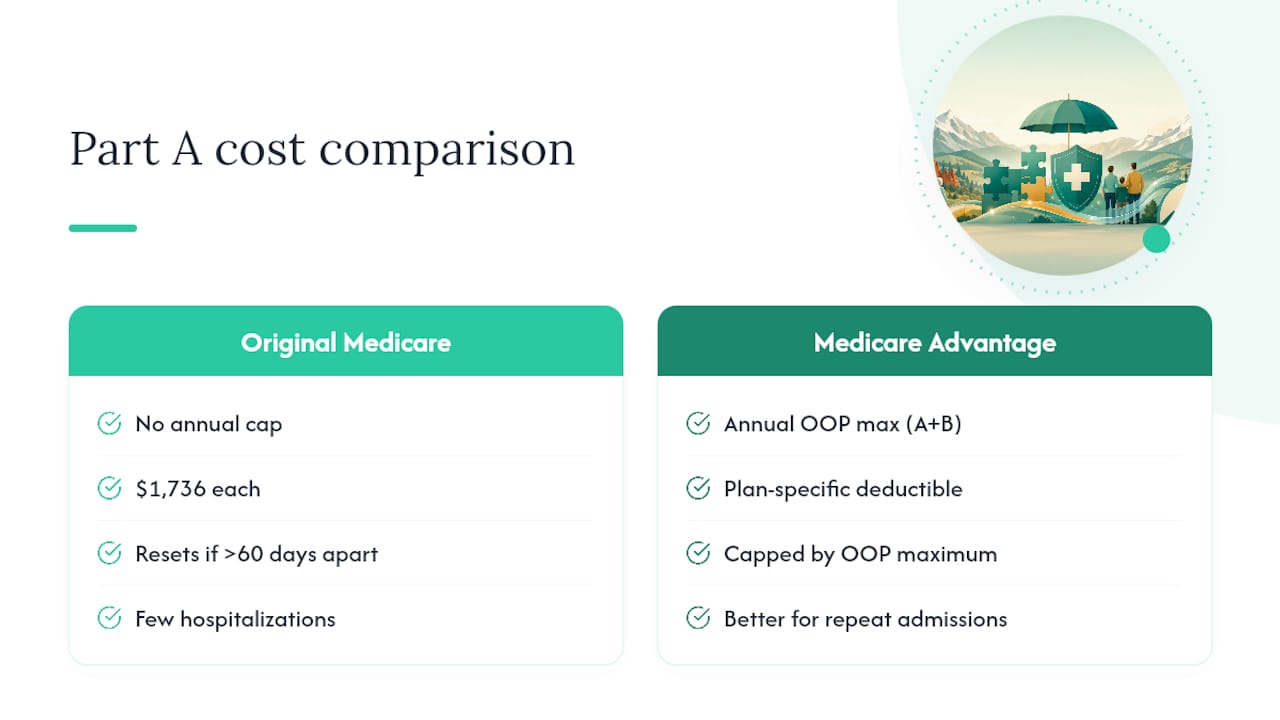
Original Medicare has no yearly cap on what you might pay through Part A cost-sharing. Multiple hospitalizations spaced more than 60 days apart can each trigger a fresh $1,736 deductible, and there’s no ceiling that says “you’ve paid enough this year.” That structural gap is the single biggest financial risk built into Part A, and it’s the reason supplemental coverage exists as a category in the first place.
Compare that to Medicare Advantage plans, which are required to include an annual out-of-pocket maximum for Parts A and B services combined, even though the specific dollar figure varies by plan and by carrier. That single design difference, a hard ceiling on the Medicare Advantage side versus no ceiling on Original Medicare, is often the deciding factor for beneficiaries choosing between the two paths.
For someone in reasonably good health with no history of repeat hospitalizations, a single $1,736 deductible in a bad year is a manageable, budgetable expense. For someone managing a chronic condition with a pattern of hospital admissions, the math changes fast, and the absence of an annual cap under Original Medicare becomes the central planning question rather than a footnote. Reviewing your own admission history over the past two or three years is the most honest way to figure out which category you fall into, and it’s exactly the kind of review a licensed broker consultation is built to walk through with you.
What we see working for Colorado beneficiaries
Licensed brokers who compare Medicare plans and run annual reviews for clients across Colorado report a consistent pattern in conversations. People don’t come in asking about the deductible in the abstract. They come in wanting to know three things: how to limit their Part A exposure, how to find a Medigap policy that fits their actual budget, and how to avoid enrollment penalties that stick around for life.
Those three questions usually have straightforward answers once someone looks at your specific health history and enrollment timeline instead of a generic chart.
— Zach
Get a personalized Part A cost review before you need it
Licensed brokers compare actual Medicare options side by side, often at no direct cost to you, instead of leaving you to interpret CMS fact sheets alone.

Before you reach out, gather three things: your Medicare card, a list of any hospital or skilled nursing stays over the past year or two, and details on your current coverage if you have any. That short prep turns a broker conversation into a specific, numbers-based plan instead of a general overview. Consultations can walk through Medigap options, Medicare Advantage tradeoffs, and how specific admission history affects exposure to the 2026 deductible. Visit the Medicare Guide to schedule a consultation and get a plan comparison built around your actual situation, not a generic checklist.
This article is general information, not a substitute for advice from a qualified financial advisor. Consult a qualified financial professional about your own circumstances before acting on anything here.
Sources
- 2026 Medicare Parts A & B Premiums and Deductibles
- Costs | Medicare
- Medicare Program; CY 2026 Inpatient Hospital Deductible and Hospital and Extended Care Services Coinsurance Amounts | 90 FR 52075