
Publication time reported by BabyLoveGrowth, shown in Mountain time. This is not an independently measured first appearance on this website.

Avoid Penalties: Medicare Part B Enrollment With Local Broker Help
If you’re approaching 65, enroll in Medicare Part B during your 7-month Initial Enrollment Period to avoid a permanent late penalty. If you’re still working with active employer group coverage, you likely qualify for an 8-month Special Enrollment Period instead. Either way, the fastest path is applying online at Ssa, not mailing paperwork.
SimplyinsuranceforyouGet Clear Medicare Enrollment GuidanceSimply Insurance provides personalized guidance from licensed brokers, with ongoing support for Medicare enrollment, claims, and annual reviews.Get Medicare guidanceTL;DR:
- Enrolling early through the online SSA portal significantly reduces processing time and helps track your application status.
- Active employer coverage can qualify for an 8-month Special Enrollment Period, but COBRA, retiree plans, and Marketplace coverage often do not.
- Missing your initial or special enrollment window can lead to permanent late enrollment penalties added to your monthly premium.
- Applying during the General Enrollment Period results in delayed coverage starting July 1 and may still incur penalties if coverage gaps occur.
- Working with a licensed broker can help verify your eligibility, ensure correct paperwork, and avoid delays or penalties during enrollment.
Table of Contents
- When Is Medicare Part B Enrollment? IEP, SEP, and GEP Explained
- Do I Have to Enroll in Part B Right Now?
- How to Enroll in Part B: Forms, Methods, and What to Gather
- When Does Part B Coverage Actually Start?
- What Are the Medicare Part B Late Enrollment Penalties?
- Missed Your Window? What to Do Next
- Why Local Broker Help Matters for Part B Enrollment
- Get Hands-On Help With Your Part B Enrollment
- Sources
- FAQ
When Is Medicare Part B Enrollment? IEP, SEP, and GEP Explained
Three separate windows govern Medicare Part B enrollment, and picking the right one determines whether you pay a penalty or not.
Your Initial Enrollment Period (IEP) runs 7 months: the 3 months before you turn 65, your birthday month, and the 3 months after. The month you choose within that window changes when coverage actually kicks in, which matters if you’re scheduling a surgery or switching off a spouse’s plan. Miss this window without other coverage, and the meter starts running on a penalty that follows you for as long as you have Part B, according to Medicare.

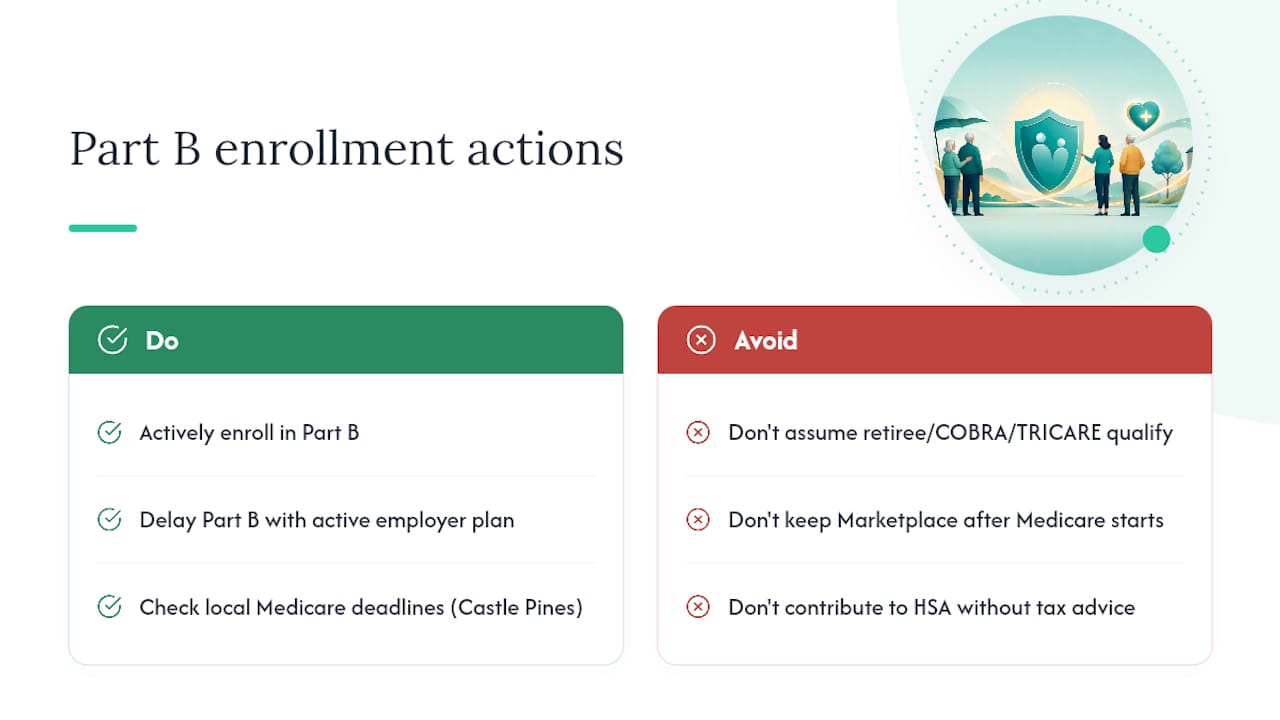
If you’re still working past 65 and covered by an active employer group health plan, you typically get a Special Enrollment Period (SEP): 8 months after your employment or that group coverage ends. This SEP does not apply to everyone, though. COBRA and most retiree health plans generally do not count as active employer coverage, so people on those plans often assume they’re protected and later discover they’ve been racking up penalty months without realizing it.
Missed both windows? The General Enrollment Period (GEP) runs every January 1 through March 31, with coverage typically starting July 1. It’s a real fallback, but the gap between applying and getting covered can stretch several months, and penalties may still apply. For a deeper breakdown of each window’s edge cases, see this Medicare enrollment periods guide.
Do I Have to Enroll in Part B Right Now?
It depends on what coverage you already have. Part A often enrolls people automatically if they’re already collecting Social Security benefits, but Part B almost always requires you to actively opt in.
If you have an active employer group health plan through your own job or a spouse’s job at a company with enough employees, you can often delay Part B penalty-free. However, retiree plans, COBRA, and TRICARE usually do not count as qualifying coverage for a SEP, and TRICARE has its own rules tied to Part B enrollment. Marketplace plans are a common trap too. Marketplace coverage and Medicare don’t coordinate as primary and secondary, so most people need to transition off the Marketplace once Medicare eligibility starts. If you contribute to an HSA, enrolling in Part A or Part B can affect your eligibility to keep contributing, so loop in a tax advisor before you file. Castle Pines residents can check a localized FAQ on Medicare deadlines for common local scenarios.
How to Enroll in Part B: Forms, Methods, and What to Gather
The Medicare Part B application process has three practical paths, and one is faster than the other two by a wide margin.
- Online at SSA.gov — the recommended route for most people, since it processes faster and lets you track status through your Social Security account.
- By phone at 1-800-772-1213, useful if you have questions or your situation involves employer coverage documentation.
- By mail or fax to your local Social Security office, typically reserved for those submitting the CMS-L564 employer form alongside your application.
You’ll need the Application for Enrollment in Medicare Part B, form CMS-40B, if you already have Part A and want to add Part B. If you’re applying during a Special Enrollment Period because of employer coverage, you’ll also usually need CMS-L564, the Request for Employment Information form, completed and signed by your employer’s benefits office.
Before you start, gather:
- Your Social Security number and Medicare number (if you already have Part A)
- Exact dates your employer coverage started and, if applicable, ended
- A completed, signed CMS-L564 if you’re enrolling during a SEP
- Contact information for your employer’s benefits office, in case Social Security needs to verify anything
Pro Tip: Get the employer to sign CMS-L564 before you submit CMS-40B. A common holdup happens when people send the enrollment form first and chase down employer paperwork afterward, which can delay your effective date by weeks.
When Does Part B Coverage Actually Start?
The month you submit your application relative to your birthday month decides your effective date, and the rules shift slightly depending on which window you’re using.
Enrollment scenario Coverage effective date Apply before your birthday month (during IEP) The month you turn 65 Apply during your birthday month or the 3 months after (IEP) Generally the month after SSA processes your application Apply during a SEP (employer coverage ending) Typically the month after SSA receives your forms Apply during GEP (January 1 to March 31) July 1 of that yearUnder certain conditions, the CMS-40B form lets you request a specific start date, including delaying up to 3 months if you’re still covered by employer group coverage when you apply. That flexibility helps if you want your Part B start date to line up cleanly with the day your employer coverage actually ends, rather than leaving a gap or paying for overlapping coverage.
What Are the Medicare Part B Late Enrollment Penalties?
The penalty for delaying Part B without qualifying coverage isn’t a one-time fee. It’s added to your monthly premium for as long as you’re enrolled in Part B, and Medicare.gov confirms it can grow the longer you wait.
Here’s what typically triggers it and how to sidestep it:
- Missing your IEP with no active employer group coverage to justify the delay
- Assuming COBRA or a retiree plan qualifies as active coverage when it usually doesn’t
- Waiting for the GEP instead of using your SEP, which means months without coverage and possibly a penalty on top
- Submitting CMS-40B without a properly completed CMS-L564, which can create confusion about whether you actually qualified for a SEP
Enrolling within your SEP window, with documentation in hand, is the surest way to avoid this entirely. For the math behind how penalty percentages accumulate, the Medicare late enrollment penalty guide breaks down real scenarios.
Missed Your Window? What to Do Next
If you missed both your IEP and SEP, the General Enrollment Period is your standard fallback. Apply between January 1 and March 31, and coverage generally starts July 1.
In rare circumstances, such as a natural disaster, employer error, or misinformation from a government source, you may qualify for an exceptional-condition SEP using CMS-10797, which requires documentation supporting your claim. If you’re staring down a coverage gap between now and July, don’t just wait it out. Call SSA directly or reach out to a licensed broker the same week you realize you’ve missed a deadline. Timing matters more than most people expect.
Why Local Broker Help Matters for Part B Enrollment
Paperwork errors are the most common reason Part B enrollment gets delayed or denied outright. A licensed broker who handles this daily can verify your SEP eligibility, make sure CMS-L564 is filled out correctly by your employer, and catch mistakes before SSA does.
That kind of help matters most in messy situations: spouse coverage, retiree plans that look like active coverage but aren’t, or employer HR departments that don’t process CMS-L564 quickly. Licensed brokers work these cases with Colorado clients regularly, and offer annual plan reviews afterward so enrollment isn’t a one-time event you have to figure out alone.
— Zach
Get Hands-On Help With Your Part B Enrollment
You can get help from a licensed local broker who checks your specific situation, whether that’s spouse coverage, a retiree plan, or a CMS-L564 that’s stuck on an employer’s desk, before you submit anything.

Simply Insurance’s Medicare Planning service walks Colorado residents through the entire Part B enrollment process at no direct cost to you, since compensation comes from carriers, not your pocket. That includes verifying your Special Enrollment Period eligibility, helping get CMS-L564 completed correctly by your employer, and following up with annual plan reviews once you’re enrolled. If your situation involves working past 65, a spouse’s coverage, or a retiree plan you’re not sure qualifies, browse the full lineup of Medicare Advantage consultations, Plan G and Plan N quotes, and Social Security planning services, then reach out for a no-obligation conversation before your deadline gets closer than you’d like.
This article is general information, not a substitute for advice from a qualified doctor. Consult a qualified healthcare professional about your own circumstances before acting on anything here.
Sources
- When does Medicare coverage start? | Medicare
- Application for Enrollment in Medicare Part B (Medical Insurance) — CMS-40B (PDF)
- Sign up for Part B only | Social Security
FAQ
Who Pays 75% of Medicare Part B?
The federal government covers roughly three-quarters of Part B costs through general tax revenue, while enrollees pay the remaining share through monthly premiums. This funding structure is part of why Part B has an enrollment window and a penalty system: it’s designed to keep the risk pool stable rather than let people opt in only once they need care.
Is It Mandatory to Enroll in Medicare Part B?
No, Part B enrollment isn’t legally required, but skipping it without qualifying employer coverage usually means a permanent monthly penalty once you do enroll. Whether it makes sense to delay depends entirely on what other coverage you have, which is why confirming your situation with SSA or a licensed broker before your Initial Enrollment Period closes matters.
What Happens if You Don’t Enroll in Medicare Part B at 65?
If you don’t have qualifying employer coverage and you skip your Initial Enrollment Period, you’ll likely face a late enrollment penalty added to your premium for as long as you carry Part B. You’ll also have to wait for the next General Enrollment Period, January through March, with coverage not starting until July 1.
Can I Choose to Not Enroll in Medicare Part B?
Yes, you can decline Part B, and many people with active employer group coverage do exactly that until their job or coverage ends. Just confirm your specific plan actually qualifies as active employer coverage first. COBRA and most retiree plans don’t, and finding that out after the fact is how avoidable penalties happen.