
Publication time reported by BabyLoveGrowth, shown in Mountain time. This is not an independently measured first appearance on this website.

Avoid Surprise Costs: $2,100 Cap and Medicare Part D for U.S. Seniors
Medicare Part D is the federal prescription drug benefit sold through private insurers, either as a stand-alone plan or bundled into a Medicare Advantage plan. Enrollment is voluntary, but skipping it without other credible drug coverage triggers a penalty that follows you for life. In 2026, new caps on out-of-pocket spending and insulin costs make joining more valuable than ever.
TL;DR:
- Choosing the lowest premium plan may lead to higher overall costs if your drugs are on a high tier or require prior authorization or step therapy.
- The 2026 out-of-pocket cap of 2,100 dollars is a major change, effectively eliminating the coverage gap and reducing financial risk for high-cost drug users.
- You must carefully review each plan’s formulary and tier placement for your specific medications during open enrollment to avoid unexpected expenses.
- Enrollment windows are strict: missing your initial enrollment period or delayed proof of credible coverage can result in permanent penalties that increase your costs over time.
- Extra Help programs and manufacturer assistance can significantly lower drug costs, especially for low-income beneficiaries or those taking expensive specialty medications.
Table of Contents
- What Is Medicare Part D and Who Can Get It?
- How Part D Formularies and Drug Tiers Actually Work
- Medicare Part D Costs in 2026: Premiums, Deductibles, and the New Caps
- When to Enroll in Part D and How to Sidestep the Penalty
- How Part D Coverage Works at the Pharmacy Counter
- Extra Help and Other Ways to Lower Your Drug Costs
- What Changed for Part D Between 2023 and 2026
- Choosing a Part D Plan: A Step-by-Step Checklist
- Why the Real Cost of Part D Isn’t the Premium
- Get Local Help Choosing a Part D Plan in Colorado
- Sources
What Is Medicare Part D and Who Can Get It?
Part D has covered outpatient prescription drugs through private insurers since January 1, 2006, and nothing about that structure has changed since. The federal government sets the rules; insurance companies design and price the actual plans within those rules. That’s why two Part D plans in the same Colorado county can charge wildly different amounts for the same prescription.
You qualify for Part D coverage if you’re entitled to Part A, enrolled in Part B, or both, and you live in the plan’s service area within the United States. There’s no separate application hurdle beyond picking a plan and enrolling in it during an eligible window.
You’ll run into two flavors of Part D coverage:
- Stand-alone Prescription Drug Plans (PDPs): paired with Original Medicare, sold purely for drug coverage.
- Medicare Advantage Prescription Drug plans (MA-PDs): drug coverage bundled into a Medicare Advantage plan alongside hospital and medical benefits.
KFF’s analysis of the Part D market shows enrollment has been tilting toward MA-PDs for years, partly because bundling can lower total premiums, though it also means your drug coverage and your doctor network live under one roof, for better or worse.
A few terms you’ll see constantly and need to actually understand:
- Formulary: the list of drugs a specific plan covers.
- Tier: the pricing category a drug sits in on that formulary, which determines your copay or coinsurance.
- Deductible: what you pay out of pocket before the plan starts sharing drug costs.
- Initial coverage phase: the period after the deductible where you and the plan split costs.
- Catastrophic coverage: the phase that kicks in once your spending hits the annual cap, where covered drugs cost you nothing more.
- TrOOP (True Out-of-Pocket costs): the running total of what counts toward your out-of-pocket cap, which includes what you pay plus, in most cases, manufacturer discounts on brand drugs.
How Part D Formularies and Drug Tiers Actually Work
Every Part D plan has to cover a broad range of drug categories, and federal rules single out certain protected classes, including antidepressants, antipsychotics, anticonvulsants, and antiretrovirals, where plans must cover nearly all drugs in that class. That protection exists because interrupting those medications can be dangerous, not just inconvenient.
Beyond the protected classes, each insurer builds its own formulary, and that’s where cost differences between plans get dramatic. According to Humana’s explanation of Part D formulary tiers, most plans use five tiers: preferred generic, generic, preferred brand, non-preferred drug, and specialty. Tier 1 vs. Tier 3 drugs can carry a cost difference of hundreds of dollars a year for the exact same prescription, just because of which plan you picked.
Plans generally must also cover commercially available adult vaccines when they’re medically necessary, and enrollees pay nothing out of pocket for those vaccines under Part D.
What’s commonly excluded from Part D coverage:
- Over-the-counter medications, even ones your doctor recommends.
- Drugs for cosmetic purposes, weight loss, or hair growth in most cases.
- Fertility drugs and some erectile dysfunction medications.
- Drugs already covered under Medicare Part A or Part B (like many infusion drugs given in a clinical setting).
If your plan doesn’t cover a drug you need, you have real options, not just a shrug. You or your prescriber can request a formulary exception (asking the plan to cover a drug that’s not on the list) or a tiering exception (asking for a lower copay because a similar drug on a cheaper tier isn’t medically appropriate for you). If the plan says no, you can appeal. CMS outlines the exceptions and appeals process and requires a prescriber’s supporting statement for most requests.
Pro Tip: Before you enroll in any plan, search its formulary directly for the exact drug name, dosage, and quantity you take. A generic and brand version of the same medication can land on completely different tiers.
Medicare Part D Costs in 2026: Premiums, Deductibles, and the New Caps
Part D costs stack in a specific order: premium, deductible, then cost-sharing (copays or coinsurance) until you hit the annual out-of-pocket cap. Your premium is what you pay monthly to stay enrolled, regardless of whether you fill a single prescription. The deductible is what you pay before the plan starts sharing costs at all, and after that, cost-sharing continues until your total spending trips the cap.
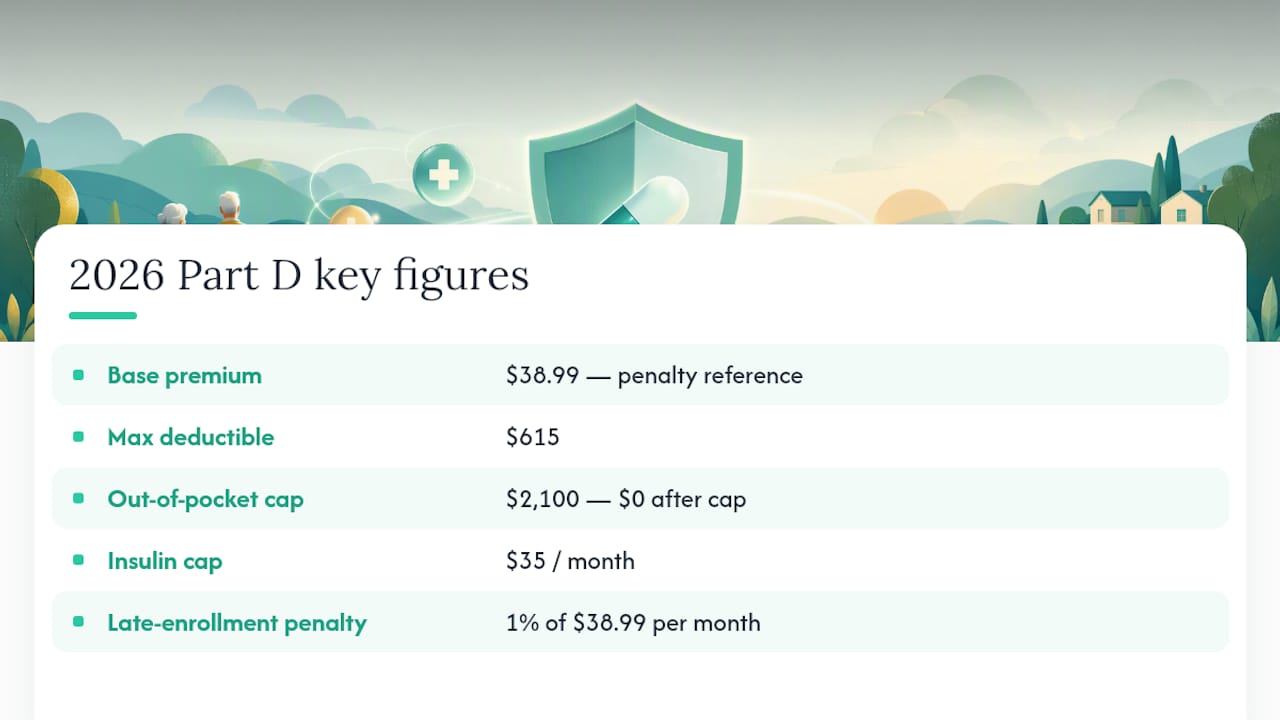
2026 Part D figures to know: The national base beneficiary premium is $38.99, used specifically as the reference point for penalty calculations, not as what every plan actually charges. Plan premiums vary widely above and below that number. The maximum allowable deductible is $615. The annual out-of-pocket spending cap is $2,100, after which covered drugs cost $0 for the rest of the year. Insulin products are capped at $35 per month’s supply, no matter which phase of the benefit you’re in.
That out-of-pocket cap is the single biggest structural change to hit Part D since it launched, a direct result of the Inflation Reduction Act. Before it phased in, someone with a serious chronic illness could face thousands of dollars in annual drug spending with no ceiling. Now there is a hard stop on annual out-of-pocket spending.
The late enrollment penalty is where a lot of people get burned without realizing it until years later. If you go 63 or more consecutive days without Part D or other creditable drug coverage after your Initial Enrollment Period ends, Medicare tacks on a permanent penalty: 1% of that $38.99 national base beneficiary premium for every full month you went without coverage, rounded to the nearest $0.10, added to your premium for as long as you have Part D.
A few things reshuffle the math. If you qualify for Extra Help (the Low-Income Subsidy), your deductible, premium, and copays can drop dramatically or disappear. If your income is high, you’ll pay an IRMAA surcharge on top of your premium, assessed based on your tax return from two years prior. And if you have retiree drug coverage through a former employer that’s certified as creditable, you can often delay Part D enrollment penalty-free, but you need documentation proving that coverage was, in fact, creditable.
When to Enroll in Part D and How to Sidestep the Penalty
Timing determines everything with Part D, and the windows are less forgiving than most people assume.
- Initial Enrollment Period (IEP): This runs for seven months, starting three months before the month you turn 65, including your birthday month, and extending three months after. Coverage typically starts the month after you enroll, sometimes with a short delay depending on when in the window you sign up.
- Annual Open Enrollment Period (AEP): Every year from October 15 through December 7, you can switch plans, drop a plan, or enroll if you missed your original window and now qualify. Any changes take effect January 1 of the following year.
- Special Enrollment Periods (SEPs): Triggered by specific life events, like losing employer coverage, moving out of your plan’s service area, or qualifying for Extra Help. These have their own timelines and don’t wait for AEP.
- Automatic enrollment for dual eligibles: If you qualify for both Medicare and Medicaid, or you’re already enrolled in Extra Help, Medicare often enrolls you automatically in a Part D plan so you’re never left without coverage.
If you missed your IEP and don’t have proof of creditable coverage, don’t wait for the “right” moment to sort it out. Gather any documentation from a former employer or union plan showing your prior drug coverage met Medicare’s creditable standard, and hold onto it. If you genuinely have no gap to justify, enrolling during the next AEP is your best move, even with a penalty attached, because delaying further only makes that penalty grow.
How Part D Coverage Works at the Pharmacy Counter
Signing up for a plan is only step one. Using it well, month after month, is where people either save money or get blindsided by a bill they didn’t expect.
Every Part D plan has a pharmacy network, and most networks include “preferred” pharmacies that charge lower copays than “standard” ones in the same network. Filling a maintenance prescription at a non-preferred pharmacy, even one that technically accepts your plan, can cost noticeably more for the exact same drug.
- Mail order or 90-day fills often lower your per-dose cost and cut down on pharmacy trips, but they’re a poor fit if your dosage changes often or you’re still stabilizing on a new medication.
- Prior authorization means your plan requires proof from your prescriber that the drug is medically necessary before it’ll cover it, common for expensive specialty drugs.
- Step therapy requires you to try a cheaper drug first and show it didn’t work before the plan covers a pricier alternative.
- Quantity limits cap how much of a drug the plan will cover in a given period, often tied to safety guidelines rather than cost control.
If any of those roadblocks hit you, your prescriber can request an exception on your behalf, and these decisions are generally required within 72 hours for standard requests, faster if an expedited review applies because waiting would harm you.
One protection people rarely know about: if your plan removes a drug from its formulary partway through the year, or moves it to a costlier tier, plans must notify affected members in advance and typically provide a temporary transition fill so you have time to switch medications or pursue an exception rather than getting cut off cold.
Extra Help and Other Ways to Lower Your Drug Costs
If Part D costs feel unmanageable on a fixed income, there are real programs designed specifically for that problem, not just marketing copy promising savings.
- Extra Help (Low-Income Subsidy): Based on income and resource limits, this federal program can reduce or eliminate your premium, deductible, and copays. Apply through the Social Security Administration or your state Medicaid office.
- State Pharmaceutical Assistance Programs (SPAPs): Some states run supplemental drug assistance programs on top of Extra Help; availability and rules vary, so check with your state’s health department or a local broker familiar with Colorado programs.
- Manufacturer patient-assistance programs: Many drug manufacturers offer direct assistance or copay cards for specific brand-name drugs, particularly for specialty medications without a generic equivalent.
- Formulary and tiering exceptions: Worth repeating here: if a needed drug is too expensive or excluded, requesting an exception is a legitimate, structured process, not a long shot.
Pro Tip: Apply for Extra Help even if you think you make “too much.” The income and asset limits are higher than most people assume, and a denial costs you nothing but a form.
What Changed for Part D Between 2023 and 2026
The Inflation Reduction Act rewired Part D’s cost structure in stages, and 2026 is when most of the biggest pieces are fully in place. The $2,100 out-of-pocket cap eliminated the old “donut hole” model, where beneficiaries could face a coverage gap with high costs before catastrophic coverage kicked back in. That gap is functionally gone now, replaced by a single, predictable ceiling.
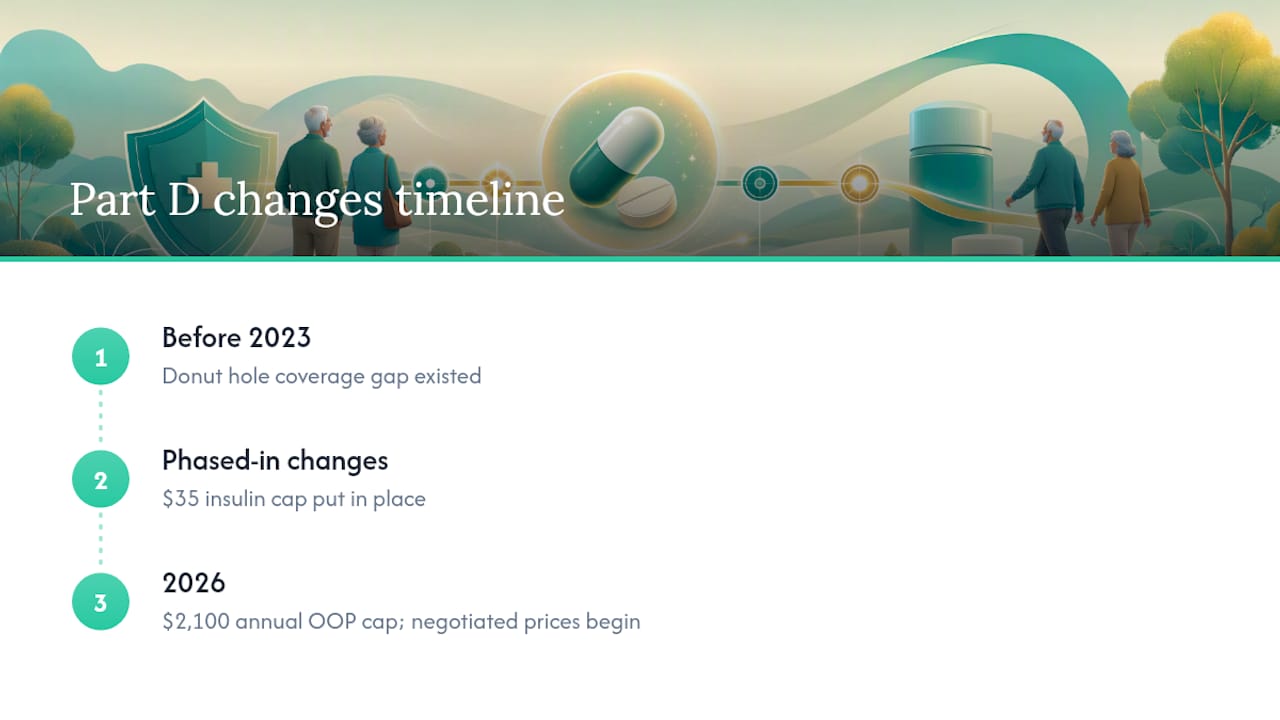
The $35 insulin cap, phased in earlier, remains fixed regardless of which coverage phase you’re in. And starting in 2026, Medicare’s negotiated prices for a first set of high-cost drugs take effect, a direct result of CMS negotiating with manufacturers under the same law.
Practically, that means someone on an expensive specialty drug who used to face thousands of dollars in spring and summer costs now hits the $2,100 ceiling once, then pays nothing more for covered drugs the rest of the year. For someone on insulin alone, monthly costs are locked at $35 no matter what the list price does.
Choosing a Part D Plan: A Step-by-Step Checklist
Picking a plan by premium alone is the single most common and costly mistake seniors make with Part D. The cheapest premium can easily turn into the most expensive plan overall once your actual prescriptions hit its formulary.
Start with your medication list, not the plan brochure:
- Step 1: Write out every medication you currently take, with exact dosage and quantity.
- Step 2: Check each plan’s formulary against that exact list, drug by drug, not by category. A plan covering “diabetes medications” broadly may still exclude your specific brand.
- Step 3: Add up expected annual cost, premium plus realistic out-of-pocket spending for your specific drugs, not just the deductible. A low premium with high coinsurance on your main drug often loses to a higher premium with better tier placement.
- Step 4: Confirm your regular pharmacy is in the plan’s preferred network, not just its standard network.
- Step 5: Check for prior authorization, step therapy, or quantity limits on your specific drugs, and ask your prescriber if they’re prepared to support an exception request if needed.
When you’re ready to compare plans directly, a detailed breakdown of Part D formularies and 2026 premiums can help you see how the numbers play out for common drug categories.
If you talk to a licensed broker, ask pointed questions: Which plans actually cover my specific drugs at the lowest tier? What’s my realistic total annual cost, not just the premium? Is my pharmacy preferred or standard in this network? Watch for red flags too, like a broker who only shows you one or two carriers, can’t answer formulary questions about your actual medications, or rushes you toward a decision before AEP closes.
Pro Tip: Recheck your plan every single Open Enrollment, even if you’re happy with it. Formularies and tiers change annually, and a plan that was your best fit last year can quietly become your worst fit this year.
Why the Real Cost of Part D Isn’t the Premium
Most people shopping for Part D fixate on the monthly premium because it’s the number they see first and the easiest to compare across plans. That instinct is backwards, and it’s the single biggest reason people end up frustrated with a plan they picked deliberately.
The premium is a fixed, predictable cost. Your formulary fit is not, and it’s the variable that actually determines whether you save or lose money over a year. A $10 difference in monthly premium is $120 a year. A drug landing on the wrong tier, or getting hit with step therapy you didn’t see coming, can cost that much in a single month. KFF’s data on Part D plan availability shows a genuinely wide spread of plan designs on the market, which is exactly why the “best” plan is never universal. It’s specific to your exact medication list.
The other underappreciated shift is the out-of-pocket cap itself. For years, Part D shopping advice centered on surviving the coverage gap. That advice is now mostly obsolete, and a lot of outdated guidance still floating around online hasn’t caught up. The smarter question for 2026 isn’t “how do I get through the donut hole,” it’s “how fast will I hit the $2,100 cap, and does that change which plan makes sense for me.” For someone on one or two expensive specialty drugs, hitting that cap early in the year can make a slightly higher premium plan the objectively cheaper choice overall.
— Zach
Get Local Help Choosing a Part D Plan in Colorado
Comparing formularies, tiers, and penalty math across a dozen plans is exactly the kind of work that eats an afternoon and still leaves you unsure you picked right. Some brokers work differently by matching your actual medication list against real plan formularies, at no direct cost to you, since carriers pay the commission.

That local knowledge matters more than it sounds. A plan that’s the best value in Denver isn’t necessarily the best one for a Castle Pines household, and formulary quirks show up differently depending on which pharmacies dominate your area. Some brokers provide ongoing support through claims questions and a full annual review every fall, so your coverage gets rechecked before AEP closes, not after a surprise bill arrives.
If you’re ready to compare your options, start with the Medicare guide to see how Part D fits alongside your other Medicare coverage, or reach out directly to schedule a no-cost consultation and get your medication list checked against real 2026 formularies before you commit to a plan.
Sources
- What’s Medicare drug coverage (Part D)? | Medicare
- A current snapshot of the Medicare Part D prescription drug benefit | KFF
This article is general information, not a substitute for advice from a qualified financial advisor. Consult a qualified financial professional about your own circumstances before acting on anything here.