
Publication time reported by BabyLoveGrowth, shown in Mountain time. This is not an independently measured first appearance on this website.

Save on 2026 Premiums: 4 Medicare Savings Programs for Low Income Seniors
Medicare Savings Programs are state-run benefits that can pay some or all of your Medicare Part A and/or Part B costs if your income and resources fall within certain limits. There are four programs (QMB, SLMB, QI, and QDWI), each covering different costs, and your state Medicaid office decides eligibility. Even if you’re unsure whether you’d qualify, apply anyway. Many states use more generous rules than the federal baseline.
TL;DR:
- Many qualify for MSPs because federal income and resource limits are often exceeded only by small margins, and states may have more generous thresholds.
- Applying can be done easily through your state Medicaid office with basic documents like income proof, ID, and bank statements, often accessible online or in person.
- Qualification for QMB automatically confers drug cost assistance through Part D Extra Help, significantly lowering prescription costs without additional paperwork.
- Most MSP benefits, especially for QMB, can be retroactive to the month of application if approved, and failing to renew timely can cause benefits to lapse.
- Households should review eligibility annually and report any income or resource changes promptly to maintain benefits and potentially qualify for broader coverage.
Table of Contents
- What Are the Four Medicare Savings Programs?
- What Are the 2026 Income and Resource Limits?
- How Do You Apply for a Medicare Savings Program?
- Does Qualifying for an MSP Also Get You Extra Help With Drug Costs?
- Why You Should Apply Even if You’re Not Sure You Qualify
- What Happens After You Submit Your Application?
- What Other Eligibility Rules Apply Beyond Income and Resources?
- How Do You Renew Your Medicare Savings Program Benefits?
- What Exactly Do These Programs Pay For?
- What Mistakes Do Applicants Commonly Make?
- How Long Does the Application and Approval Process Take?
- How Do MSPs Work Alongside Other Public Assistance Programs?
- Practitioner Perspective: How Zach Helps Colorado Families Navigate This
- Get Local Help Applying for a Medicare Savings Program
- Where to Verify Limits and Find State Contacts
- Sources
What Are the Four Medicare Savings Programs?
Each Medicare Savings Program (MSP) helps with a different slice of your Medicare bill, and the differences matter because they determine how much you’ll actually save. All four are administered by state Medicaid agencies, but the federal government sets the ground rules for what each one covers.
Qualified Medicare Beneficiary (QMB) is the most comprehensive of the four. It pays your Part A premium (if you owe one), your Part B premium, and your deductibles, coinsurance, and copayments for Medicare-covered services. QMB also comes with a legal billing protection: providers cannot bill you for the difference between what Medicare pays and what they’d normally charge.
Specified Low-Income Medicare Beneficiary (SLMB) only pays your Part B premium. You need to already have Part A to qualify, and SLMB doesn’t touch deductibles or coinsurance.
Qualifying Individual (QI) also covers just the Part B premium, but it’s funded on an annual basis and isn’t automatic. You have to reapply every year, and approval depends on funds being available.
Qualified Disabled and Working Individual (QDWI) is narrower still. It helps disabled individuals who lost premium-free Part A because they returned to work, covering their Part A premium so they can keep coverage.
- QMB: Part A and B premiums, plus deductibles, coinsurance, and copays
- SLMB: Part B premium only (requires existing Part A)
- QI: Part B premium only, funded yearly, requires annual reapplication
- QDWI: Part A premium for working individuals with disabilities
What Are the 2026 Income and Resource Limits?
Your monthly income and countable resources determine which program you qualify for, and the thresholds shift slightly every year with inflation. For 2026, the federal income limits break down by program and household size, with QMB set the lowest and QDWI set dramatically higher because it targets a different population entirely.
These figures come from Medicare’s 2026 cost savings publication, and Alaska and Hawaii use higher limits to reflect local cost of living.
“Countable resources” means cash, checking and savings accounts, stocks, and bonds. Your home, one vehicle, and money set aside for burial expenses generally don’t count against you. Some states disregard even more, including retirement accounts, so it’s worth applying even if you appear to be over the line.
How Do You Apply for a Medicare Savings Program?
Applications go through your state Medicaid office, not Medicare directly, and the process is more paperwork than mystery once you know what to gather.
- Find your state Medicaid office. Use your state’s Medicaid or Department of Human Services portal, or call 1-800-MEDICARE for a referral. Most states let you apply online, by mail, or in person.
- Gather your documents. You’ll typically need your Medicare card, recent proof of income (pay stubs or Social Security award letters), bank statements from the last two or three months, a photo ID, and proof of residency.
- Submit your application through whichever channel your state offers, and keep copies of everything you send.
- Follow up if you don’t hear back. Processing can take anywhere from a few weeks to a couple of months, and you can ask for an expedited review if you’re facing an urgent billing issue.
- Get help if you’re stuck. State Health Insurance Assistance Programs (SHIP), local aging services offices, and licensed brokers can walk you through the paperwork at no charge to you.
Medicare’s own getting started guide outlines exactly what most states require.
Pro Tip: Pull your last two months of bank statements before you start the application. Missing financial documentation is the single biggest reason MSP applications get delayed for follow-up requests.
Does Qualifying for an MSP Also Get You Extra Help With Drug Costs?
Yes, and this is one of the most overlooked parts of the whole system. If you qualify for QMB, SLMB, or QI, you’re generally deemed eligible for Part D Extra Help automatically, without a separate application. QDWI does not carry this automatic link.
- Extra Help lowers your Part D premium, deductible, and copays on prescriptions
- Social Security typically mails LIS and MSP outreach notices in May and November
- A “Deemed Status Notice” confirms you’re automatically enrolled in Extra Help
- Once deemed eligible, review your Part D plan during open enrollment to make sure it still fits your prescriptions
Coordinating both benefits together, rather than treating them as separate applications, tends to produce the largest total savings over a year.
Why You Should Apply Even if You’re Not Sure You Qualify
States routinely disregard income or resources that the federal baseline counts, and some have dropped the resource test altogether. That gap means plenty of people who assume they’re over the limit actually qualify under their state’s own rules. It’s worth re-checking every year too, since federal guideline updates issued each January or February don’t always reach state systems until later in the year.
A smart habit: check your MSP status at the same time you review your Medicare plan each fall. Doing both together during Part D open enrollment catches savings you’d otherwise miss.
What Happens After You Submit Your Application?
Expect a notice confirming receipt, followed by a decision letter, usually within 45 days depending on your state’s caseload.
- If approved for QMB, providers legally cannot bill you for Medicare-covered services beyond your normal cost-sharing
- If you get a bill anyway, send it to your state Medicaid office with your Medicaid ID to request a correction
- If denied, you can request reconsideration or a fair hearing through your state Medicaid agency
- Free help with appeals is available through SHIP counselors in every state
What Other Eligibility Rules Apply Beyond Income and Resources?
Income and resource limits get most of the attention, but a few other conditions determine whether your application actually clears. You must already be enrolled in Medicare Part A, or in the process of enrolling, to qualify for QMB, SLMB, or QI. QDWI has its own separate trigger: it only applies to people under 65 with disabilities who lost their premium-free Part A because they went back to work and now earn too much to keep it free.
Household composition matters too. Caseworkers count income and resources differently depending on whether you’re single or applying as part of a couple, and if you’re married but living apart from your spouse for a documented reason, some states will evaluate you individually rather than combining household finances. Immigration and residency status also come into play. Applicants generally need to be a U.S. citizen or a qualified immigrant, and you must reside in the state where you’re applying.
A detail people miss: certain types of income don’t count at all toward your limit, including some Veterans Affairs benefits, portions of earned income if you’re still working, and irregular gifts below a small threshold. If your caseworker doesn’t automatically exclude these, ask directly, because the burden often falls on the applicant to point them out. Similarly, medical expenses you’re currently paying out of pocket can sometimes be deducted from your countable income in certain states, effectively lowering the number your eligibility gets measured against.
None of this is uniform nationwide, which is exactly why a state-by-state check matters more than memorizing the federal chart.
How Do You Renew Your Medicare Savings Program Benefits?
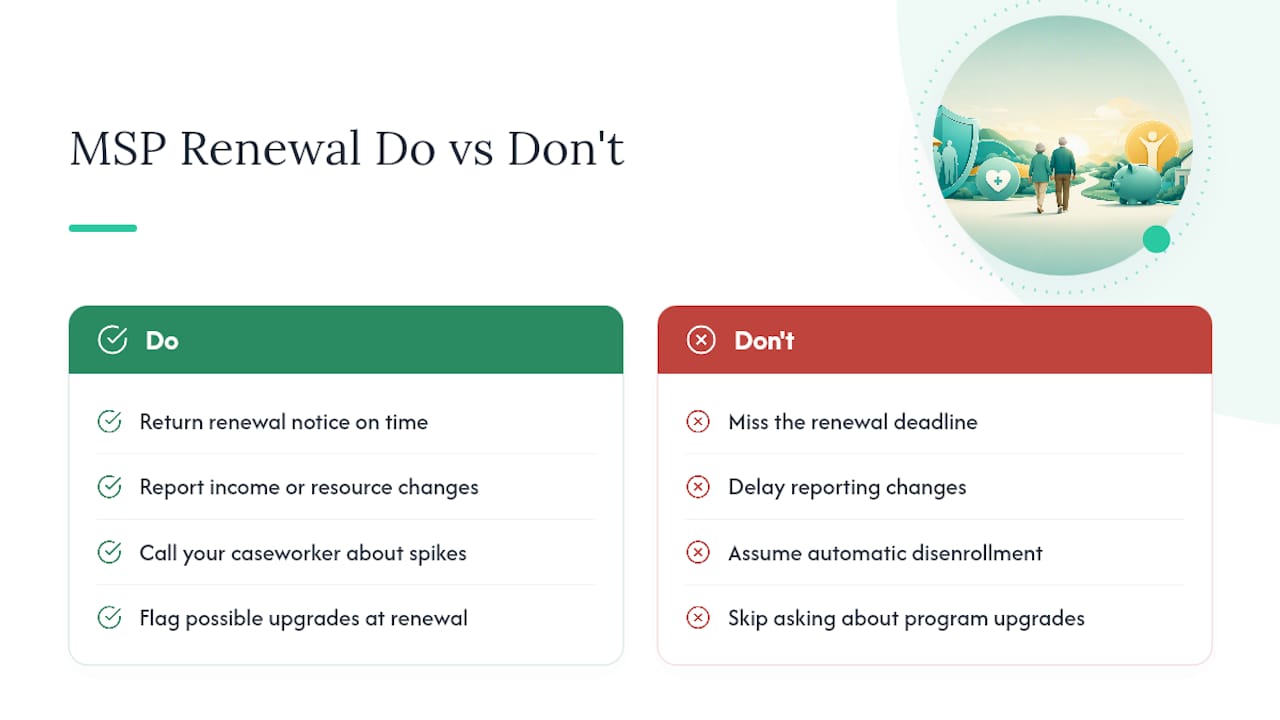
MSP eligibility isn’t permanent. Most states conduct an annual redetermination, sometimes called a renewal or recertification, where you have to confirm your income and resources are still within range. You’ll typically get a notice in the mail several weeks before your renewal date, and missing that deadline can mean your benefits lapse, even if you’re still financially eligible.
Between renewals, you’re generally required to report changes that could affect your eligibility: a new job, a raise, an inheritance, a change in your living situation, or a shift in your resources like selling a home or receiving a lump sum. Some states require you to report changes within 10 days; others give you 30. Check your approval letter for your state’s specific reporting window, because failing to report a change promptly can trigger an overpayment notice down the line, where the state asks you to repay benefits you weren’t actually entitled to.
If your income temporarily rises above the limit, don’t assume you’re automatically disenrolled. Some states apply a grace period or average income over several months, particularly for people with seasonal or fluctuating earnings. It’s worth calling your caseworker directly rather than guessing.
Renewal is also your opportunity to catch a program upgrade. If your income dropped since your last determination, you might now qualify for QMB instead of SLMB, meaning broader coverage of deductibles and coinsurance you weren’t getting before. Nobody automatically checks this for you. It’s on you, or whoever helps you with your paperwork, to flag it during the renewal window.
What Exactly Do These Programs Pay For?
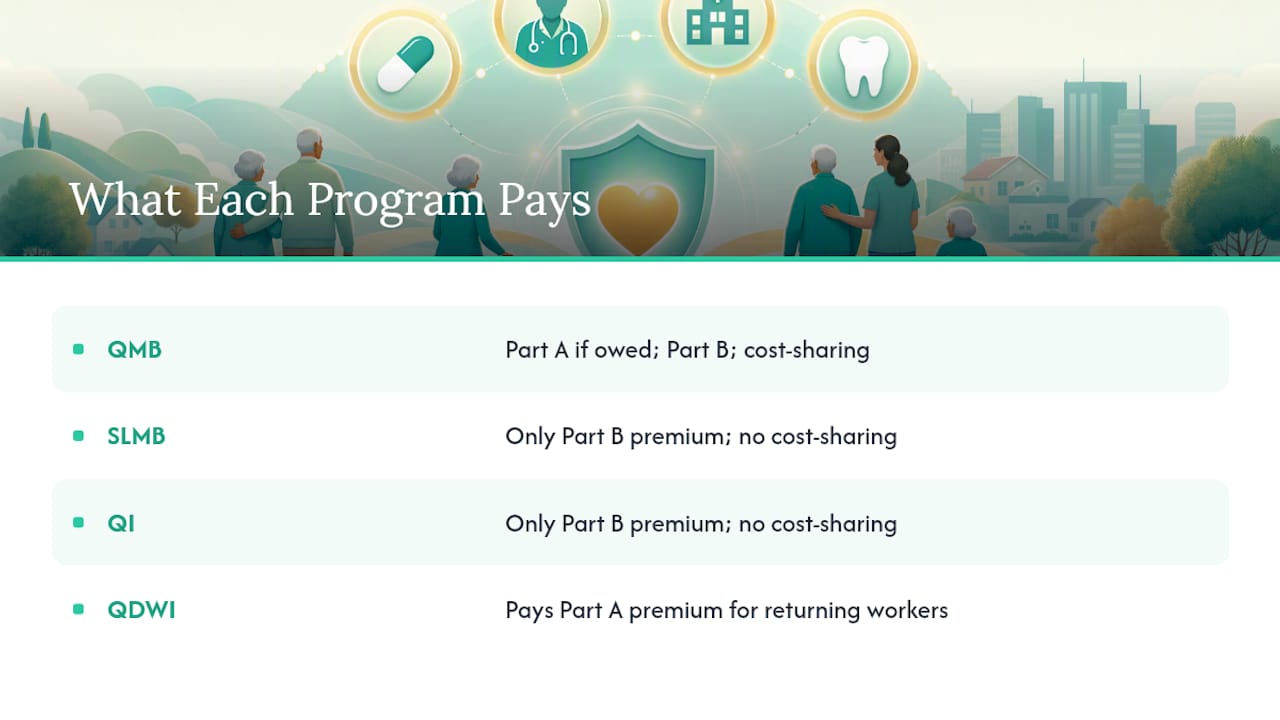
QMB is the only one of the four that touches your out-of-pocket costs beyond the premium. It pays your Part A premium if you owe one, your full Part B premium, and then your deductibles, coinsurance, and copayments across the board for Medicare-covered care. If you’re admitted to a hospital, see a specialist, or need durable medical equipment, QMB is picking up the cost-sharing Medicare leaves on your plate.
SLMB and QI are narrower by design. Both cover only the Part B premium, which currently runs over $100 a month for most beneficiaries, so even that single benefit adds up to well over $1,000 a year in relief. Neither program touches deductibles or coinsurance, so if you’re hospitalized, you’re still responsible for those costs unless you also carry a Medicare Supplement or Advantage plan with its own cost-sharing structure.
QDWI stands apart because it’s not about income-based hardship in the traditional sense. It exists specifically for people under 65 with disabilities who went back to work, lost their premium-free Part A as a result, and now face a Part A premium bill they didn’t have before. QDWI picks up that premium so returning to work doesn’t cost someone their hospital coverage.
The billing protection tied to QMB deserves its own mention. Providers who accept Medicare are barred from charging QMB enrollees the balance between their fee and what Medicare pays, a practice called balance billing. That protection applies whether or not the provider realizes the patient is enrolled in QMB, which is why documentation matters if a bill shows up anyway.
What Mistakes Do Applicants Commonly Make?
The most common mistake is simply not applying because someone assumes their income is too high. Federal limits are a floor, not a hard ceiling nationwide, and state-level disregards for things like retirement accounts or vehicles routinely push the real threshold higher than what’s published federally.
A second mistake is confusing QI with the other programs. QI requires annual reapplication and depends on yearly federal funding, so people who assume it renews automatically like SLMB sometimes lose coverage without realizing it.
Applicants also frequently under-document income, submitting a benefit statement that doesn’t match their actual monthly deposit, or forgetting to disclose a small pension alongside Social Security. Caseworkers will flag mismatches, which slows processing. On the flip side, some people over-report by including excluded resources like their home equity or a single vehicle, which can make them appear ineligible when they’re not.
Finally, many people don’t realize that getting denied once doesn’t mean they’re permanently ineligible. Income changes, and a denial from two years ago has no bearing on your situation today. Reapplying costs nothing but time.
How Long Does the Application and Approval Process Take?
The timeline runs in a fairly predictable sequence, though the exact pace depends on your state’s caseload and how complete your paperwork is on the first submission.
You’ll typically get a written confirmation within a week or two of submitting your application, acknowledging it’s in the queue. From there, most states aim to process a determination within 45 days, though some move faster and others take closer to 60 days during high-volume periods, like right after annual Medicare enrollment ends. If your file is missing documentation, expect a request for additional information that can add another two to three weeks while you gather and resubmit.
Once approved, coverage is often retroactive to the month you applied, sometimes even earlier depending on your state’s rules, so a slow approval doesn’t necessarily mean lost benefits. You’ll receive an approval letter specifying which program you qualify for and the effective date.
If your situation is urgent, such as an active medical bill you can’t pay, ask specifically about expedited review when you submit. Not every state offers it, but many will prioritize a file if you explain the hardship in writing.
How Do MSPs Work Alongside Other Public Assistance Programs?
Medicare Savings Programs rarely operate in isolation. Because they’re run through your state Medicaid office, many states use a shared or streamlined application that also screens you for other assistance, including full Medicaid, Supplemental Nutrition Assistance Program benefits, or state-specific utility and housing assistance.
Qualifying for an MSP also typically triggers Extra Help for Part D drug costs, and the National Council on Aging notes that beneficiaries who coordinate these benefits together see meaningfully lower total annual costs than those who apply for just one piece. If you already receive Supplemental Security Income or full Medicaid, you may already meet MSP criteria without realizing it, since income limits for those programs often overlap closely with MSP thresholds.
The practical takeaway: when you apply for one form of assistance, ask your caseworker what else you might qualify for. State systems are increasingly built to check multiple programs from a single application, so a QMB or SLMB application is often a doorway to broader support rather than a standalone form.
Practitioner Perspective: How Zach Helps Colorado Families Navigate This
As a licensed broker, Zach regularly walks Colorado clients through MSP eligibility, from gathering documents to reviewing state applications before submission. Simply Insurance also runs educational seminars and provides ongoing annual reviews, so clients aren’t left figuring out renewals or Part D coordination alone once they’re enrolled.
— Zach
Get Local Help Applying for a Medicare Savings Program
Reading the eligibility rules is one thing. Filling out your state’s application correctly, on the first try, is another. Simplyinsuranceforyou works with Colorado residents to check MSP eligibility against both federal and state-level rules, walk through the documents your state office wants, and coordinate your Extra Help enrollment so your drug coverage lines up with your new savings.

Because Simplyinsuranceforyou operates as an independent brokerage, there’s no cost to you for this support. Its revenue comes from the insurance carriers, not from your MSP application, so the guidance is built around what actually fits your situation rather than any deadline pressure. Beyond the initial application, the team also handles your annual Medicare plan review, so if your income or a plan detail changes next year, someone is already tracking it with you.
If you’re in Colorado and want a straightforward eligibility check, visit the Medicare help page for your area to connect with a local licensed broker, or browse the full range of services Simplyinsuranceforyou offers beyond MSP support.
Where to Verify Limits and Find State Contacts
Confirm current figures directly through Medicare’s MSP page, find your state Medicaid contact, or call 1-800-MEDICARE (TTY 1-877-486-2048) for phone assistance.
This article is general information, not a substitute for advice from a qualified financial advisor. Consult a qualified financial professional about your own circumstances before acting on anything here.