
Publication time reported by BabyLoveGrowth, shown in Mountain time. This is not an independently measured first appearance on this website.

Medicare Skilled Nursing: Check 3 Day Rule and When to Call a Broker
Yes, Original Medicare Part A pays for short-term skilled nursing facility care, but only when you meet strict conditions. You typically need a qualifying 3-day inpatient hospital stay, admission to a Medicare-certified facility, and daily skilled care ordered by a physician. Coverage runs up to 100 days per benefit period, and Medicare will not pay for long-term custodial care once skilled needs end.
SimplyinsuranceforyouGet Clearer Medicare Coverage GuidanceSimply Insurance provides personalized advice on Medicare options, plus ongoing support with claims and annual reviews.Visit Simply InsuranceTL;DR:
- Medicare covers up to 100 days of skilled nursing care per benefit period only after a qualifying three-day inpatient hospital stay, with coverage ending once skilled needs cease.
- Services must require the skill of licensed professionals, such as wound management or physical therapy, and are not reimbursed for custodial or assistance-only care.
- Coverage depends on strict conditions including hospital inpatient status, timing of admission to a Medicare-certified facility, and the stay occurring within roughly 30 days of hospital discharge.
- Patients face a daily coinsurance of $209.50 from day 21 to 100, with full coverage for the first 20 days, and no Medicare payments beyond day 100 unless other coverage applies.
- Planning ahead involves verifying hospital inpatient status, checking facility certification, and requesting written notices to prevent coverage denials or unexpected costs.
Table of Contents
- What Does Medicare Skilled Nursing Coverage Actually Pay For?
- How Do You Qualify for Skilled Nursing Coverage Under Medicare?
- How Long Does Medicare Cover Skilled Nursing Facility Days?
- What Are the Out-of-Pocket Costs for Skilled Nursing Care?
- What Does Medicare Nursing Home Coverage Exclude?
- Do Medicare Advantage Plans Cover Skilled Nursing Differently?
- How Do You Protect Your Skilled Nursing Coverage Before Admission?
- What Should You Do If Medicare Denies or Ends SNF Coverage?
- How Simply Insurance Helps You Navigate Skilled Nursing Coverage Questions
- A Broker’s Honest Take on Medicare’s Skilled Nursing Rules
- Get Local Help Reviewing Your Medicare Skilled Nursing Coverage
- Where to Read the Official Medicare Rules
- Sources
- FAQ
What Does Medicare Skilled Nursing Coverage Actually Pay For?
Medicare skilled nursing coverage applies to care that requires the skill of licensed professionals, not help with everyday tasks like bathing or dressing. Think wound care that needs a nurse’s judgment, intravenous medication management, or physical therapy following a hip replacement. The Merck Manual’s clinical overview of skilled nursing facilities draws a sharp line between this kind of care and custodial support, which Medicare treats as a completely different category.
The facility itself matters as much as the service. Medicare only pays claims at a Medicare-certified skilled nursing facility (SNF), and it pays through a bundled per-diem system rather than itemizing every service separately. That per-diem rate, set under the Patient-Driven Payment Model, covers room, board, nursing, therapy, and most supplies in one daily figure. The MedPAC payment basics report breaks down how that per-diem rate gets calculated and why it varies by patient acuity.
Here’s where families get tripped up: a doctor’s order alone doesn’t guarantee coverage. The care has to be something only a skilled professional can safely provide.
Services Medicare typically covers in a skilled nursing facility:
- Skilled nursing care, such as IV therapy, injections, and wound management
- Physical, occupational, and speech-language therapy tied to a specific recovery goal
- Medically necessary supplies and equipment used during the stay
- Dietary counseling connected to a medical condition
- Medications administered as part of the treatment plan
Services that don’t qualify, even in the same facility:
- Help with bathing, dressing, or eating when no skilled treatment is involved
- Long-term supervision for dementia or mobility issues without an active rehab goal
- Custodial room and board once skilled therapy or nursing is no longer needed
A patient recovering from a stroke might get 45 days of covered speech therapy and nursing, then plateau. Once the treatment team documents no further skilled progress is expected, Medicare coverage typically ends, even if the person still needs daily assistance.
How Do You Qualify for Skilled Nursing Coverage Under Medicare?
Four conditions have to line up before Medicare pays a dime toward SNF care. Miss one, and the claim gets denied no matter how medically necessary the care seems.
- You have Part A coverage with days left in your current benefit period. Everyone enrolled in Original Medicare has Part A, but your available days depend on how much of your 100-day allotment you’ve already used since your last qualifying gap in care.
- You had a qualifying inpatient hospital stay of at least three consecutive days. This is the rule that trips up more families than any other. Time spent under “observation status” does not count, even if you were in a hospital bed for a week. According to Medicare, you must be formally admitted as an inpatient, and the distinction is entirely up to the hospital’s classification, not how sick you feel.
- You’re admitted to the SNF within roughly 30 days of hospital discharge, and a physician has certified that you need daily skilled nursing or therapy for the same condition treated in the hospital, or a related one.
- The facility itself is Medicare-certified. Not every nursing home or rehab center qualifies, so this needs to be confirmed before admission, not after the bill arrives.
There are exceptions worth knowing about. Some Medicare Advantage plans and Accountable Care Organization arrangements waive the 3-day hospital stay requirement entirely, and PACE (Programs of All-Inclusive Care for the Elderly) uses its own eligibility rules altogether. If you’re in one of these arrangements, the standard checklist above doesn’t fully apply. That’s exactly why checking your specific plan documents before you assume coverage, one way or the other, matters more than following general rules.
How Long Does Medicare Cover Skilled Nursing Facility Days?
Medicare skilled nursing days are counted within something called a “benefit period,” and understanding this mechanic is the difference between planning correctly and getting blindsided by a bill.
A benefit period starts the day you’re admitted as a hospital inpatient or SNF resident. It ends only after you’ve gone 60 consecutive days without inpatient hospital or skilled nursing care. Within that single benefit period, Medicare.gov confirms coverage works like this:
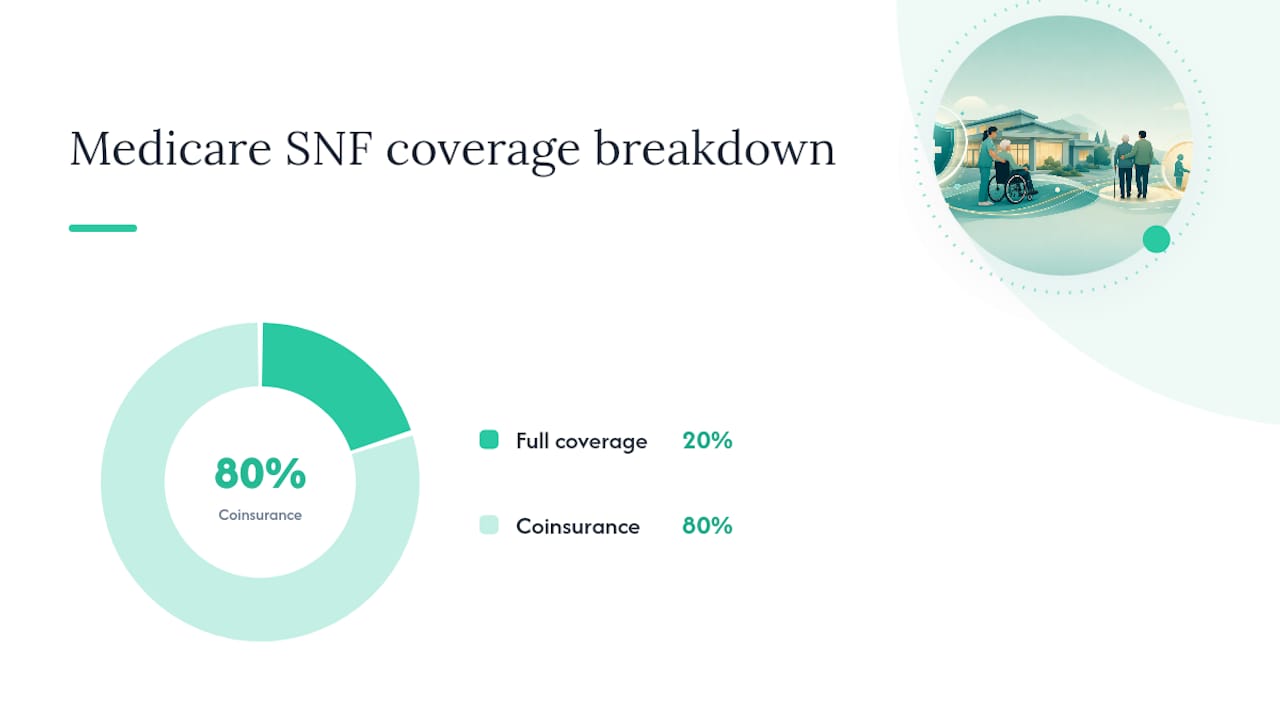
- Days 1 through 20: Medicare pays the full cost. You owe nothing for room, board, nursing, or therapy.
- Days 21 through 100: You owe a daily coinsurance charge, and Medicare covers the rest.
- Day 101 and beyond: Medicare pays nothing. You’re responsible for the full daily rate unless you have supplemental coverage.
Here’s the part that saves people real money if they understand it: readmission timing. If you’re discharged from the SNF and readmitted within 30 days for a related condition, you resume using your remaining days from the same benefit period. You don’t need a new 3-day hospital stay to restart coverage.
Walk through a real scenario. Say you’re hospitalized for 4 days after a fall, spend 25 days in a SNF for rehab, go home, then get readmitted to the SNF 18 days later because your recovery stalls. Because that gap was under 30 days, you pick up right where you left off; you’d still have 75 days remaining in that same benefit period, no new hospital stay required. But if that gap had stretched to 60 days or more, the benefit period would have closed, and you’d need a fresh 3-day qualifying hospital stay to open a new one.
What Are the Out-of-Pocket Costs for Skilled Nursing Care?
The daily coinsurance for skilled nursing facility care runs $209.50 for days 21 through 100 of a benefit period, according to Medicare’s 2025 published rate. That’s on top of any Part A deductible you owe for the hospital stay that qualified you for SNF care in the first place, which applies once per benefit period, not per admission.
Here’s how the math typically plays out for someone using a full 100-day stay:
- Days 1 to 20: $0 coinsurance (Medicare pays the full covered cost)
- Days 21 to 100: $209.50 per day, which adds up to over $16,700 across those 80 days if the full stretch is used
- Day 101 onward: 100% of the cost falls on you unless another payer steps in
Beyond the coinsurance, watch for charges Medicare never covers regardless of benefit period: a private room upgrade you request for comfort rather than medical necessity, personal items like a TV rental or hairstyling, and, of course, any custodial care once skilled treatment stops.
Pro Tip: Don’t assume a Medigap policy automatically wipes out the days 21 to 100 coinsurance. Most Medigap plans do cover it, but confirm your specific plan letter before you rely on it.
For longer-term needs beyond what Medicare covers, Medicaid serves as the primary payer of last resort for custodial nursing home care for those who qualify financially. Employer retiree plans, VA benefits, and standalone long-term care insurance policies are other routes worth exploring well before a crisis hits.
What Does Medicare Nursing Home Coverage Exclude?
The gap between what people expect and what Medicare nursing home coverage actually delivers causes more financial stress than almost any other part of the program. Medicare.gov is direct about this: the program does not cover long-term custodial care when that’s the only type of care a person needs.
Covered under the SNF benefit when skilled criteria are met:
- Semi-private room and meals
- Skilled nursing services and care coordination
- Physical, occupational, and speech therapy
- Medically necessary drugs administered during the stay
- Medical supplies and equipment used in treatment
- Ambulance transportation when medically required and no other transport works safely
Excluded, even inside a covered SNF stay:
- Custodial care, meaning help with daily activities that doesn’t require clinical skill
- Personal convenience items, from phone service to private-room upgrades not medically justified
- Long-term room and board once the skilled component of care ends
Here’s a nuance that surprises people: a doctor can order a service, and Medicare can still deny it. Coverage isn’t triggered by a physician’s signature alone. It’s triggered by whether the service genuinely requires the judgment and skill of a licensed nurse or therapist to be delivered safely. A daily blood pressure check, for instance, might get ordered by a physician but denied as coverage because it doesn’t rise to the level of “skilled” under Medicare’s definition.
Do Medicare Advantage Plans Cover Skilled Nursing Differently?
Medicare Advantage plans follow different rules than Original Medicare, and the differences can work in your favor or against you depending on the plan. Some MA plans waive the standard 3-day hospital stay requirement entirely, letting you access SNF care faster after a shorter hospitalization or, in some cases, without any inpatient stay at all.
That flexibility comes with trade-offs. MA plans typically require prior authorization before SNF admission, and they often restrict coverage to an in-network facility list, which is narrower than the pool of Medicare-certified SNFs available under Original Medicare.
- MA plans and ACO arrangements can waive the 3-day rule, but confirm this in writing before assuming it applies
- Network restrictions mean the closest facility to your home may not be covered
- Cost-sharing structures (copays instead of coinsurance) vary by plan and by day range
- PACE programs use an entirely separate eligibility and coverage framework
Pro Tip: Before any planned hospital stay, call your Medicare Advantage plan directly and ask them to confirm, in writing, whether the 3-day rule applies to your situation and which local SNFs are in-network. Your plan’s Evidence of Coverage document is the definitive source, and it overrides general information every time. If you’re weighing Medicare Advantage against Medigap for exactly this kind of coverage certainty, that comparison is worth working through before you enroll, not after a hospital admission.
How Do You Protect Your Skilled Nursing Coverage Before Admission?
The single biggest mistake families make is discovering, after the fact, that a hospital stay didn’t count toward SNF eligibility. Here’s how to avoid that.
- Ask hospital staff directly: “Am I an inpatient or under observation status?” Get the answer in writing if there’s any ambiguity. This single question determines whether your stay counts toward the 3-day requirement.
- Verify the receiving facility is Medicare-certified before transfer, and check its quality history on Medicare’s Care Compare tool.
- Ask the SNF billing office exactly what will be billed to Part A versus what you’ll be responsible for, including any day-101 exposure if your stay might run long.
- Request written notice the moment coverage is expected to end. This document, called a Skilled Nursing Facility Advance Beneficiary Notice (SNF ABN), should specify the reason coverage is stopping.
- Keep a written log of every admission and discharge date, both hospital and SNF. These dates determine benefit-period math, and disputes over coverage almost always come down to timing.
Pro Tip: Photograph or scan every notice the facility hands you the day you receive it. Denial letters and ABNs have appeal deadlines, and a missing document has ended more than one legitimate appeal before it started.
If you want a deeper walkthrough of exclusions before you’re in the middle of a hospital discharge conversation, Simply Insurance’s guide on what Medicare doesn’t cover lays out the full picture in plain language.
What Should You Do If Medicare Denies or Ends SNF Coverage?
When a facility tells you Medicare coverage is ending, you have real rights, and acting fast protects them.
- Read the SNF ABN carefully. It must state the specific reason coverage is stopping and estimate what you’d owe if you continue care anyway.
- Request a “demand bill” before you pay anything. This forces the facility to submit the claim to Medicare formally, which preserves your right to appeal a denial rather than simply accepting it.
- File an appeal within the deadline listed on your denial notice. The Medicare SNF booklet outlines the formal appeals timeline and required documentation.
- Call 1-800-MEDICARE for procedural questions, or work with a licensed broker for help interpreting the denial and building your case.
- Involve legal counsel if the denial involves a large financial exposure or repeated disputes with the same facility.
Complex or contested cases benefit enormously from someone who reads these notices daily rather than for the first time under stress.
How Simply Insurance Helps You Navigate Skilled Nursing Coverage Questions
Simply Insurance offers expert, independent guidance for individuals and families across Castle Pines and throughout Colorado, and Medicare’s SNF rules are exactly the kind of fine print where that guidance earns its keep. Licensed brokers who work with these plans daily can interpret Evidence of Coverage language and flag whether your specific Medicare Advantage plan waives the 3-day rule before you need that answer under pressure.
That support doesn’t stop at enrollment. Simply Insurance stays involved through future claims questions and annual plan reviews, which matters because SNF network rules and cost-sharing structures can shift year to year even within the same plan.
Because brokers work independently across multiple carriers, the advice you get isn’t tied to pushing one insurer’s product. If you’re comparing Plan G and Plan N quotes specifically to close the gap on SNF coinsurance exposure, that’s a conversation Simply Insurance is built to have, with your actual health picture and budget in view rather than a generic recommendation.
A Broker’s Honest Take on Medicare’s Skilled Nursing Rules
The conventional wisdom treats Medicare skilled nursing coverage like a simple insurance benefit: you qualify, you get 100 days, done. That framing sets people up to fail. Medicare was built to fund short-term recovery, not to be a long-term care solution, and the entire structure, from the skilled-versus-custodial distinction to the 60-day benefit-period reset, reflects that design choice deliberately.
The three most expensive mistakes I see are entirely avoidable. First, families assume a hospital stay counted as inpatient when it was actually observation, torching SNF eligibility before rehab even starts. Second, Medicare Advantage members assume their plan follows Original Medicare’s rules exactly, then get blindsided by a network denial. Third, nobody keeps the paperwork, so when a coverage dispute happens, there’s no documentation trail to support an appeal.
None of this is complicated once you know where to look. It just requires asking the right question at the right moment, usually while standing in a hospital hallway feeling overwhelmed by everything else happening. That’s precisely when a second set of eyes, someone who’s read a hundred Evidence of Coverage documents, is worth the call.
— Zach
Get Local Help Reviewing Your Medicare Skilled Nursing Coverage
Licensed brokers who serve Colorado can review your specific plan documents, check for Medicare Advantage plan waivers of the 3-day hospital rule, and estimate your likely coinsurance exposure, offering guidance beyond piecing together government rules during a crisis.

Simply Insurance’s services cover the full picture: Medicare planning, Medicare Advantage consultations, Medigap Plan G and Plan N quotes, and appeals support when a SNF claim gets denied. There’s no cost to you for the consultation itself since brokers are compensated by carriers, not by clients. A typical review starts with confirming your Part A status and benefit-period standing, then walks through your plan’s Evidence of Coverage line by line so nothing surprises you at the SNF admissions desk.
If you’re facing a hospital discharge decision now, or just want your coverage checked before you need it, visit the Simply Insurance services page to schedule a plan review with a licensed broker who knows Colorado’s local facility networks.
Where to Read the Official Medicare Rules
For primary documentation beyond this guide, a few official sources cover the technical detail directly:
- Medicare for current coverage rules and coinsurance rates
- The Medicare SNF booklet, Publication 10153, for benefit-period mechanics in full detail
- CMS’s Medicare Learning Network SNF resources for billing and provider-side rules
- MedPAC’s payment basics report for how SNF payment rates are actually calculated
This article is general information, not a substitute for advice from a qualified doctor. Consult a qualified healthcare professional about your own circumstances before acting on anything here.
Sources
- Medicare
- Medicare
- Skilled Nursing Facility Billing Reference - MLN — CMS
- Skilled nursing facilities — Merck Manual (Professional)
- Skilled nursing facility services payment system — MedPAC
FAQ
How Long Will Medicare Pay 100% of a Skilled Nursing Facility Stay?
Medicare pays the full cost of a skilled nursing facility stay for the first 20 days of a benefit period, with $0 coinsurance. Starting on day 21, you owe a daily coinsurance of $209.50 through day 100, after which Medicare stops paying entirely.
Do You Lose Social Security Benefits When You Go Into a Nursing Home?
No, entering a nursing home does not affect your Social Security retirement or disability benefits, which continue regardless of where you live. Social Security and Medicare skilled nursing coverage operate under completely separate rules, and a nursing home stay has no bearing on your monthly benefit amount.
How Much Skilled Nursing Care Will Medicare Pay For?
Medicare pays for up to 100 days of skilled nursing facility care per benefit period, provided you meet eligibility rules like the qualifying 3-day inpatient hospital stay. Coverage requires that you need daily skilled nursing or therapy, not just custodial assistance.
Why Won’t Medicare Pay for Nursing Home Care?
Medicare won’t pay for nursing home care when the only need is custodial, such as help with bathing or dressing, rather than skilled medical treatment. According to Medicare.gov, the program is designed to fund short-term rehabilitation and skilled care, not long-term custodial housing, which is why families often need to explore Medicaid or long-term care insurance for extended stays.
Can a Licensed Broker Help Me Understand My Skilled Nursing Coverage?
Yes, a licensed broker can review your specific Medicare Advantage or Original Medicare plan documents and clarify how the 3-day rule, network restrictions, and coinsurance apply to your situation. Simply Insurance offers this kind of independent, no-cost consultation for residents throughout Colorado through its Medicare planning services.