
Publication time reported by BabyLoveGrowth, shown in Mountain time. This is not an independently measured first appearance on this website.

Narrow vs Broad Network: Which Health Plan Fits You?
A narrow network plan contracts with fewer doctors and hospitals and usually charges a lower premium. A broad network plan contracts with most providers in your area and usually costs more. Neither is better in the abstract: the right one is the plan whose network includes the doctors you actually use, at a premium you can carry. Checking that takes a list of your providers and a few minutes with each plan’s directory. At Simply Insurance, we are independent licensed brokers in Castle Pines, and we do that comparison across carriers with you, so you see both kinds of plans side by side.
Simplyinsuranceforyousimplyinsuranceforyou.comCompare Plans Around Your DoctorsSimply Insurance’s independent licensed brokers help you compare network options across carriers, so you can weigh coverage against your needs and budget.VisitTL;DR
- A broad network includes almost all providers in an area. A narrow network includes a limited group, which is how it keeps premiums lower.
- Marketplace plans with broader physician networks cost about 8% more in premiums than the narrowest ones, according to KFF’s 2024 analysis.
- Going out of network can mean paying the full bill, so your doctor list should come before the premium in any comparison.
- In Medicare Advantage, HMO plans generally cover only in-network care outside emergencies, while PPO plans let you go out of network at a higher cost.
- Networks change every year. Review your plan’s Annual Notice of Change before Medicare’s yearly Open Enrollment.
Table of Contents
- What a provider network is
- Narrow vs broad: how the sizes are defined
- Why narrow networks cost less
- What you give up, and what you gain
- In-network vs out-of-network: what it means on a bill
- Narrow vs broad in Medicare Advantage
- What families should compare
- How to check a network before you enroll
- Our view
- Get a network comparison built on your doctors
- FAQ
- Sources
What a provider network is
A provider network is the group of doctors, hospitals, labs and other providers a health plan has negotiated prices with. FAIR Health’s consumer guide describes it this way and notes that plans must meet state rules requiring an adequate network, including primary care doctors and specialists, in each city or region they cover.
Providers in the network are “in-network.” Providers without a contract are “out-of-network.” The difference matters at the billing desk, which we cover below.
Narrow vs broad: how the sizes are defined
There is no single legal cutoff, but the Society of Actuaries gives a useful yardstick for hospitals. In its 2018 provider networks report:
Network size Share of area hospital admissions covered Broad More than 80% Narrow 20% to 80% Very narrow Less than 20%The same report points out that “narrow” describes size only. It says nothing on its own about the quality or value of the care. Some smaller networks are very good, and size alone does not predict performance.
On the physician side, KFF found that in 2021 Marketplace enrollees could reach on average 40% of the doctors near home through their plan. About 23% of enrollees were in plans covering a quarter or fewer of local doctors, and only 4% were in plans covering more than three-quarters (KFF, August 2024). In other words, narrow is common, and broad is rare.
Why narrow networks cost less
The mechanism is simple bargaining. A systematic review of narrow and tiered networks explains that providers accept lower prices in exchange for the promise of more patients, which lets the insurer set lower premiums. Higher cost-sharing for out-of-network care nudges patients to stay inside the group.

The Peterson-KFF Health System Tracker describes the balance plans try to strike: a network narrow enough to bargain with, but broad enough that members stay satisfied (Peterson-KFF, 2019).
How much do you save? It varies by market:
- KFF found Silver Marketplace plans with more than 50% of area doctors cost 8% more in premiums than plans with 25% or fewer, and 3% more for plans in the 25% to 50% range (KFF).
- In Medicare Advantage, KFF’s 2017 analysis found broad-network HMOs averaged $54 a month in premium against $4 for narrow-network HMOs, and broad-network PPOs averaged $100 against $28 (KFF, 2017). Those are 2015 plan-year figures, so treat them as a picture of the gap, not today’s prices.
The review also found evidence that narrow networks can reduce out-of-pocket costs, and that studies of access and quality generally found no systematic harm. So a narrow plan can be a sound value, provided your own providers are in it.
What you give up, and what you gain
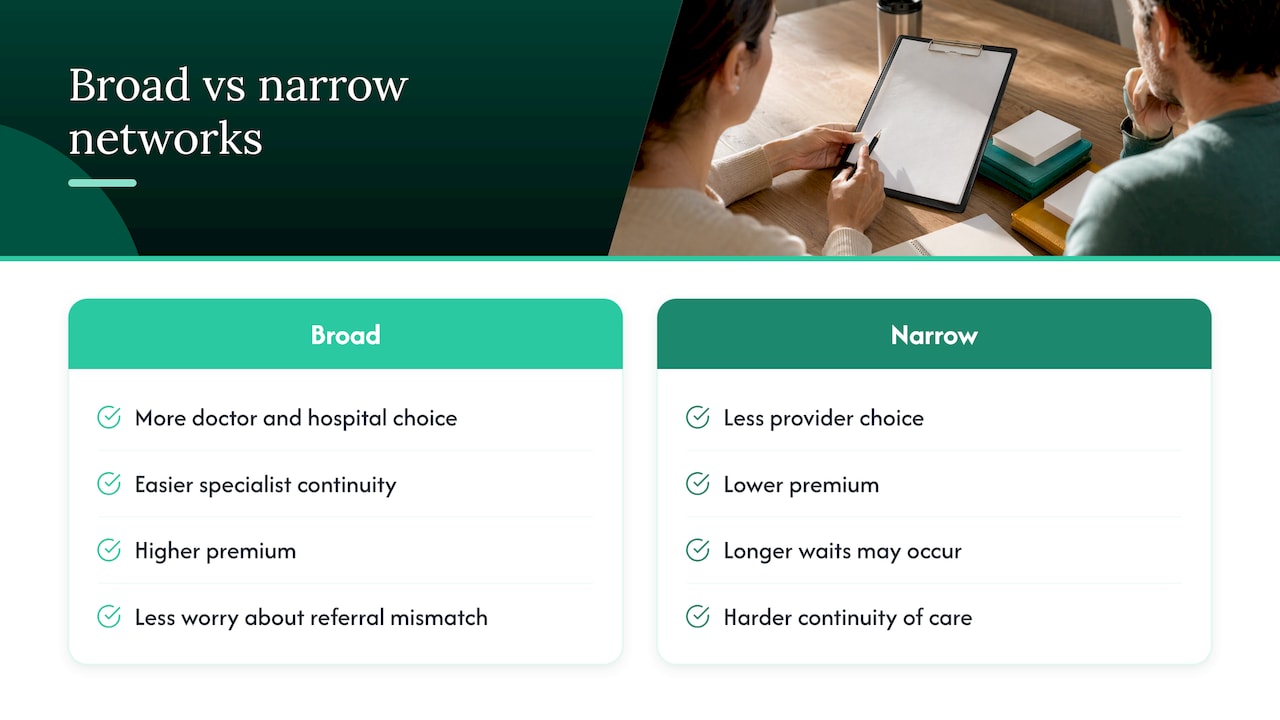
Broad network: more choice of doctors and hospitals, easier continuity of care if you already have a specialist you trust, and less worry about a referral landing outside the plan. The price is a higher premium.
Narrow network: a lower premium, and often a perfectly good set of providers. The price is less choice. KFF notes that smaller networks can mean longer waits, harder continuity of care, and bigger bills for people who end up out of network. In its Marketplace survey data, 20% of consumers said a provider they needed was not covered in the past year (KFF).
Specialties matter too. In KFF’s study of Medicare Advantage plans, psychiatrists were the most restricted specialty, with plans including 23% of county psychiatrists on average (KFF, 2017). If you or a family member needs mental health care, a specialist, or a particular hospital, check those names first.
In-network vs out-of-network: what it means on a bill
In-network providers have agreed to the plan’s negotiated prices. Out-of-network providers have not. According to the Washington State Office of the Insurance Commissioner, going out of network can mean:
- paying the full bill if the plan does not cover it,
- coinsurance that does not count toward your out-of-pocket limit,
- balance billing, where the provider bills you for the difference above what the plan pays,
- paying first and then seeking reimbursement.
The same logic applies to other coverage. Dental is a common example, and an out-of-network dentist’s costs can look quite different from in-network pricing. If you are weighing dental plans, our dental HMO vs PPO guide walks through the same trade-off.
Emergencies and surprise bills
Emergencies are treated differently. CMS explains that plans cannot charge higher copayments or coinsurance for emergency care at an out-of-network hospital, and cannot require prior approval for it. You may still owe your in-network deductible.
The No Surprises Act, signed December 27, 2020, goes further. It prohibits balance billing and limits cost sharing for most out-of-network emergency services, certain out-of-network non-emergency services at in-network facilities, and out-of-network air ambulance services (CMS No Surprises Act toolkit). If you think you were billed wrongly, the No Surprises Help Desk at 1-800-985-3059 takes questions and complaints, per the same toolkit.
Narrow vs broad in Medicare Advantage
For readers turning 65 or reviewing Medicare, network type is mostly a question of plan type. Medicare.gov’s guide to Medicare Advantage explains the split:
- HMO plans generally cover care only from in-network providers, with exceptions for emergency care, out-of-area urgent care and temporary out-of-area dialysis. Non-emergency care outside the network without authorization may leave you paying the full cost.
- PPO plans let you use out-of-network providers for covered services, usually at a higher cost.
Plans must also notify you if your doctor leaves the network.
KFF found that in 2015, 35% of Medicare Advantage enrollees were in narrow-network plans (under 30% of county physicians) and 22% were in broad-network plans (70% or more) (KFF, 2017). The share varies by county, which is why a Castle Pines resident’s options can differ from those of someone in another part of Colorado.
If you want the details on what happens when a Medicare Advantage member goes outside the network, we cover it in out-of-network Medicare Advantage coverage and costs. To weigh Medicare Advantage against a Medigap policy, see our Medicare Advantage vs. Medigap comparison.
What families should compare
Families buying individual coverage face the same trade, with more moving parts: pediatricians, an OB-GYN, a family doctor, maybe a therapist, and the nearest hospital. CMS’s enrollment guidance suggests asking whether you would pay more for a larger pool of providers, since some plans hold premiums down with a smaller network (CMS enrollment toolkit, 2025).
Premium is one piece of total cost, so look at deductibles too. Our guides on choosing family health insurance by total cost and Bronze vs Silver plans cover that. In Colorado, plan type also shapes network rules, as we explain in PPO vs POS.
How to check a network before you enroll
- Write your list. Include every doctor, specialist, hospital, lab and pharmacy you use or expect to use this year.
- Search each plan’s directory. CMS advises searching for your providers in each specific plan’s network when comparing Marketplace plans, then calling the insurer’s customer service line to confirm they participate (CMS, February 2026). For Medicare, Medicare.gov recommends confirming with both your providers and the plan, and comparing plans at Medicare.gov/plan-compare or by calling 1-800-MEDICARE.
- Confirm by phone. Directories can lag. Ask the provider’s office whether they accept that specific plan, not just that insurer.
- Compare out-of-network rules. Know whether the plan covers any out-of-network care and at what cost.
- Price the whole year. Add premium, deductible and likely copays for the care you expect.
- Recheck every fall. Providers can leave a network or change tiers, a point the Massachusetts insurance regulator makes in its network guide. Medicare plans mail an Annual Notice of Change by September 30 describing changes that take effect in January.
Open Enrollment for Medicare runs from October 15 to December 7 each year. During it you can switch Medicare Advantage or drug plans, and changes take effect January 1.
The hardest part is step 2 repeated across several carriers. Our Medicare provider directory page is a place to start finding providers near you.
Our view
We don’t think the question is narrow or broad. The question is whose names are on your list.
A narrow plan that includes your primary care doctor, your cardiologist and your hospital can be an excellent value. A broad plan that costs more than you need, for doctors you never see, is not a bargain. Neither answer is visible from a premium table.
That’s why we work as independent, licensed brokers across multiple carriers. We compare networks against your actual providers and prescriptions, tailored to your health needs and your budget. And because networks change each year, we stay with clients after enrollment, with annual reviews and help with claims.
If you’re turning 65 in Castle Pines or anywhere in Colorado, bring your list. We’ll start there.
Zach
Get a network comparison built on your doctors
If you are choosing between Medicare Advantage, Medigap and a Part D plan, or comparing individual and family plans, we can compare carriers against your provider list. Our service has no direct cost to you, since carriers pay us when you enroll. Start with our Medicare Advantage consultation and other services, or see our Medicare Advantage plans for Castle Pines.

If you are not yet sure when to enroll, our Medicare enrollment timeline lays out the windows.
FAQ
What does broad network mean?
A broad network includes almost all providers in an area. The Society of Actuaries describes a broad hospital network as one covering hospitals with more than 80% of the area’s admissions. You get the most choice, and the premium is usually higher.
Is a narrow network plan always worse?
No. Narrow describes size, not quality. A systematic review found narrow networks associated with lower costs, and studies of access and quality generally found no systematic harm. What matters is that your doctors and hospitals are inside it.
Which is better, in-network or out-of-network?
In-network care is usually cheaper because the provider has agreed to the plan’s prices. Out-of-network care can mean higher cost-sharing, balance billing or the full bill, depending on the plan. Emergencies are the exception: federal rules limit what plans can charge for out-of-network emergency care.
Can my doctor leave my plan’s network?
Yes. Providers can leave a network or change tiers. Medicare Advantage plans must notify you if your doctor leaves, and your Annual Notice of Change describes network changes for the new year. Review it before Open Enrollment ends on December 7.
Sources
- KFF: How Narrow or Broad Are ACA Marketplace Physician Networks?
- KFF: Medicare Advantage: How Robust Are Plans’ Physician Networks?
- Society of Actuaries: Provider Networks, Actuarial Perspective on Performance
- FAIR Health: Narrow Networks
- Systematic review of narrow and tiered networks (PMC)
- Peterson-KFF Health System Tracker: Employer strategies and network configuration
- Washington State Office of the Insurance Commissioner: Medical provider networks
- CMS: What You Should Know About Provider Networks
- CMS: No Surprises Act Toolkit for Consumer Advocates
- CMS: Enrollment Toolkit 2025
- Medicare.gov: Understanding Medicare Advantage Plans
- Medicare.gov: Open Enrollment
- Massachusetts Division of Insurance: Network guide
- Out-of-network dentist costs