

Colorado Seniors: Get a Broker to Check Your 2026 Part D Deductible
The maximum deductible for Medicare Part D plans in 2026 is capped at $615, and once your out-of-pocket spending reaches $2,100 for the year, your covered drugs will cost you nothing for the rest of the year. Plenty of plans set their deductible lower than $615, and some charge $0. The number that actually matters is the one printed on your specific plan’s Summary of Benefits, not the national ceiling, so check it before you assume anything about next year’s drug bill.
SimplyinsuranceforyouReview Your Medicare Drug CoverageSimply Insurance provides personalized guidance from licensed brokers to compare Medicare plans and support you beyond enrollment.Visit Simply InsuranceTL;DR:
- Most plans will have deductibles below the maximum $615 limit, with some offering plans that charge no deductible at all, especially through Extra Help programs.
- During the deductible stage, you pay 100% of drug costs on your formulary filled at in-network pharmacies, with only those expenses counting toward the $2,100 out-of-pocket cap.
- The average deductible for Medicare Advantage plans is around $371, while standalone drug plans average about $544, but there is significant variation among plans and tiers.
- Comparing drug-specific costs using Medicare Plan Finder or working with a broker can prevent overpaying, especially with specialty drugs or complex formulary arrangements.
- Shifting to generic medications, 90-day supplies, and applying for assistance programs can substantially lower your annual drug costs amid rising deductibles and shifting plan designs.
Table of Contents
- Part D Deductible 2026: The Numbers You Need First
- How the Deductible Stage Actually Works in 2026
- MA-PD vs. PDP: Why Your Deductible Amount Varies
- Checking Your Plan and Estimating Your 2026 Drug Costs
- Practical Ways to Lower Your Drug Costs in 2026
- What Changed for 2025 and 2026, and What’s Next
- A Broker’s Quick View: Why Individualized Plan Reviews Matter in 2026
- How Simply Insurance Helps You Navigate Your 2026 Part D Options
- Primary Sources and Official Guidance
- Sources
- FAQ
Part D Deductible 2026: The Numbers You Need First
Two figures anchor everything else in this article. The CMS final CY 2026 Part D program instructions set the maximum allowable deductible at $615 and the annual out-of-pocket cap at $2,100.
- Maximum deductible: The ceiling is $615; no Part D plan can legally charge more, and Medicare some plans charge less or nothing at all.
- Deductible stage: You pay the full negotiated price for covered drugs until you hit your plan’s deductible amount.
- Initial coverage stage: After the deductible, you typically pay 25% coinsurance on covered drugs.
- Catastrophic stage: Once you reach the $2,100 out-of-pocket cap, your cost sharing drops to $0 for the rest of the calendar year.
- Extra Help exception: Beneficiaries enrolled in the Low-Income Subsidy program pay no deductible at all, regardless of which plan they choose.
Quick fact: Not every plan sets its deductible at the $615 maximum. Many Medicare Advantage plans with drug coverage (MA-PDs) charge far less than standalone Part D plans, a gap that shows up clearly once you compare Summary of Benefits documents side by side.
How the Deductible Stage Actually Works in 2026
During the deductible stage, you pay 100% of the negotiated cost for your covered drugs, and the plan pays nothing, according to CMS’s 2026 program instructions. That continues until your spending reaches your plan’s deductible amount, which can be anywhere from $0 up to the maximum allowed.
What counts toward that deductible is narrower than people expect. Only amounts you pay for drugs on your plan’s formulary, filled at an in-network pharmacy, count. Over-the-counter medications, drugs excluded from Part D by law, and anything filled outside your plan’s network typically don’t apply.
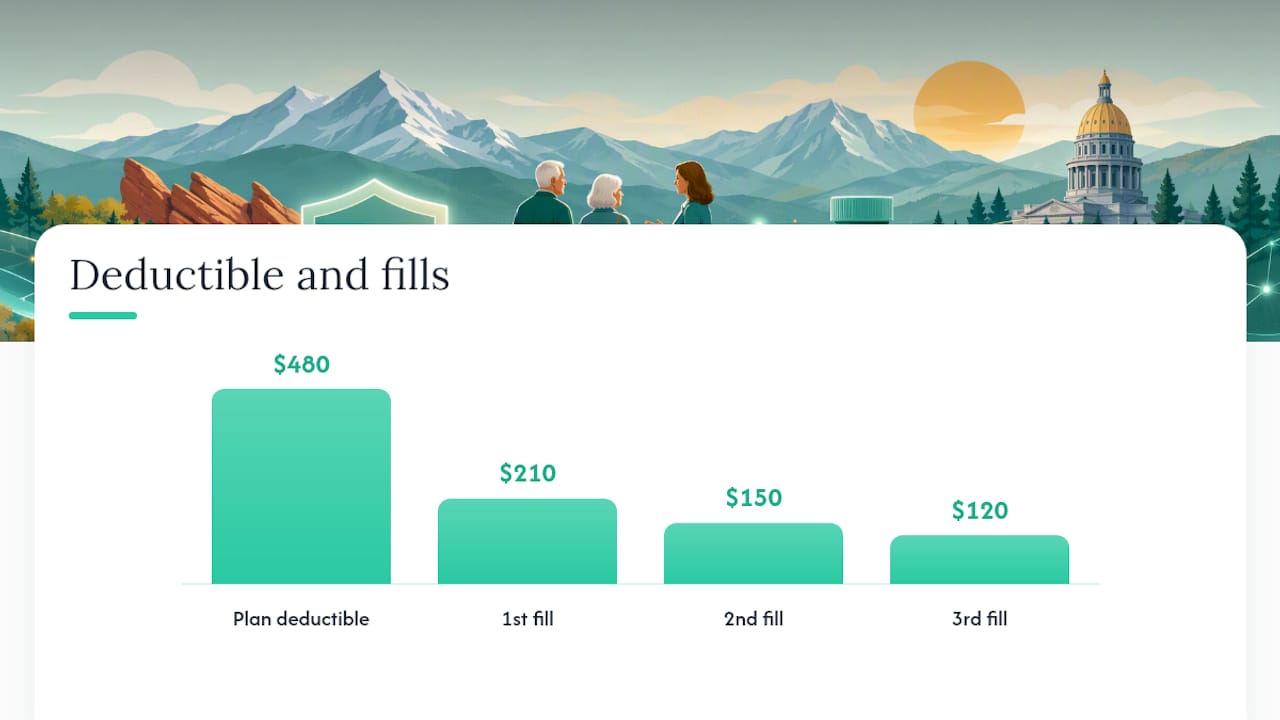
Here’s how it plays out with real numbers. Say your deductible is $480 and your first prescription of the year, a 30-day supply of a brand-name blood pressure medication, costs $210 at the pharmacy counter.
- You pay the full $210, since you haven’t met your deductible yet.
- Your remaining deductible drops to $270.
- Your next fill, say a $150 cholesterol drug, again gets paid in full by you.
- Your remaining deductible is now $120.
- On your third fill, once that $120 is covered, you move into the initial coverage stage and start paying 25% coinsurance instead of the full price.
Every dollar you pay in the deductible stage also counts toward your $2,100 out-of-pocket cap for the year, so nothing you spend there is wasted. It’s simply front-loaded.
Pro Tip: Keep every pharmacy receipt from January onward. If a claim gets miscoded or a plan’s records lag, your receipts are the fastest way to prove you already met part of your deductible.
MA-PD vs. PDP: Why Your Deductible Amount Varies
Not all Part D coverage looks the same, and plan type is the biggest reason why. KFF’s 2026 analysis puts the weighted average deductible at $371 for Medicare Advantage plans with drug coverage and $544 for standalone prescription drug plans (PDPs).
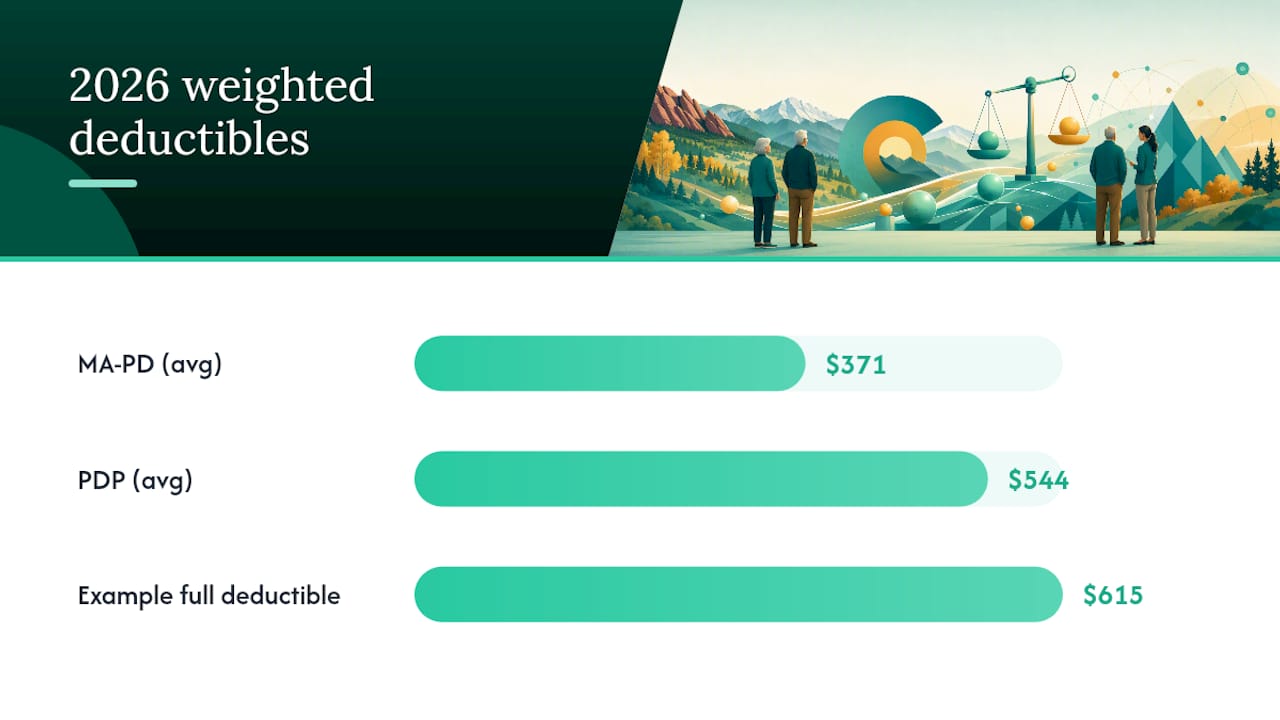
That gap didn’t exist a few years ago. A growing share of MA-PDs now charge some deductible where many once charged none, a shift tied directly to the Part D redesign’s new out-of-pocket cap. Plans absorbed less risk on the back end, so more of them added cost sharing on the front end.
A few things worth knowing as you compare options:
- Partial deductibles are common. Some plans apply the deductible only to certain drug tiers, often tiers 3 through 5, while tiers 1 and 2 (generics) skip the deductible entirely.
- Lower deductibles often mean higher premiums. A $0 deductible plan isn’t automatically cheaper. It may charge more monthly or apply steeper coinsurance later.
- The Summary of Benefits spells it out. Look for the line labeled “Annual Deductible” and check whether it says “applies to all tiers” or lists exceptions.
- Star ratings don’t reflect deductible size. A 5 star plan can still carry the full $615 deductible, so don’t assume quality and cost sharing move together.
Checking Your Plan and Estimating Your 2026 Drug Costs
Guessing at your annual drug spending is a bad habit that costs real money. Medicare’s Plan Finder tool exists specifically so you don’t have to.
- Log into your plan’s member portal or Medicare.gov and pull up your Summary of Benefits.
- Find the deductible line and confirm whether it applies to all drug tiers or only some.
- Open your plan’s formulary and locate each of your current medications by tier.
- Enter your exact drug list and preferred pharmacy into Medicare Plan Finder to get a personalized cost estimate for the year.
- Compare that total, not just the premium, against other plans available in your area.
A few situations call for more than a solo search:
- You take specialty drugs that jump between formulary tiers year to year.
- Your regimen includes drugs with prior authorization or step therapy requirements.
- You’re unsure whether a manufacturer coupon or assistance program applies to your specific plan.
When your situation gets that complicated, calling your plan’s customer service line answers billing questions, but working with a licensed broker who can run drug-specific projections across multiple carriers often saves more time and money. Track every fill and receipt as the year goes on. That running total tells you exactly how close you are to the $2,100 catastrophic threshold.
Practical Ways to Lower Your Drug Costs in 2026
The deductible is fixed once you pick a plan, but plenty of your total spending isn’t. Small choices compound fast over twelve months of refills.
- Ask about generics and therapeutic alternatives every time a doctor writes a new prescription. Brand-name drugs eat through a deductible far faster than their generic equivalents.
- Check tier placement before you fill anything new. A drug that’s tier 2 on one plan can be tier 4 on another, and that difference alone can shift your annual cost by hundreds of dollars.
- Switch to 90-day mail-order fills for maintenance medications. Most plans price a 90-day supply lower per unit than three separate 30-day fills.
- Look into manufacturer copay cards and patient assistance programs for expensive brand-name drugs, especially specialty medications with no generic option.
- Apply for Extra Help if your income and assets fall within program limits. Recipients skip the deductible stage entirely.
- Compare total annual cost, not premium, during the Annual Election Period. A plan with a $0 premium and a $615 deductible can easily cost more over the year than a plan with a modest premium and a $0 deductible.
Pro Tip: Run your full drug list through Plan Finder every single Annual Election Period, even if you liked your plan last year. Formularies and deductibles reset annually, and last year’s best deal is rarely this year’s best deal.
What Changed for 2025 and 2026, and What’s Next
The Part D redesign introduced the annual out-of-pocket cap, eliminating the old coverage gap (“donut hole”) entirely starting in 2025. That cap protects beneficiaries from unlimited drug spending, but it changed who absorbs the risk along the way.
Plan sponsors, facing more exposure once a beneficiary hits catastrophic coverage, responded by shifting more cost sharing to the front end. That’s a big reason more plans now charge deductibles than in prior years, including many MA-PDs that used to waive them. Watch for CMS guidance updates on prescription drug event reporting and formulary changes throughout the year. Those notices can shift what counts toward your deductible mid-year.
A Broker’s Quick View: Why Individualized Plan Reviews Matter in 2026
The premium on the brochure rarely tells you what you’ll actually spend. Your medication list does. I’ve seen beneficiaries pick the cheapest-looking plan and end up paying more than a neighbor on a pricier plan simply because their prescriptions landed on better tiers elsewhere. That’s why annual reviews matter as much as enrollment itself, and why understanding how Part D works before you commit saves real money down the line.
— Zach
How Simply Insurance Helps You Navigate Your 2026 Part D Options
You can work with a licensed broker who runs the numbers on your specific medication list before you enroll.

If you’re turning 65, aging into Medicare, or just tired of guessing whether your current plan still fits your prescriptions, you can get plan comparisons, enrollment help, and annual reviews from a local broker in Castle Pines and Colorado. That last part matters more than most people realize. Plans change their formularies and deductibles every year, and a plan review each fall catches cost increases before they hit your wallet in January. Because brokers typically earn fees from carriers rather than clients directly, there may be no added cost to getting a second opinion on your coverage. If you want help sorting through 2026 Part D options for your exact drug list, visit the Medicare guide to see how a consultation works, or reach out directly to get started before the next enrollment window closes.
Primary Sources and Official Guidance
- CMS Final CY 2026 Part D Redesign Program Instructions: the federal source for 2026 deductible and out-of-pocket cap figures.
- Medicare: official consumer guidance and Plan Finder access.
- KFF’s Part D enrollment and cost-sharing analysis: independent data on plan-level averages and enrollment trends.
- NCOA’s guide to who pays what under Part D: accessible breakdown of the redesigned benefit’s cost-sharing shifts.
This article is general information, not a substitute for advice from a qualified doctor. Consult a qualified healthcare professional about your own circumstances before acting on anything here.
Sources
- Final CY 2026 Part D Redesign Program Instructions | CMS
- Medicare
- Medicare Part D enrollment, premiums, and cost sharing in 2026 | KFF
FAQ
What Is the Best Medicare Part D Drug Plan for Seniors?
There’s no single best plan. The right one depends on your specific medications, pharmacy preference, and total annual cost, which is why comparing your drug list through Medicare Plan Finder or with a licensed broker matters more than picking the plan with the lowest premium.
Can You Deduct Medicare Part D Premiums From Your Taxes?
If you itemize deductions and your total medical expenses exceed 7.5% of your adjusted gross income, Part D premiums generally count as a deductible medical expense on your federal return; check with a tax professional for your specific situation.
What Do Most People Pay for Medicare Part D?
Costs vary widely by plan type. In 2026, the average deductible runs about $371 for MA-PD plans and $544 for standalone PDPs, with the maximum any plan can charge capped at $615.
What Types of Prescriptions Are Not Covered by Medicare Part D?
Part D generally excludes over-the-counter drugs, medications used for weight loss or cosmetic purposes, and certain drugs already covered under Medicare Part A or Part B, so those costs won’t count toward your deductible or out-of-pocket cap.
What Happens After I Hit the $2,100 Out-of-Pocket Cap?
Once your out-of-pocket spending reaches $2,100 for the year, you enter catastrophic coverage and pay $0 for covered Part D drugs for the remainder of the calendar year, as outlined in CMS’s 2026 program instructions.