
Publication time reported by BabyLoveGrowth, shown in Mountain time. This is not an independently measured first appearance on this website.

Part D Drug Exceptions: How to Request One and Win
A Part D drug exception is a request that your plan cover a medication it would normally restrict. Your drug may be missing from the plan’s list, or it may need step therapy or a dose limit that doesn’t work for you. Or it may sit on a tier that costs too much. You can ask, your prescriber has to back the request, and the plan has to answer within set deadlines. If it says no, you have five levels of appeal. Here is how the process works and where requests tend to stall. Our licensed, independent Colorado brokers help people through exactly this kind of problem, including appeals and grievances.
SimplyinsuranceforyouGet Clearer Medicare GuidanceSimply Insurance offers personalized, independent guidance to compare Medicare options, with support during enrollment and for future claims and annual reviews.VisitTL;DR
- An exception is a type of coverage determination. It asks the plan to cover a drug that is off its formulary (its list of covered drugs), to waive a restriction, or to move a drug to a cheaper tier.
- You, your representative or your prescriber can file it, but the prescriber’s statement that the drug is medically necessary is what makes it work.
- The plan’s clock for an exception starts when it receives that prescriber statement, not when you first call.
- A denial is not the end: you have 65 days to ask for a redetermination, the first of five appeal levels.
- An approved exception normally lasts to the end of the calendar year, so plan ahead for next year.
Table of Contents
- What a Part D exception actually is
- When an exception is worth requesting
- Who can file, and what the prescriber must provide
- How to request an exception, step by step
- What happens if the plan says no
- What an approved exception costs you
- Exceptions expire: plan for next year
- Common reasons requests fail
- Let us handle the hard parts with you
- Our perspective
- FAQ
- Sources
What a Part D exception actually is
Every Part D plan, whether a stand-alone drug plan or a Medicare Advantage plan with drug coverage, publishes a formulary. That list decides which drugs are covered, at what cost tier, and under what rules. Part D is provided only through private insurers that contract with the federal government, so each plan’s list differs.
An exception is the formal way to ask the plan to bend its own list for you. CMS explains that an exception request is a type of coverage determination, which is simply the plan’s official decision on a drug benefit. There are two kinds:
- Formulary exception: you ask for coverage of a drug that is not on the formulary, or you ask the plan to waive a utilization management rule on a drug that is.
- Tiering exception: you ask for the lower cost-sharing of a preferred tier for a drug that sits on a more expensive, non-preferred tier.
“Utilization management” sounds technical, but it means the rules that limit how you get a drug. Federal regulation counts dose restrictions, step therapy (trying a cheaper drug first) and required therapeutic substitution among them. So if your plan wants you to fail on drug A before it pays for drug B, or caps your quantity below what you take, an exception is the tool.
Prior authorization, where the plan wants approval before it pays, is a related but separate coverage determination. Our guide to Medicare prior authorization covers that side.
When an exception is worth requesting
The test the plan applies is medical necessity. Under the regulation, a plan must grant a formulary exception when it determines the drug is medically necessary, consistent with your prescriber’s statement, and would be covered if it were on the formulary. That puts the focus on your clinical situation rather than on your preferences.
Typical situations where requests make sense:
- Every formulary alternative has been tried and was less effective or caused side effects.
- The step-therapy drug would likely be ineffective or harmful for you.
- A dose or quantity limit is not enough to control your condition.
- You are stable on a drug and the plan’s list changed.
CMS recognizes three kinds of supporting reasoning from the prescriber: that all the formulary alternatives would be less effective or cause adverse effects, that the step-therapy alternative has been or would be ineffective or harmful, or that the dose restriction is ineffective. Those line up with the situations above.
Two limits are worth knowing before you file. According to the New York State HIICAP 2026 training materials, you cannot request a tiering exception for a drug on a specialty tier, and you cannot use one to get a brand-name drug priced as a generic. Know which kind of request you are really making.
Who can file, and what the prescriber must provide
Three people can start the request: you, your appointed representative, or your prescriber (a doctor or other health professional who can write prescriptions). The regulation is clear, though, that the prescriber must supply a supporting statement, oral or written, that the drug is medically necessary. The plan may ask for a written follow-up and extra medical documentation.
This is the step where most requests succeed or fail. A request with no prescriber statement simply cannot be decided.
What a strong statement covers:
- The diagnosis the drug treats.
- What you tried before, with drug names, doses, dates and results (not working, side effects, allergic reaction).
- Why the formulary alternatives are not appropriate for you specifically.
- Why the requested drug is. The plan must compare the applicable medical and scientific evidence on safety and effectiveness of your drug against the formulary options, so references to clinical guidelines or published evidence help.
- The exact drug, strength, dose and quantity you need.
The statement does not need a special form. CMS says it can go on the Model Coverage Determination Request Form, a plan’s own form, or any written document, such as a letter.
If you want to understand how doctors and patients frame medical necessity in practice, this overview of medical necessity and what to do about it gives useful language for conversations with your prescriber.
How to request an exception, step by step
1. Confirm what the plan is actually restricting
Check the formulary or call the plan. Is the drug missing, subject to step therapy, limited in quantity, or just on a high tier? The answer decides which request you file. If you aren’t sure how to read the formulary, this is a good moment to ask us: we are independent brokers who compare plans across carriers, and we can look at how your plan treats your drug.
2. Get your prescriber on board first
Call the office before you call the plan. Ask whether they will support an exception and whether their staff has handled these before. Many offices do this routinely. Because the plan cannot finish its review until the statement arrives, a delay at the office becomes a delay in your care.
3. File a coverage determination request
You, your representative or your prescriber can contact the plan. CMS notes that requests can be standard or expedited, and benefit requests may be made verbally or in writing. Writing creates a record, so even if you phone, follow up in writing.
Ask for an expedited (fast) decision if waiting could seriously harm your health. The prescriber can support that.
4. Keep a log
The HIICAP 2026 guidance recommends keeping records of what you and your doctor send and when. Note dates, names of people you speak with and what was said. Since the clock depends on when the statement arrives, a dated record settles disputes about timing.
5. Watch the deadlines
For exception requests, the decision timeframe begins when the plan receives the prescriber’s supporting statement. For a request about a drug you have not yet received, the plan must decide within 24 hours if expedited and 72 hours if standard, per CMS’s coverage determination rules. If you are asking the plan to pay you back for a drug you already bought, the plan has 14 calendar days. CMS also says that for payment requests, the plan must give written notice and pay within 14 calendar days.
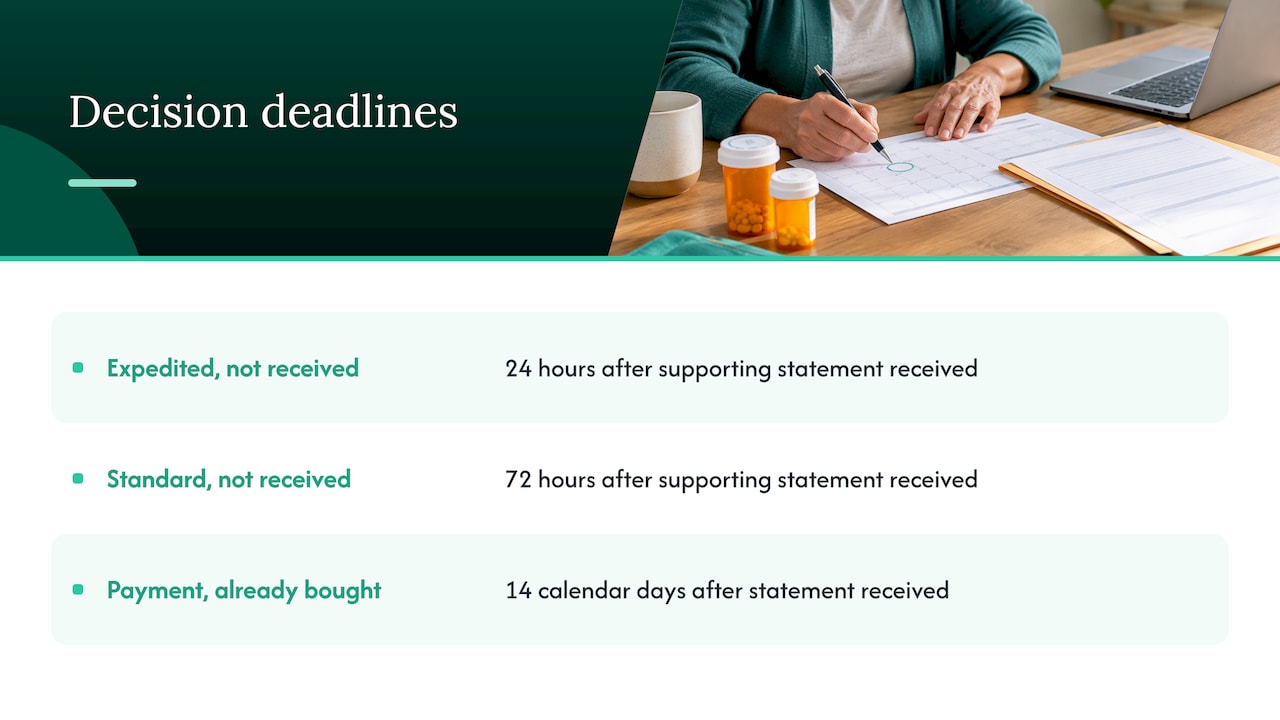
If the answer is no, the notice must explain how to appeal. Keep it: it starts your next deadline.
What happens if the plan says no
A denial is common enough that the system has five levels of appeal built in. The numbers below come from CMS’s Medicare Appeals publication and its 2026 Part D flow chart.
Level Who decides Time to file Decision time 1. Redetermination Your plan 65 days from the denial notice 72 hours expedited, 7 days standard, 14 days payment 2. Reconsideration Independent Review Entity (IRE) 65 days Same as Level 1 3. Hearing Office of Medicare Hearings and Appeals (OMHA) judge 60 days 90 days standard, 10 days expedited 4. Review Medicare Appeals Council 60 days 90 days standard, 10 days expedited 5. Federal court District court 60 days Set by the courtThe Independent Review Entity is an outside organization that contracts with Medicare and has no tie to your plan. For a reconsideration, CMS says the request must be in writing, including by fax. If the case involves an exception and the prescriber’s statement has not arrived, the IRE’s timeframe can be extended up to 14 calendar days. So the statement matters again at Level 2.
For the 2026 calendar year, reaching Level 3 requires an amount in controversy of at least $200, and Level 5 requires at least $1,960. For most people, the first two levels are where an exception is won or lost, so put your best documentation in at Level 1.
A written appeal should include your name, address and Medicare Number, the drug and your reasons, any representative’s information, and supporting documents such as the prescriber statement. Our Appeals & Grievances service exists for people who would rather not manage that paperwork alone.
What an approved exception costs you
Approval does not mean the drug is free. When a plan covers a non-formulary drug through an exception, the plan’s exception criteria must describe the cost-sharing that applies. The useful part: under the regulation, what you spend on that drug counts toward the annual out-of-pocket threshold.
That threshold is $2,100 in 2026. The Medicare & You handbook says that once your yearly out-of-pocket drug spending reaches it, you pay nothing more in copays or coinsurance for covered Part D drugs for the rest of the year. CMS’s 2026 redesign instructions set 25% coinsurance in initial coverage and no cost-sharing in the catastrophic phase.
Payments that count include your deductible, what you pay in the initial phase, amounts paid by family members, most charities, Extra Help and state pharmaceutical assistance programs, according to HIICAP. If you might qualify for low-income help, our guide to Extra Help for Part D shows who is eligible. For a wider look at the 2026 numbers, see our explanation of the $2,100 cap.
Exceptions expire: plan for next year
An approved exception is normally good until the end of the current calendar year, per HIICAP’s 2026 materials. If your plan will not continue coverage next year, you can appeal again or switch plans during Fall Open Enrollment, the yearly window when you can change your Part D coverage.
That makes the fall review the real safeguard. Before you renew or switch, check three things on the plan’s next-year formulary: whether your drug is listed, what tier it sits on, and whether new restrictions apply. A plan that covers your drug without an exception beats one you must fight every January. Our article on how to change your Part D plan explains the dates and steps, and the Medicare changes for 2026 piece covers what shifted this year. Note too that CMS requires plans to include drugs with a negotiated maximum fair price on their formularies starting in 2026, so some lists look different from before.
Common reasons requests fail
- A vague prescriber note. “Patient prefers this drug” is not medical necessity. Name what failed and why.
- Missing the follow-up. The plan may ask for written confirmation or more records. Answer quickly, because the clock depends on it.
- Filing the wrong type. Asking for a tiering exception on a specialty-tier drug will not work. Asking for a formulary exception when only prior authorization is needed wastes time.
- Missing the 65-day window after a denial notice.
- Not tracking the year-end expiry, then being surprised in January.
Let us handle the hard parts with you
We are an independent brokerage serving Castle Pines and the rest of Colorado, with licensed brokers who work across multiple carriers. We offer Medicare Planning, Annual Enrollment (AEP) support, Prescription Drug Plans and an Appeals & Grievances service. Our support continues after enrollment, through claims help and yearly plan reviews, and our services have no direct cost to you.
If you are comparing plans around your medications, start with our Part D plans in Castle Pines, or see everything on our services page.

If a denial has already landed, bring us the notice and your prescription list, and we will go through the next steps with you.
Our perspective
Most people meet the exception process at the worst moment: standing at a pharmacy counter, told a medication is not covered. We think the better time to deal with it is before you enroll.
When we compare Part D plans, we start with your prescription list, not the premium. A plan that already lists your drugs at a tier you can live with saves you the exception process altogether. That is why we recommend a yearly review: formularies change, and your health does too.
When an exception is the right path, the work is mostly organization: the right type of request, a prescriber statement with real clinical detail, a dated record, and the deadlines in view. We help clients with appeals and grievances because we believe nobody should face those deadlines alone.
Our approach is independent, local and ongoing. We do not disappear after enrollment day.
Zach
FAQ
How long does a plan have to decide on a formulary exception?
The clock starts when the plan receives your prescriber’s supporting statement. For a drug you have not yet received, the plan must decide within 24 hours on an expedited request and 72 hours on a standard one. For payment requests, including exceptions, the limit is 14 calendar days.
Can I request an exception myself?
Yes. You, your representative or your prescriber can file the request. Your prescriber still has to supply a statement that the drug is medically necessary, so involve their office from the start.
Will the drug count toward my $2,100 out-of-pocket cap?
Yes. If the plan covers a non-formulary drug through an exception, what you pay for it counts toward the annual out-of-pocket threshold. In 2026 that threshold is $2,100, and after you reach it you pay no copays or coinsurance on covered Part D drugs for the rest of the year.
How long does an approved exception last?
Normally until the end of the calendar year. For the following year, you can ask again, appeal if the plan will not continue coverage, or switch plans during Fall Open Enrollment.
Sources
- Exceptions | CMS
- Coverage Determinations | CMS
- Reconsideration by the Part D Independent Review Entity | CMS
- 42 CFR 423.578, Exceptions process | eCFR
- Medicare Appeals | Medicare.gov
- Medicare Prescription Drug Part D Flow Chart | CMS
- Final CY 2026 Part D Redesign Program Instructions | CMS
- Medicare and You Handbook 2026
- Module 6: Medicare Prescription Drug Coverage (Part D) | New York State HIICAP, 2026