

Short Term Health Insurance: What It Covers and Costs
Short term health insurance makes sense if you’re healthy, don’t qualify for Marketplace subsidies, and need coverage for a defined gap of weeks or a few months. It’s a poor fit if you’re pregnant, managing a chronic condition, or eligible for premium tax credits, since these temporary limited-duration policies skip guaranteed-issue protections and often cap what they’ll pay.
TL;DR:
- Most short-term plans cover emergency services, hospital stays, and urgent care, but often exclude maternity, mental health, and pre-existing conditions.
- Prices are lower than unsubsidized ACA plans, yet benefit caps and exclusions can lead to unexpectedly high out-of-pocket costs during serious illness.
- Short-term insurance is suitable mainly for brief gaps under 120 days for healthy individuals with no ongoing medical needs.
- Availability depends heavily on state regulations, with some states banning or heavily restricting these plans, making local verification essential.
- Checking eligibility for Marketplace subsidies often reveals more affordable ACA options, especially for those with qualifying incomes or existing subsidies.
Table of Contents
- What Short Term Health Insurance Plans Actually Cover
- Who Should Buy a Short-Term Plan (and Who Shouldn’t)
- Does Your State Allow Short-Term Health Insurance?
- What Short Term Plans Cost Compared to ACA and COBRA
- How to Shop for and Enroll in a Short-Term Plan
- Fine Print That Decides Whether Your Claim Gets Paid
- Your Legal Rights Under a Short-Term Health Plan
- Short-Term Plans and the ACA Individual Mandate
- Checking an Insurer’s Financial Strength and Service Record
- Simply Insurance’s Practical Perspective: When a Short-Term Bridge Makes Sense
- How Simply Insurance Helps You Compare Your Options
- Sources
What Short Term Health Insurance Plans Actually Cover
Short-term limited-duration insurance, known in the industry as STLDI, was built for gaps, not for ongoing care. Insurers design these plans around one goal: covering unexpected, acute events cheaply, while excluding anything that looks like a predictable or expensive long-term cost.
Most policies cover emergency room visits, inpatient hospital stays, urgent care, and outpatient doctor visits, usually with a deductible you pay first. Some include limited prescription drug coverage, though often just for generics, and a smaller share offer any preventive care at all.
Here’s what typically gets left out:
- Maternity and newborn care
- Mental health and substance use treatment
- Coverage for pre-existing conditions
- Comprehensive prescription drug benefits
- Preventive screenings and annual checkups in many plans
The reason for these gaps is structural. STLDI plans are exempt from the Affordable Care Act’s essential health benefits requirement, so insurers aren’t obligated to include the ten categories ACA plans must cover. That exemption is also what keeps premiums low, but it means the plan is doing less work for you than it might appear to on a quote page.
Pro Tip: Look for the plan’s total benefit maximum, not just the monthly premium. Some short-term policies cap total payouts at $250,000 or even $1 million for the full plan period. That sounds like a lot until you’re facing a real hospitalization with surgery, ICU time, and follow-up care, which can burn through six figures faster than most people expect.
A benefit cap is the single most overlooked detail in these policies. Two plans can look nearly identical on price, and one can leave you owing tens of thousands of dollars more simply because its annual or per-condition cap kicks in sooner. Always read the Schedule of Benefits line by line before assuming “covered” means fully covered.
Who Should Buy a Short-Term Plan (and Who Shouldn’t)
Short-term coverage earns its keep in a narrow set of situations. It’s a tool for a specific problem: a coverage gap with a known end date, held by someone with no major medical needs on the horizon.
Good candidates generally fall into one of these buckets:
- You’re between jobs and expect new employer coverage within 30 to 120 days.
- You’re aging off a parent’s health plan at 26 and haven’t started a new job yet.
- You missed ACA open enrollment and don’t qualify for a special enrollment period.
- You retired early and need a bridge until Medicare eligibility at 65, though you should confirm there’s no employer retiree coverage available first.
Poor candidates include anyone managing a chronic condition, anyone currently pregnant or planning a pregnancy, anyone who takes regular prescription medications that need consistent coverage, and anyone who qualifies for Medicaid or a subsidized ACA plan. If you fall into the last group, a short-term plan is almost never the cheaper option once you actually run the numbers.
Pro Tip: Before you buy anything, check your Marketplace subsidy eligibility at HealthCare.gov. A surprising number of people who assume they earn “too much” for help discover they qualify for a tax credit that makes an ACA Bronze plan cheaper than short-term coverage, with far better protection. If you’re weighing this against other paths, our individual health insurance guide for Castle Pines breaks down how ACA plans compare on cost and coverage.
Does Your State Allow Short-Term Health Insurance?
Availability isn’t uniform across the country, and this trips up more shoppers than any other part of the buying process. Federal rules set the outer boundary for what insurers can offer, but individual states decide whether to allow, shorten, or ban these plans outright.
As of 2026, a handful of states, including California, New York, and New Jersey, either prohibit short-term plans entirely or restrict them so heavily that they’re barely available in practice. Other states allow the plans but cap durations well below the federal maximum, or require insurers to offer renewal guarantees that go beyond what federal rules demand.
This is why a national quote comparison site can show you completely different options depending on your ZIP code. The federal government sets a ceiling; state insurance departments decide how close to that ceiling insurers can actually get, and recent federal rulemaking has shifted that ceiling more than once in the past decade.
Before you assume a plan is available to you, verify it through one of these channels:
- Your state’s Department of Insurance website
- HealthCare.gov’s plan search tool for your ZIP code
- A licensed broker who works in your state and knows current carrier offerings
Colorado currently permits short-term plans, but the specific durations and renewal terms available to you depend on which carriers are active in your county, which changes from year to year.
What Short Term Plans Cost Compared to ACA and COBRA
Short-term premiums are genuinely lower than unsubsidized ACA plans in most cases, and that’s the entire reason people consider them. KFF’s analysis confirms short-term plans generally carry smaller premiums than full-price ACA coverage, but the same analysis flags the trade-off: significant coverage limitations, benefit caps, and exclusions that shift financial risk onto the person who gets sick.
Typical short-term plans come with deductibles ranging from $1,000 to $10,000, and out-of-pocket maximums that can run even higher once you account for services the plan doesn’t count toward that cap at all. A low sticker price often hides a much higher real-world cost if you actually need care.
Here’s where the math gets misleading for a lot of shoppers:
- Unsubsidized ACA Bronze plans typically cost more per month than short-term coverage but include the full essential health benefits package and out-of-pocket protections.
- COBRA lets you keep your former employer’s plan, usually at 102% of the full premium, which is often the most expensive option but preserves continuous, comprehensive coverage.
- Subsidized ACA plans can undercut short-term premiums entirely once a premium tax credit is applied, which is why checking subsidy eligibility before buying short-term coverage matters more than comparing sticker prices.
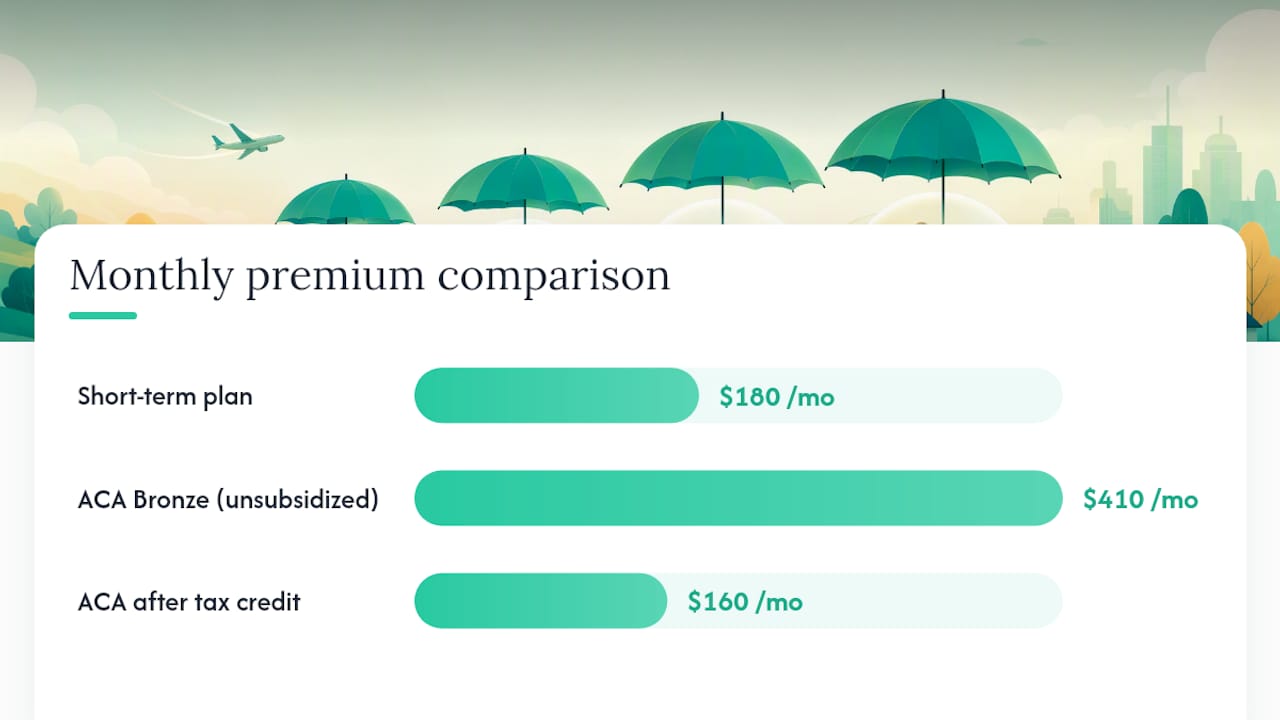
Say a 35-year-old in Colorado gets quoted $180 a month for a short-term plan versus $410 a month for an unsubsidized ACA Bronze plan. That looks like an easy call, until a subsidy calculation shows they qualify for a $250 monthly tax credit, dropping their real ACA cost to $160. Suddenly the “cheap” plan is the more expensive one, and it comes with a benefit cap the ACA plan doesn’t have. For a broader sense of what coverage runs in this market, see our breakdown of health insurance costs in Colorado.
How to Shop for and Enroll in a Short-Term Plan
Buying short-term coverage moves faster than ACA enrollment, but that speed can work against you if you skip steps. Here’s the sequence that actually protects you.
- Get quotes from multiple carriers available in your state, since pricing and benefit structures vary widely even within the same ZIP code.
- Read the Schedule of Benefits in full, not just the summary page, paying close attention to per-condition caps, total plan maximums, and what counts toward your deductible.
- Answer medical underwriting questions honestly. Short-term insurers can and do use health history to deny applications or exclude specific conditions, and a look-back period of two to five years is standard. Misrepresenting anything here risks a denied claim later, even if the claim isn’t related to what you left out.
- Choose your effective date carefully. Coverage can often start the day after you apply, which matters if you’re closing a gap that starts on a specific date.
- Confirm the provider network before you enroll, especially if you have a preferred doctor or hospital system.
- Keep documentation of your enrollment and coverage dates, since this record matters if you need to prove continuous coverage later or if a dispute arises over your effective date.
Pro Tip: Set aside emergency savings equal to at least your plan’s deductible before you rely on a short-term policy. These plans work fine for the routine and fall short during the expensive events they’re designed to limit exposure to, so having cash on hand closes that gap yourself. The DOL’s guidance on short-term plans is also worth a look if you’re transitioning from employer coverage and want to understand how the two interact.
Fine Print That Decides Whether Your Claim Gets Paid
The contract language in a short-term policy determines what you actually get when something goes wrong, and most of the disappointing surprises trace back to a handful of specific clauses.
Pre-existing condition exclusions are the biggest one. Insurers can deny claims tied to any condition you had, or arguably had symptoms of, before your policy started, often looking back several years. Benefit maximums work the same way life caps used to under pre-ACA rules: once you hit the ceiling, whether it’s per-condition or for the whole policy period, you’re paying out of pocket for everything after that.
Watch for these specific red flags:
- Vague language like “usual and customary charges” without a clear definition of how that’s calculated
- Prior authorization requirements buried in the fine print that apply to routine services
- Prescription drug riders that only cover a short, named list of generics
- Marketing that describes the plan as “comprehensive” or “ACA-compliant” when it isn’t required to include essential health benefits at all
HealthInsurance.org’s analysis points to a consistent pattern: consumers get surprised by denied claims most often because they never checked mental health or prescription coverage details before enrolling, not because the insurer hid anything technically.
Before you rely on a plan for a specific procedure or ongoing prescription, call the insurer directly and get a written coverage determination. Save that confirmation, along with your policy documents and any correspondence, in a single file you can pull up quickly if a claim gets denied and you need to appeal it.
Your Legal Rights Under a Short-Term Health Plan
Short-term plans operate with fewer consumer protections than ACA-compliant coverage, and understanding that gap matters more than almost anything else in this decision.
These plans are not required to guarantee issue, meaning insurers can deny your application based on health history. They’re not required to cover pre-existing conditions, and unlike ACA plans, there’s no federal ban on medical underwriting for STLDI. CMS confirms that short-term insurance isn’t classified as minimum essential coverage, which has a real consequence: losing a short-term plan doesn’t trigger a Marketplace special enrollment period the way losing job-based coverage does.
Your appeal rights also differ from ACA plans. While insurers generally must offer some internal appeals process, short-term plans aren’t bound by the same external review standards that apply to ACA-compliant coverage in every state, so read your policy’s appeals section closely rather than assuming a familiar process applies.
State insurance departments remain your primary recourse if you believe a short-term insurer acted in bad faith or misrepresented coverage terms. Every state’s Department of Insurance handles consumer complaints against carriers licensed to sell in that state, and filing a complaint there is typically faster and more direct than pursuing a legal claim on your own. Because state regulation varies so widely on renewal guarantees, maximum duration, and required disclosures, the protections you have in Colorado may not match what a friend gets in a different state, even with an identical-sounding plan name.
Short-Term Plans and the ACA Individual Mandate
The federal individual mandate penalty was reduced to $0 starting in 2019, and it remains at zero heading into 2026, so choosing a short-term plan won’t trigger a federal tax penalty the way it might have before that change.
That said, a small number of states still enforce their own individual mandates with their own penalties, including Massachusetts, New Jersey, California, and Rhode Island, along with the District of Columbia. In those states, whether a short-term plan satisfies your mandate requirement depends entirely on that state’s specific definition of qualifying coverage, and STLDI frequently doesn’t meet it since it isn’t classified as minimum essential coverage.
There’s a second, quieter consequence worth understanding. Time spent on a short-term plan doesn’t count as a qualifying life event when it ends, so you can’t use the end of your short-term policy to open a new Marketplace special enrollment window. That means if you buy a 90-day short-term plan expecting to transition smoothly into an ACA plan afterward, you need to time that transition around the standard open enrollment period or another qualifying event, not around your short-term plan’s expiration date. Plan the calendar backward from open enrollment, not forward from your short-term plan’s start date, to avoid an unplanned gap.
Checking an Insurer’s Financial Strength and Service Record
A cheap premium means nothing if the company behind it can’t pay claims or makes the claims process miserable. Two checks matter here, and both take less than fifteen minutes.

First, look up the insurer’s financial strength rating through AM Best, Standard & Poor’s, or Moody’s. These agencies grade insurers on their ability to pay out claims over time, and a rating in the A range from AM Best generally signals solid financial footing. A short-term insurer with a weak or unrated status is a real risk, since these companies are often smaller, newer entrants to the market than the household-name carriers writing ACA plans.
Second, check the insurer’s complaint ratio through your state’s Department of Insurance. Every state tracks complaints against licensed carriers relative to the volume of business they write, so a company with an outsized number of complaints for its size is worth a second look before you sign anything.
It also helps to ask a direct question before enrolling: how does this insurer handle claims processing time, and what does their appeals process actually look like on paper? Carriers that partner with established brokers, and that a licensed agent will actually vouch for, tend to have more predictable service records than obscure online-only options that show up first in a generic price search. A broker who works with multiple carriers regularly can usually tell you which companies pay claims without a fight and which ones don’t, based on real client experience rather than marketing copy.
Simply Insurance’s Practical Perspective: When a Short-Term Bridge Makes Sense
When we evaluate whether short-term coverage fits a client’s situation, we start with four questions: how long is the actual gap, what does their health picture look like, do they qualify for a Marketplace subsidy, and can they absorb an unexpected medical bill if the plan’s cap gets reached. A client bridging 60 days between jobs with no ongoing prescriptions is a very different conversation than someone managing diabetes who assumes short-term coverage will work the same way ACA coverage does.
Simply Insurance walks Colorado clients through that subsidy check first, before recommending anything, because skipping it is the most common way people overpay. If you want that comparison run for your own situation, our services page outlines how we support clients through enrollment and beyond.
— Zach
How Simply Insurance Helps You Compare Your Options
Short-term plans, COBRA, and ACA Marketplace coverage all involve trade-offs that are hard to weigh alone, especially under a deadline. Simply Insurance gives Colorado residents a faster path to the right answer: a licensed, independent broker who runs the subsidy check, compares real quotes across carriers, and tells you plainly whether short-term coverage actually saves you money or just looks like it does.

Our brokers serve Castle Pines and clients throughout Colorado, and the guidance on checking Marketplace subsidy eligibility applies no matter where in the state you live. We handle plan comparisons, enrollment paperwork, and stay on for claims support and annual reviews after you’re covered, at no direct cost to you since we’re paid by the carriers. If you’re facing a coverage gap and want a clear answer instead of a guess, start with our Medicare guide if you’re approaching 65, or reach out through our services page to get a comparison built around your specific gap and health needs.
This article is general information, not a substitute for advice from a qualified financial advisor. Consult a qualified financial professional about your own circumstances before acting on anything here.
Sources
- Short-term limited-duration insurance and independent noncoordinated excepted benefits coverage | Federal Register (2024)
- Examining short-term limited-duration health plans on the eve of ACA Marketplace open enrollment | KFF (2025)
- DOL/EBSA statement on short-term limited-duration insurance (STLDI) | DOL (2025)
- Healthinsurance